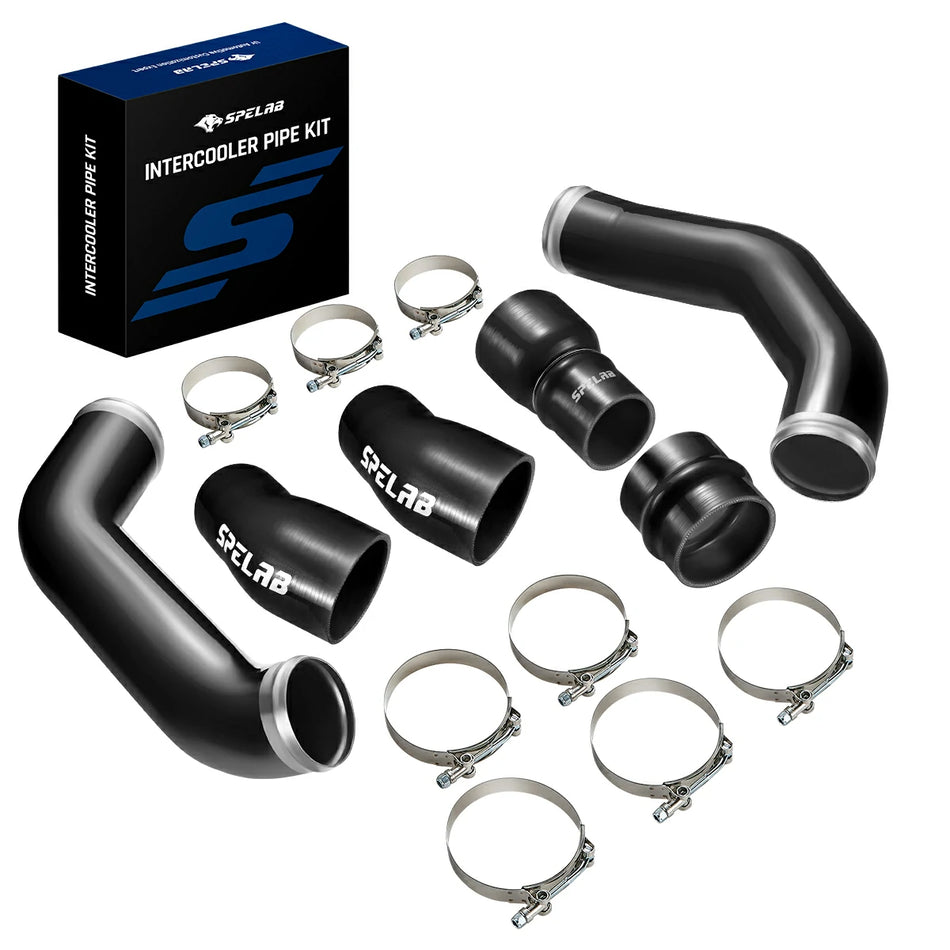
A 6.7 Cummins intake horn can help, but the benefit depends on the truck and the problem you are trying to solve. On a stock Ram with no boost leak, no intake fault, and no cold-start concern, an intake horn is usually an optional upgrade rather than a stand-alone power modification. It becomes more relevant on tuned trucks, towing builds, higher-airflow turbo setups, or engines already being opened for intake, gasket, or grid-heater work.
The most useful question is not simply, “Does an intake horn add power?” The better question is, “Is the factory intake path currently limiting, leaking, contaminated, or being changed for another reason?” A larger horn cannot repair a loose charge-air boot, a leaking gasket, a contaminated MAP sensor, or a tune that commands more air and fuel than the rest of the system can support.
Quick answer: A healthy stock 6.7 Cummins often gains more from diagnosis and maintenance than from replacing the intake horn alone. A tuned, frequently towed, or higher-airflow truck can be a better candidate, provided that boost leaks, sensor problems, soot buildup, fitment, and cold-start requirements have already been addressed.
Who Is Most Likely to Benefit?
An intake horn is one part of a larger airflow system that includes the turbocharger, intercooler, charge pipes, boots, clamps, intake heater area, sensors, intake plenum, fueling, and calibration. The horn matters most when the rest of that system is healthy enough to use the additional flow path.
| Truck condition | Upgrade priority | Why | Check first |
|---|---|---|---|
| Stock daily driver with no symptoms | Optional | The factory system may already meet the engine's airflow demand. | Boots, clamps, MAP sensor, gasket area, and service history |
| Truck that regularly tows or hauls | Worth evaluating | Long periods under load can make an existing restriction or leak easier to notice. | Requested versus actual boost, smoke, EGT trend, and charge-air leaks |
| Tuned truck or larger-turbo build | More relevant | Higher commanded airflow can make the complete intake path more important. | Pressure-test the charge-air system and confirm that the tune matches the hardware |
| Heavy soot, oil residue, or repeat gasket seepage | Diagnose before buying | Contamination and leaks can imitate a restriction or reduce sensor accuracy. | MAP sensor, EGR/CCV contamination, sealing surfaces, and gasket condition |
| Grid-heater terminal concern | Depends on climate and configuration | Changing the heater arrangement can remove one concern while changing cold-start behavior. | Truck year, ambient temperature, parking conditions, electrical strategy, and local use requirements |
A tuned truck does not automatically need an aftermarket horn, and a stock truck does not automatically lack a reason to install one. Engine condition, use under load, heater strategy, existing modifications, and whether the intake is already being serviced often matter more than the “stock versus tuned” label by itself.
What the Intake Horn Actually Does
The intake horn directs compressed charge air into the intake side of the 6.7L Cummins. Its shape, inlet size, bends, transitions, sensor locations, and heater arrangement can influence pressure loss and packaging. A smoother or larger path can reduce a restriction, but the improvement at the wheels depends on the complete system rather than the horn alone.
A replacement intake horn should therefore be evaluated by measurable construction details: inlet diameter, port count, material, heater configuration, year-specific fitment, included hardware, and the routing of nearby fuel lines, sensors, and wiring. A claimed horsepower number without the truck configuration, baseline, dyno procedure, correction method, and repeat runs is not enough to predict what another truck will gain.

Diagnose the Intake Side Before Buying Parts
A new intake horn will not correct a charge-air leak or a faulty sensor. Before ordering parts, inspect the system in a sequence that separates airflow demand from a repair problem.
- Inspect charge-air boots and clamps. Look for oil tracks, displaced boots, loose clamps, rubbed tubing, or a connection that has moved under boost.
- Inspect the intake-horn flange and gasket area. A visible oil-and-soot track around one sealing edge can point to leakage, but residue alone does not prove that the gasket has failed.
- Inspect the MAP sensor and intake throat. Oily soot can affect the sensor area and narrow the passage. Clean only with a method that is compatible with the sensor and the applicable service procedure.
- Compare requested and actual boost when diagnostic data is available. Low actual boost can come from leaks, turbo control, exhaust drive, sensor input, calibration, or other causes; it does not identify the horn by itself.
- Pressure-test the charge-air path when a leak is suspected. Many technicians begin a regulated test at roughly 10–15 psi and increase pressure only if the model-specific procedure and test equipment allow it. Never apply unregulated shop air to the intake system.
- Check fault codes before disconnecting components. Save the codes and freeze-frame data before clearing anything, because post-install codes are easier to diagnose when the original record is available.
If the truck is losing boost, start with the boost-leak diagnosis guide. If the symptom is oil or soot around the intake flange, use the 6.7 Cummins intake leak guide before assuming that a higher-flow part is the repair.
Grid Heater Delete or Retained Heat?
The factory grid heater warms intake air during cold starting. Some owners change the factory arrangement because they are concerned about the heater connection hardware, want to reduce restriction, or are already servicing the intake. The correct choice depends on climate, truck configuration, electrical strategy, and how the truck is used.
Removing the factory grid heater changes the cold-start system; it does not guarantee a performance increase or prevent every possible engine failure. At temperatures around freezing—roughly 32°F (0°C)—and below, starting quality can vary with battery condition, oil viscosity, fuel quality, engine compression, wind exposure, soak time, block-heater use, calibration, and the replacement heating strategy.
- Warm-climate or competition/off-road configuration: a delete plate may be considered when cold-start heat is not normally required, but the intake-heater circuit and local use requirements still need a plan.
- Cold-weather daily driver: retaining a compatible heating solution is usually the more conservative path when the truck regularly cold-soaks near or below freezing.
- Truck with an unresolved heater code: diagnose the electrical circuit before replacing hardware. A delete or replacement part should not be used to hide an unknown wiring, relay, or control problem.
A disconnected factory heater can trigger an intake-heater circuit fault. Depending on the model year and configuration, the truck may require a compatible electrical solution or calibration. Confirm that requirement before disassembly, not after the truck is already apart.
For a deeper climate-based comparison, see the 6.7 Cummins cold-start and grid-heater decision guide.

Fitment and Current SPELAB Options
“Fits 2007–2024” does not mean that every component, tube, fuel line, bracket, or electrical connection is identical across all trucks. SPELAB's current Shopify product records divide several configurations into 2007–2012, 2013–2018, and 2019–2024 groups. Pickup and chassis-cab layouts must also be treated separately.
Use the year-by-year 6.7 Cummins fitment guide before selecting a variant. Confirm the VIN/model year, Ram 2500/3500 pickup versus 3500–5500 chassis cab, single- or dual-alternator layout where applicable, fuel-line routing, sensor ports, heater configuration, and the exact parts included with the selected style.
| Current option | Backend-listed specifications | Best suited to | Backend price checked September 24, 2026 |
|---|---|---|---|
| Cast-aluminum intake manifold | 3-3/8-inch inlet; four 1/8-inch NPT ports; listed weight 9.26 lb (4.2 kg); optional heater components | Owners who want a cast replacement with multiple ports and year-specific configurations | About $539 for manifold-only pickup variants; about $617 for listed manifold-plus-delete pickup variants |
| 3.5-inch stainless manifold with heating element | 3.5-inch inlet; T-201 stainless steel; two 1/8-inch NPT ports; pre-installed ceramic heating element; 2019–2024 selection includes a replacement fuel line | Ram 2500/3500 pickup owners comparing a larger fabricated path while retaining a heating solution | Current variants can range from about $199 to $349, depending on the selection |
| Grid heater delete/upgrade plate | CNC-machined billet aluminum; listed for compatible 2007–2024 Ram 2500/3500 6.7L applications; includes the plate, intake gaskets, spacer gasket, and four aluminum bushings | Owners who have already decided that a delete configuration fits their climate, electrical plan, and legal use | About $169 in the current backend listing |
| Inspection and cleaning | Reuses serviceable factory components after the leak, sensor, gasket, and contamination checks | Healthy stock trucks with no confirmed airflow limitation | Cost depends mainly on labor, gaskets, cleaning supplies, and any damaged components found |
Prices above are informational snapshots from the Shopify backend and can change with color, year, kit contents, promotions, and availability. Verify the selected variant before publishing or purchasing. The 3.5-inch product is listed for Ram 2500/3500 pickups and is specifically described as not fitting chassis-cab applications.
What Results Should You Realistically Expect?
A 6.7 Cummins intake horn can produce measurable changes, but the range is usually wider than a single advertised number suggests. On an otherwise healthy stock truck, a manifold-only change often falls within roughly 0–5 rear-wheel horsepower, about 0–0.5 mpg, and approximately 0–50°F of sustained-load EGT change. On a tuned, higher-airflow, or genuinely restricted combination, a reasonable planning range can be roughly 5–20 rear-wheel horsepower, about 0–1 mpg, and approximately 25–100°F lower EGT during a repeatable loaded test.
These ranges are conservative estimates rather than official SPELAB specifications or guaranteed results. The outcome depends on the original restriction, turbocharger, tune, commanded fueling, intercooler condition, boost leaks, exhaust drive pressure, ambient temperature, elevation, trailer weight, gearing, transmission strategy, probe location, driving cycle, and test method. A healthy stock truck may show no repeatable change, while a modified truck with a verified restriction may land closer to the upper end of a range.
| Configuration | Typical horsepower range | Typical fuel-economy range | Possible sustained-load EGT change |
|---|---|---|---|
| Healthy stock truck, manifold only | Roughly 0–5 rear-wheel horsepower; the result can remain within normal dyno variation | About 0–0.5 mpg; driving conditions can easily hide the difference | Approximately 0–50°F, depending heavily on load and probe location |
| Tuned, higher-airflow, or previously restricted combination | Roughly 5–20 rear-wheel horsepower when the rest of the system can use the additional airflow | About 0–1 mpg in repeatable driving; added power use can erase the gain | Approximately 25–100°F lower during comparable sustained load when intake restriction was a contributing factor |
For towing, compare repeatable data instead of relying on one drive:
- Use the same route, trailer weight, fuel, gear-selection strategy, and similar ambient conditions.
- Record requested and actual boost, engine speed, vehicle speed, and EGT location.
- Compare several pulls or grades rather than one peak number.
- Stop the test if boost, EGT, smoke, coolant temperature, oil pressure, or transmission behavior becomes abnormal.
EGT readings are especially sensitive to probe location. A pre-turbo reading and a post-turbo reading are not directly interchangeable, and a universal temperature limit should not be copied from another truck without considering the sensor location, engine calibration, duration, and manufacturer guidance.
Installation Reality and Safety
An intake-horn job can be straightforward for an experienced diesel technician, but year-specific fuel lines, wiring, heater components, sensors, brackets, and chassis-cab plumbing can turn a routine installation into a longer project. Plan for several hours rather than assuming that every configuration is a quick bolt-on.
- Work on a cool engine and disconnect the negative battery terminals before handling the high-current grid-heater circuit.
- Keep the intake path covered whenever it is open. A washer, fastener, gasket fragment, or cleaning debris entering the intake can cause serious engine damage.
- Use the model-year service procedure for torque values. Intake fastener torque and sequence should not be guessed or copied from a different year or component.
- Do not use sealant as a substitute for the correct gasket. Excess sealant can squeeze into the intake path or interfere with sensor and sealing surfaces.
- Photograph sensor, bracket, hose, and wiring locations before disassembly. This reduces the chance of a pinched harness or missed connector.
- After installation, check for leaks and codes before towing. Verify idle quality, heater-circuit behavior, fuel-line clearance, sensor readings, and charge-air connections under controlled conditions.
If you need the full sequence, use the 6.7 Cummins intake manifold installation guide. If a code appears after the work, see the post-install fault-code and troubleshooting guide.
Frequently Asked Questions
Q: Does a 6.7 Cummins intake horn add horsepower?
A: On a healthy stock truck, a manifold-only change often produces roughly 0–5 rear-wheel horsepower and can remain within normal dyno variation. On a tuned, higher-airflow, or genuinely restricted combination, a reasonable estimate is roughly 5–20 rear-wheel horsepower, depending on the turbo, tune, fueling, supporting hardware, baseline, dyno method, correction method, and repeatability.
Q: Can a 6.7 Cummins intake horn improve fuel economy?
A: A healthy stock truck often shows roughly 0–0.5 mpg of change, while a tuned or previously restricted truck can sometimes show about 0–1 mpg in repeatable driving. Trailer weight, speed, wind, idle time, regeneration events, tire size, gearing, fuel quality, and use of the added power can be larger variables than the manifold itself.
Q: Is an intake horn worth it on a stock 6.7 Cummins?
A: An intake horn is usually optional on a healthy stock 6.7 Cummins with no boost leak, no intake fault, and no grid-heater work planned. It can make more sense when the intake is already being serviced, the stock part is damaged, the owner wants specific ports or heater hardware, or future airflow demand is part of the build.
Q: Should I replace the intake horn before fixing a boost leak?
A: No. A confirmed boost leak should normally be repaired before evaluating an intake-horn upgrade, because leaking boots, clamps, pipes, gaskets, or intercooler connections can reduce delivered boost and make a healthy horn appear restrictive.
Q: Will an intake horn lower EGT while towing?
A: A healthy stock truck may show approximately 0–50°F of sustained-load EGT change, while a tuned or previously restricted system may show roughly 25–100°F lower EGT during a comparable loaded test. The result depends on fueling, tune, boost, turbo efficiency, trailer weight, grade, gear selection, speed, ambient temperature, intercooler performance, test duration, and whether the probe is mounted before or after the turbo.
Q: Do I need to delete the factory grid heater?
A: No. A 6.7 Cummins intake-horn upgrade does not automatically require a grid-heater delete. Owners who regularly start near or below 32°F (0°C) should plan a compatible cold-start strategy before removing factory heat, while owners in warmer climates still need to address the heater circuit, fitment, and applicable use requirements.
Q: Can a grid heater delete cause a check-engine light?
A: Disconnecting the factory grid heater can trigger an intake-heater circuit fault on some 6.7 Cummins configurations. The required electrical or calibration solution depends on model year and hardware, so it should be confirmed before installation.
Q: Will the 3.5-inch heated intake manifold fit a chassis-cab truck?
A: The current Shopify backend listing for the SPELAB 3.5-inch heated manifold states that it fits 2007–2024 Ram 2500/3500 pickups and does not fit chassis-cab applications. Chassis-cab owners should use a configuration specifically listed for the applicable Ram 3500–5500 layout.
Q: What does the current cast-aluminum SPELAB intake manifold include?
A: The exact contents depend on the selected style. The current backend lists manifold-only, manifold-plus-grid-heater-delete, standalone heater/delete components, and chassis-cab configurations, so buyers should verify the selected year, color, heater parts, gaskets, hardware, tubes, fuel-line requirements, and sensor connections before ordering.
Q: How much does a 6.7 Cummins intake-horn upgrade cost?
A: As of September 24, 2026, current SPELAB backend prices include about $169 for the listed delete plate, roughly $199–$349 for 3.5-inch heated-manifold selections, about $539 for listed cast-manifold-only pickup variants, and about $617 for listed manifold-plus-delete pickup variants. Final cost depends on the year, selected kit, color, heater strategy, fuel-line requirements, gaskets, labor, diagnostics, and any damaged parts discovered during disassembly.
The Practical Recommendation
Start with the truck's condition and use case, not the largest advertised airflow number. A stock truck with no symptoms may only need inspection and cleaning. A tuned or frequently towed truck may be a stronger candidate after the charge-air system is proven leak-free. A truck being opened for grid-heater work should be evaluated by climate, cold-start needs, exact fitment, electrical requirements, and the parts included in the selected configuration.
Use the Cummins intake manifold collection to compare currently available configurations. Before ordering, verify the truck year, pickup or chassis-cab layout, heater strategy, fuel-line routing, sensors, and included hardware against the selected product variant.
Fitment, Safety, and Legal Notice
Vehicle configuration can vary within the same model year. Confirm fitment with the product listing and applicable service information before disassembly. Modifying factory emissions, intake-heater, fueling, or calibration systems can affect fault monitoring, inspections, warranty coverage, cold-start behavior, and legal road use. Use emissions-related parts only where permitted, and have unfamiliar fuel-line, electrical, heater, or intake work performed or reviewed by a qualified diesel technician.
Product specifications, variant structure, and price examples in this article were checked against SPELAB Shopify Admin product records on September 23, 2026. Prices and availability can change. Performance outcomes are conditional and are not presented as official horsepower, fuel-economy, or EGT guarantees.
Last reviewed: September 23, 2026