TL;DR: A front mount intercooler is worth it for big-turbo, high-heat, or competition builds. For stock or mildly tuned trucks, the ROI is usually weak. In most cases, upgrading intercooler pipes first is the smarter and cheaper move.
Why This Upgrade Gets Misunderstood
A front mount intercooler (FMIC) is one of those upgrades that gets recommended far more often than it gets understood. In diesel truck circles, it is easy to make the FMIC sound like the next logical step: more cooling, more performance, and more serious build credibility. That is true for some trucks. It is also how many owners end up spending real money on a setup they never actually needed.
The right way to judge an FMIC is not by how aggressive it looks behind the grille. It is by return on investment. In diesel truck circles, what matters is whether the truck’s actual power level, heat load, usage pattern, and budget justify the added cost and complexity.
From an engineering standpoint, an FMIC is a specialized solution. On the right truck, it solves a real problem. On the wrong truck, it creates more commitment than benefit.
What Is a Front Mount Intercooler?
A front mount intercooler is an intercooler placed at the very front of the vehicle so it can take advantage of direct airflow. Its job is to reduce intake air temperature and help the engine maintain more consistent performance under boost.
That sounds universally beneficial, but in practice, not every truck needs the extra cooling capacity of a full front mount setup. The real buying question is simple:
Does your truck need more intercooler system capacity, or are you paying for a solution that exceeds your use case?
That is the line between a smart upgrade and a parts-budget mistake.

If you want the engineering side of the discussion, including how a front mount intercooler changes radiator airflow and cooling balance, read our technical guide to FMIC airflow and radiator performance.
FMIC Pros and Cons at a Glance
| Factor | FMIC Advantage | FMIC Drawback |
|---|---|---|
| Cooling Capacity | More headroom for high-boost or big-turbo setups | Overkill for stock or mild builds |
| Performance Consistency | Better for repeated hard pulls and competition use | Real-world gains may be small on daily drivers |
| Build Potential | Supports serious horsepower goals | Higher total cost than simpler upgrades |
| Installation | Can be worth it on purpose-built builds | Often requires more labor, trimming, or fabrication |
| Value | Strong on heat-heavy applications | Weak ROI if the truck never pushes the stock system |
The short version is simple: FMICs are not bad upgrades, just narrow-use upgrades.
When a Front Mount Intercooler Is Actually Worth It
1. Large Turbo or High-Horsepower Build
Once a truck moves well beyond stock airflow demands, the intercooler system becomes part of the performance ceiling. At that point, a front mount setup stops being cosmetic and starts becoming support hardware.
I have seen high-output builds where the owner kept adding fuel and turbo without upgrading the rest of the charge-air system. The truck would feel strong for one pull, then soften once temperature stacked up. In that kind of build, an FMIC is not hype. It is part of keeping the combination honest.
2. Competition Use
Drag racing, sled pulling, dyno events, and repeated wide-open-throttle use are exactly where an FMIC earns its keep. The point is not peak power on one hero run. The point is consistency.
A truck that only needs to feel fast once is not the same as a truck that needs to stay controlled through repeated stress cycles. An FMIC makes more sense when the build is expected to work hard, not just look ready.
3. Extreme-Heat Operation
Heat changes the economics of the upgrade. In very hot climates, thermal headroom matters more. A setup that feels fine in moderate weather can feel compromised when the truck spends months in triple-digit temperatures.
I have seen trucks that were perfectly acceptable in cooler states become far less comfortable under heat-heavy duty cycles once moved into southern summer use. That is where extra cooling capacity can move from “nice to have” to “worth the money.”
4. Performance-First Builds
Some trucks are not built for convenience. They are built for output. If the owner already accepts fabrication, tuning, and supporting mods as part of the process, an FMIC can fit that philosophy.
When a Front Mount Intercooler Is Not Worth It
1. Stock or Mildly Tuned Trucks
If the truck still runs a factory turbo or a mild tune, it usually does not create the kind of sustained thermal stress that justifies a front mount conversion. Yes, an FMIC may still work. That does not mean it is a good buy.
On mild builds, the gain is often smaller than the owner expects, and the cost is always larger than the internet makes it sound.
2. Daily Drivers and Towing-Focused Trucks
A towing or commuter truck usually benefits more from reliability, easy serviceability, and sensible upgrades than from a complex front mount conversion.
I have seen daily-driven trucks where the owner spent heavily on an FMIC, then admitted later that the truck felt no meaningfully different in the way it was actually used. That is the kind of mod regret that comes from buying for image instead of operating conditions.
3. Budget-Limited Builds
If the build has a limited budget, an FMIC should rarely be first in line. A front mount setup is not just a part. It is a project. Once labor, fitment, brackets, piping, trimming, and possible rework enter the picture, the total cost can climb quickly.
That is why ROI matters so much. A cheaper upgrade that fixes 70–80% of the problem is often smarter than an expensive upgrade solving a problem the truck barely has, which could otherwise lead to further drivability problems.
4. Owners Wanting a Simple Bolt-On
FMIC installs are usually not the cleanest “Saturday afternoon and done” upgrade. If you want easy installation, low complication, and minimal downstream hassle, an FMIC often asks for more commitment than many owners planned for.

FMIC Worth-It Table by Truck Type
| Truck / Build Type | Is FMIC Worth It? | Why |
|---|---|---|
| Stock daily driver | Usually no | Cooling gains rarely justify cost and complexity |
| Mild tune + stock turbo | Usually no | Better ROI usually comes from pipes and supporting hardware |
| Heavy towing truck | Usually not first | Reliability-focused upgrades often make more sense first |
| Big-turbo street build | Often yes | Higher heat load can justify extra cooling capacity |
| Competition truck | Yes | Consistency under repeated load matters |
| Extreme-heat performance build | Often yes | Extra thermal margin has real value |
| Budget build | Usually no | FMIC can consume money better spent elsewhere |
This is the practical buying matrix. Most owners do not need to ask whether FMICs work. They need to ask whether their truck is in the “yes” row or the “no” row.
Should You Upgrade Pipes First?
For most owners, yes.
This is where the FMIC conversation gets more realistic. A lot of trucks do not need a full front mount conversion. They need the existing intercooler system to work better. That often means addressing aging factory pipes, weak boots, restrictive routing, or worn connections before jumping to the most expensive option.
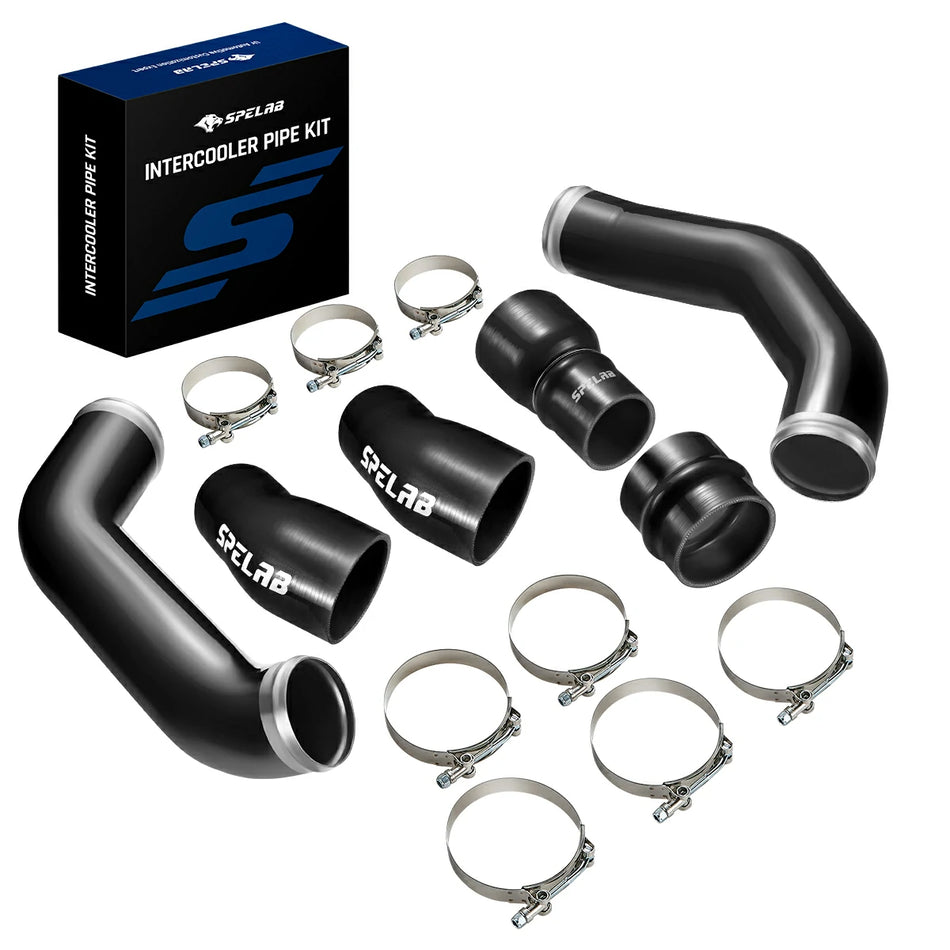
From a value standpoint, upgrading the intercooler pipe kit first is often the smarter move. It is cheaper, easier to install, and more aligned with what most stock-to-moderate builds actually need.
I have seen trucks pick up cleaner response and more stable behavior simply from replacing tired factory piping and leak-prone connections. No big visual payoff, no social-media wow factor, just a more efficient system. That is often the better engineering answer.
- Upgrade the intercooler pipe kit first.
- Evaluate performance under your real operating conditions.
- Move to an FMIC only if the truck still clearly needs more cooling capacity.
That approach protects your budget and reduces upgrade regret.
FMIC Budget: What It Really Costs
The problem with FMIC pricing is that owners often think in parts cost and forget project cost.
A pipe kit is usually manageable in both price and labor. An FMIC is different. By the time you add the kit itself, installation time, possible fabrication, trimming, custom mounting, and shop labor, the number can grow fast.
That means the true question is not “Can I afford the intercooler kit?” It is “Does the truck’s use case justify the full installed cost?”
If the answer is no, then the FMIC is not a smart performance buy. It is just an expensive badge of intent.
Installation Difficulty and Practical Ownership
Installation matters because difficult parts need to earn their place. The harder a system is to install, the more obvious the gain should be.
Many FMIC kits require more than simple bolt-on work. Depending on platform and kit quality, owners may face:
- front-end disassembly
- custom bracket work
- trimming or cutting
- rerouted piping
- longer labor time than expected
For a serious builder, that may be acceptable. For a truck owner who wants predictable reliability and minimal downtime, it is a major decision factor.
This is also where “worth it” becomes personal in the right way. Not emotional—practical. A part can be technically effective and still be the wrong purchase for a given owner.
Legality and Street Use
Street legality is another factor that gets overlooked until it becomes inconvenient. Depending on the kit and how the install affects front-end structure or equipment, legal and inspection concerns may come into play.
For a competition or off-road-oriented build, that may not matter much. For a daily driver that needs to stay low-drama, legal, and easy to live with, it matters a lot. The more a mod affects the truck beyond pure performance, the more carefully it should be justified.
Final Verdict: Is a Front Mount Intercooler Worth It?
For the average truck owner, not as a first upgrade.
If the truck is stock, mildly tuned, budget-conscious, or mainly used for daily driving and towing, an FMIC is usually not the best value. In those cases, pipe upgrades and supporting system improvements are often the smarter move.
If the truck runs a large turbo, sees competition duty, lives in extreme heat, or is being built around serious power goals, then yes, a front mount intercooler can absolutely be worth it.
An FMIC is not a universal upgrade. It is a use-case upgrade. When the build genuinely needs it, the money makes sense. When it does not, the FMIC often becomes a very expensive way to buy more complexity than performance.
FAQ
Q: Is a front mount intercooler worth it on a stock truck?
A: Usually no. On a stock truck, the factory system is often adequate, so the extra cost and installation complexity are hard to justify.
Q: What are the biggest FMIC pros and cons?
A: The biggest pros are more cooling headroom and better consistency on serious builds. The biggest cons are cost, install complexity, and weak ROI on mild setups.
Q: Should I install a front mount intercooler before upgrading pipes?
A: In most cases, no. Upgrading pipes first usually gives better value and helps confirm whether the truck really needs more intercooler capacity.
Q: Who actually needs an FMIC?
A: Owners running big turbos, competition trucks, high-horsepower builds, or vehicles operating in extreme heat are the best candidates.
Q: Is an FMIC good for daily driving?
A: It can be, but that does not automatically make it worthwhile. For many daily-driven trucks, the real-world benefit is too small relative to cost and complexity.
Q: Is FMIC installation difficult?
A: Often yes. Many kits require more labor than expected, including trimming, custom mounting, or rerouting components.
Q: Is a front mount intercooler good for towing?
A: Not always. Many towing-focused trucks benefit more from simpler, lower-cost supporting upgrades first.
Q: Are FMICs street legal?
A: That depends on local rules and how much the kit changes the front-end structure or equipment of the vehicle.