An EGR valve is one of those parts most drivers never think about until the truck starts running rough, smoking, losing power, or throwing a Check Engine Light. On diesel engines like Powerstroke, Cummins, and Duramax, the EGR system helps reduce NOx emissions, but it can also collect soot and oil vapor over time.
Updated on June 1, 2026.
How an EGR Valve Works
The EGR system is built around a trade-off. It helps reduce NOx emissions by lowering combustion temperature, but it also exposes the intake system to exhaust soot. In gasoline engines, this can cause drivability problems over time. In diesel trucks, the soot load is heavier, so buildup can happen faster and become more noticeable.
Think of the EGR valve as a controlled gate between the exhaust side and intake side of the engine. At certain operating conditions, the ECU commands the valve to open and let a measured amount of exhaust gas back into the intake stream. When the engine needs clean air for power, the valve should close or reduce flow.

Why Exhaust Gas Lowers NOx
NOx forms when combustion temperatures get very high. Exhaust gas contains very little oxygen, so when it is mixed back into the intake charge, it reduces peak combustion temperature. Lower combustion temperature means less NOx formation.
Why Diesel EGR Systems Get Dirty
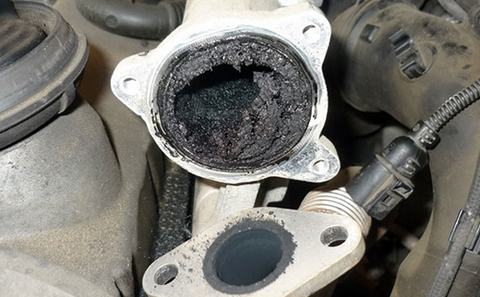
Diesel exhaust carries soot. The intake system may also receive oil vapor from the crankcase ventilation system. When dry soot mixes with oil mist, it turns into a sticky carbon sludge that can coat the EGR valve, EGR cooler, intake elbow, and intake manifold. That is why a diesel EGR problem often feels like the engine is slowly being choked off.
Where Is the EGR Valve Located?
The exact location depends on the engine, but the EGR valve is always part of the exhaust-to-intake pathway. It may be mounted near the intake manifold, intake horn, EGR cooler, or exhaust crossover tube.
- Ford Powerstroke: On many 6.0L and 6.7L engines, the valve is located near the top/front area of the engine or near the EGR cooler assembly.
- Chevy / GMC Duramax: Often found near the front of the engine bay around the intake horn and EGR cooler plumbing.
- Ram Cummins: Commonly mounted near the intake horn or intake manifold area, depending on year and emissions configuration.
Mechanic’s note: Let the engine cool completely before touching the EGR valve or cooler. These parts handle hot exhaust gas and can stay extremely hot after shutdown.
Common Bad EGR Valve Symptoms
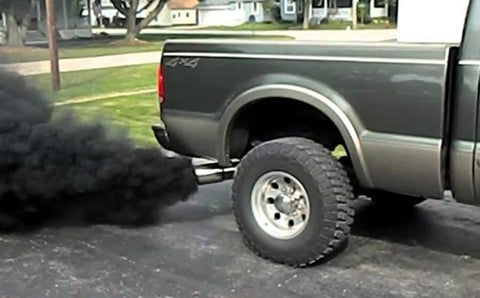
A failing EGR valve does not always fail the same way. If it sticks open, the engine may stumble because it is getting exhaust gas when it needs clean air. If it sticks closed or the passages clog, the ECU may see insufficient EGR flow and trigger a code. On diesel trucks, heavy soot can also restrict the intake path and make the truck feel lazy under load.
Real-world example: A 2008 Ford 6.4L Powerstroke came in with low power and poor fuel mileage. When the intake elbow came off, the carbon buildup was so thick that the ports were severely restricted. The valve was not the only issue—the whole intake path had been collecting soot and oil residue for a long time.
Bad EGR Valve Diagnostic Table
| Symptom | Likely EGR Condition | What It Means | What to Check |
|---|---|---|---|
| Rough idle / stalling | Stuck open | Too much exhaust gas enters the intake when the engine needs clean air. | Valve position, carbon buildup, actuator response |
| Knocking / pinging | Stuck closed or insufficient flow | Combustion temperature may rise because EGR flow is not happening as expected. | P0401 code, passages, valve movement |
| Black smoke | Clogged or slow response | Airflow and combustion balance may be affected. | Intake soot, valve response, boost leaks, air filter |
| Check Engine Light | Electronic or flow fault | The ECU sees EGR flow or circuit behavior outside the expected range. | P0401, P0402, P0404, wiring, actuator |
| White smoke / coolant loss | Possible EGR cooler issue | Coolant may be entering the exhaust or intake path. | EGR cooler, coolant pressure, coolant level |
How to Test an EGR Valve
Before replacing parts, verify the problem. A bad EGR valve can mimic other issues such as boost leaks, intake restrictions, fuel problems, or sensor faults.
Check for Trouble Codes
Use an OBD-II scanner to check stored and pending codes. Common EGR-related codes include P0401 for insufficient EGR flow, P0402 for excessive EGR flow, and P0404 for EGR control circuit or range issues. Codes do not always prove the valve itself is bad, but they help narrow the diagnosis.
Listen for Electronic Valve Cycling
On some modern trucks, the electronic EGR valve may cycle during key-on or shutdown self-checks. No movement or abnormal clicking can point to actuator issues, but this depends on the vehicle.
Use a Vacuum Test on Older Valves
Older vacuum-operated EGR valves can often be tested with a hand vacuum pump. If the diaphragm does not hold vacuum, the valve may be damaged.
Perform a Visual Inspection
If the valve is removed and looks like a charcoal briquette, heavy soot buildup is present. Light buildup may be cleaned. Heavy carbon, damaged electronics, a stuck actuator, or broken sealing surfaces usually mean replacement is the better path.
Should You Clean or Replace an EGR Valve?
If your vehicle is street-driven, the compliant repair path is to diagnose the system and clean or replace the failed components. Cleaning may work when the valve is only lightly coated and the actuator still functions. Replacement is usually better when the valve is stuck, the electronic motor has failed, the vacuum diaphragm leaks, or the buildup is severe.
Diesel EGR cleaning is often harder than gasoline EGR cleaning because soot mixes with crankcase oil vapor and bakes into a tar-like sludge. Additives rarely fix a heavily clogged diesel EGR valve once the carbon is packed into the valve or intake passages.
| Condition | Cleaning May Work | Replacement Is Better |
|---|---|---|
| Light soot on valve face | Yes | Not always needed |
| Heavy carbon blocking movement | Sometimes | Often yes |
| Failed electronic actuator | No | Yes |
| Vacuum diaphragm leak | No | Yes |
| Coolant loss / white smoke | No, inspect cooler | Possible EGR cooler repair |
EGR Delete: Legal Notice and Off-Road Use
For vehicles driven on public roads, deleting or disabling the EGR system is not the compliant repair path. The legal approach is to repair, clean, or replace the emissions-control components so the system works as designed.
Some dedicated off-road and competition builds use Powerstroke, Cummins, or Duramax EGR delete kit options to remove a known failure point from a non-street vehicle. This is not the same decision as repairing a daily-driven truck. Before buying parts, confirm your intended use, local laws, emissions requirements, and tuning needs.
Many diesel owners also compare EGR problems with other emissions-system restrictions, such as DPF and CAT delete pipes. These parts should be treated as off-road or competition-use components only, not as street repair parts.
Why Diesel Owners Consider EGR Delete for Off-Road Builds
On a dedicated off-road or competition truck, the reason owners consider removing the EGR system is usually reliability and intake cleanliness rather than a simple horsepower claim. A cleaner intake path can help reduce soot buildup, and removing EGR cooler heat load may reduce stress on parts of the cooling system in certain builds.
- Cleaner intake path: Less soot is routed back into the intake system.
- Fewer EGR-related failure points: The valve, cooler, and related plumbing are no longer part of the off-road setup.
- Reduced soot-and-oil sludge: Intake buildup may be reduced when EGR flow is removed from the system.
- Cooling-system considerations: On some platforms, the EGR cooler adds heat load and can become a failure point.
6.0L Powerstroke EGR Cooler Failure
The Ford 6.0L Powerstroke is one of the best-known diesel platforms for EGR cooler problems. When the cooler cracks or fails, coolant can enter places it should not be, and the truck may show white smoke, coolant loss, coolant pressure issues, or overheating symptoms.
For street-driven 6.0L trucks, the compliant path is proper diagnosis and repair with appropriate replacement parts. For dedicated off-road builds, some owners choose an EGR delete setup to remove the cooler and valve from the system. Either way, the key is to understand the failure mode before replacing parts blindly.
FAQs
Q: What does EGR stand for?
A: EGR stands for Exhaust Gas Recirculation. It is an emissions-control system that routes a portion of exhaust gas back into the intake system to lower combustion temperature and reduce NOx emissions.
Q: What does an EGR valve do?
A: The EGR valve controls when and how much exhaust gas enters the intake system. When it works correctly, it helps reduce NOx. When it sticks or clogs, it can cause rough idle, power loss, smoke, or trouble codes.
Q: Is it illegal to delete an EGR valve?
A: Deleting or disabling the EGR system is not legal for street-driven emissions-controlled vehicles in the United States. EGR delete kits should be treated as off-road or competition-use parts only, where allowed by law.
Q: Can I drive with a bad EGR valve?
A: You may be able to drive for a short time, but it is not recommended to ignore the issue. A stuck or clogged valve can cause rough running, poor fuel economy, high temperatures, or additional intake and emissions-system problems.
Q: Can I just unplug the EGR valve?
A: No. Unplugging the valve can trigger a Check Engine Light, drivability issues, emissions-system codes, and possibly limp mode. The correct fix depends on whether the vehicle is being repaired for street use or built for off-road competition use.
Q: How much does EGR valve replacement cost?
A: The part itself often costs a few hundred dollars, but labor varies widely by engine because some EGR valves are buried deep in the engine bay. Diesel trucks usually cost more to service than simple gasoline applications.