Last reviewed: September 23, 2026
A 2012 Ford F-250 6.7L Power Stroke intake-manifold job turned into a useful shop lesson when a fastener dropped into the open intake path. The teardown exposed heavy soot-and-oil deposits, but the video ended before the replacement manifold was fully installed or road-tested. The case documents the condition found during disassembly and the hardware recovery, not a measured performance change.
Key Takeaways
The 2012 Ford F-250 case shows why intake contamination, model-year fitment, foreign-object control, and post-install verification must be treated as separate service decisions.
- Sticky deposits commonly form when EGR soot mixes with oil mist, but appearance alone does not quantify airflow loss or rule out a separate boost leak.
- A dropped bolt in an open intake path is a stop-work event. Do not crank the engine until every fastener is accounted for.
- The 6.7L Power Stroke uses reverse-flow cylinder heads, with the intake path outside the V and the exhaust and turbocharger package inside the V.
- Cast aluminum can improve structural durability and service access, but manifold material alone does not prevent future deposits.
- 2015–2016 manifold kits require special attention to the included external turbo oil-feed line and its revised routing.
YouTube creator Jacob Hernandez described the truck as running a hot tune labeled as a 180-horsepower calibration. That description identifies the selected tune, not a chassis-dyno result or a measured 180-horsepower increase.
What Happened in the KOL Installation Video?
The video shows an unfinished intake-manifold installation on a reported 2012 Ford F-250 6.7L Power Stroke, with visible deposits and a bolt-recovery incident as the strongest documented evidence.
| Case detail | What the video documents |
|---|---|
| Truck | Reported 2012 Ford F-250 with the 6.7L Power Stroke diesel engine |
| Calibration | The owner describes the selected hot tune as “180 horses” |
| Observed condition | Dark, sticky deposits are visible in the removed factory intake assembly |
| Installation problem | A removed bolt falls into the open intake/EGR-manifold area and is recovered with additional disassembly and a magnet |
| End point | The video ends before final reassembly and a post-install road test |

How Does the 6.7L Power Stroke Reverse-Flow Layout Change the Risk?
The 6.7L Power Stroke places its intake path along the outer sides of the cylinder heads and the exhaust path and turbocharger package inside the engine's V, so a fastener that enters a lower intake runner is already on the valve side of the induction system.
Ford describes the 6.7L Power Stroke as a reverse-flow design, with the exhaust routed inside the V and the air intake positioned outside it. That packaging shortens the exhaust route to the valley-mounted turbocharger, but it also means an open outer intake runner leads toward an intake valve rather than into a large, harmless central cavity. Ford's reverse-flow layout explanation confirms the basic architecture.
The video angle does not establish whether the bolt stayed in the upper plenum, entered a lower runner, stopped above a closed intake valve, or passed an open valve. That uncertainty is the reason to disconnect the batteries, stop all crankshaft movement, and locate the hardware before continuing.
What the Case Proves and What It Does Not Prove
The teardown supports conclusions about visible contamination and installation risk, while performance, temperature, fuel-economy, and durability claims require controlled before-and-after testing that the video does not provide.
| Observation | Reasonable conclusion | Not established by this case |
|---|---|---|
| Sticky dark deposits in the intake | Soot and oil mist have accumulated in the air path | The exact airflow loss, EGT increase, or remaining turbocharger life |
| Owner-selected 180-horsepower tune label | The truck uses an aggressive calibration according to the owner | A measured 180-horsepower gain at the wheels |
| Bolt stopped in sticky material | The bolt was recoverable before the engine was started | Deposits protected the engine or made the condition acceptable |
| Replacement manifold shown | The cast-aluminum part differs in material and runner layout from the stock plastic assembly | Automatic gains in boost, horsepower, fuel economy, or intake-air temperature |
Why Does a 6.7L Power Stroke Intake Develop Sticky Deposits?
Sticky intake deposits can form when recirculated exhaust soot combines with oil mist carried through the crankcase-ventilation system, producing a paste that can collect on runners and sensor passages over time.
Deposit thickness varies with operating hours, duty cycle, engine condition, calibration, oil carryover, EGR operation, and previous service. A work truck that idles for long periods can accumulate deposits differently from a highway truck with the same odometer reading, so mileage alone is a weak inspection trigger.
A loaded CCV separator or excessive crankcase pressure can increase oil carryover, but the teardown image cannot diagnose CCV box saturation by itself. The black paste develops as soot becomes trapped in an oil film and accumulates through repeated operating cycles; the video does not provide the gas temperature, oil mass, crankcase pressure, or service history needed to assign one confirmed root cause.
The factory plastic housing does not create the soot-and-oil mixture, and a metal replacement does not remove the sources of contamination. Owners comparing Powerstroke intake manifolds should separate material durability and runner geometry from claims about deposit prevention.
Do Not Blame the Intake Manifold Before Testing the System
Weak acceleration, underboost, smoke, or poor towing response does not confirm a restricted intake manifold because charge-air leaks, sensor faults, turbocharger control problems, fuel-delivery faults, and exhaust restriction can create similar symptoms.
- Record diagnostic trouble codes and freeze-frame data before clearing anything.
- Compare key-on, engine-off MAP data with barometric pressure and inspect the MAP sensor and its pressure passage for contamination.
- Pressure-test the charge-air tract using regulated air and stay below the lowest limit specified for the test equipment, boots, pipes, and vehicle configuration.
- Inspect couplers for oil saturation, clamp tracks, splits, and rubbed-through areas. Correct boost-leak diagnosis matters more than replacing a pipe because it looks old.
- Compare commanded and actual boost under a repeatable load only after fuel, sensor, and exhaust faults have been checked.
A small film of oil inside charge-air plumbing can be normal on a closed-crankcase system. Pooled oil, rapidly returning contamination, or a sudden increase in oil consumption calls for crankcase-pressure, turbocharger, and engine-condition checks before parts are approved.
What Should You Do If a Bolt Falls Into the Intake?
A fastener dropped into an open 6.7L Power Stroke intake path must be recovered before the crankshaft is turned because hardware that passes an open intake valve can reach the combustion chamber and damage a valve, piston, or cylinder head.
- Stop and isolate the starter circuit: Disconnect both negative battery cables and do not bump the starter.
- Identify the missing hardware: Count the removed fasteners and establish the missing bolt's size and original location.
- Cover every other exposed opening with clean, lint-free material so the recovery attempt does not create a second problem.
- Inspect the runner: Use a light and articulating borescope to determine whether the bolt remains in the plenum, has entered a lower runner, or is visible near the intake valve. Note the valve position, but do not rotate the crankshaft merely to obtain a better camera angle.
- Retrieve without pushing: Use a flexible magnet only when the bolt is magnetic, visible, and reachable without driving it past the valve.
- Escalate when the bolt is not visible: Remove the next component in the intake path. If the bolt may have passed an open valve, it could be in the combustion chamber or resting on the piston crown; a qualified technician should inspect the cylinder through an appropriate service access point before any crankshaft movement.
- Verify the repair: Hold the recovered bolt in hand, inspect the runner again, and account for every rag, plug, socket, and tool before reassembly.
Jacob's bolt was caught in sticky material and eventually recovered, but that was luck, not a service method. Covering the ports as soon as the manifold is lifted is faster than fishing hardware out of the engine later.

Should You Clean, Repair, or Upgrade the Intake System?
Cleaning is reasonable when the stock housing is intact and the complaint is contamination, while replacement makes more sense when inspection finds a crack, warped sealing surface, damaged sensor port, stripped threads, or a configuration-specific need for different charge-air plumbing.
| Truck condition | Practical path | Main check before spending money |
|---|---|---|
| Stock or lightly modified truck; manifold intact | Clean the serviceable parts, inspect sensor passages, renew damaged seals, and retain the stock assembly | Confirm that the manifold is not cracked or warped and that the complaint is not a boost leak elsewhere |
| Cracked housing, damaged flange, or repeated sealing problem | Use a year-correct stock-style replacement or a compatible metal manifold | Confirm emissions-equipment interfaces, year group, sensor provisions, and road-use requirements |
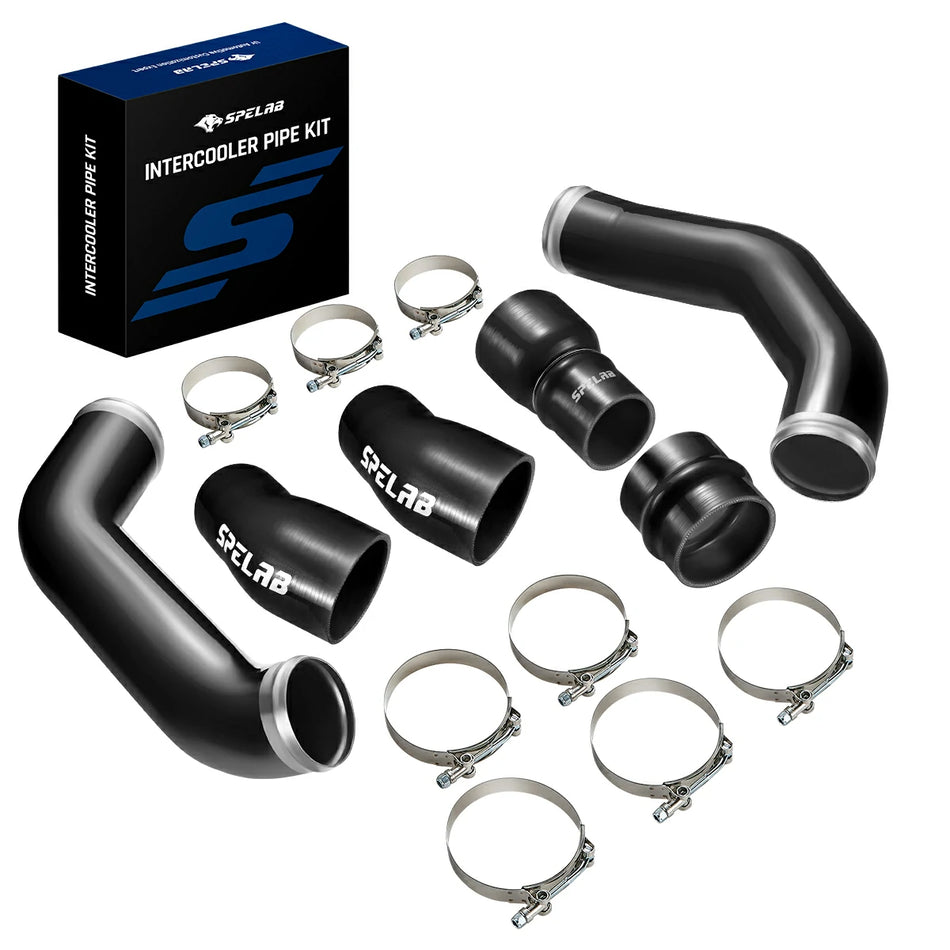
| Known charge-air pipe failure or multiple worn connections | Consider a matched intake manifold and intercooler pipe bundle after leak testing confirms the repair scope | Match the hot-side and cold-side routing to the exact model year and inspect turbo and intercooler connections |
| Oil carryover without a damaged manifold | Service the factory CCV system and evaluate a compliant closed-loop oil-separation path where permitted | Review crankcase pressure, oil consumption, turbo condition, warranty, and crankcase ventilation function and diagnostic warning signs before changing the closed system |
Which 6.7L Power Stroke Years Need Extra Fitment Attention?
The linked cast-aluminum manifold is currently listed for 2011–2019 Ford F-250, F-350, F-450, and F-550 6.7L Power Stroke trucks, but the correct year option and the truck's emissions and piping configuration must be confirmed before disassembly.
Ford identifies the 2015 Super Duty engine as the second-generation 6.7L Power Stroke, and Ford's 2015–2016 replacement turbo package includes a lower intake manifold and a turbo oil line. Those factory parts confirm that turbo, lower-intake, and oil-line packaging changed as a system; they do not prove that every aftermarket runner interferes in the same place. The current SPELAB 2015–2016 manifold listing therefore controls the practical decision: use the supplied external oil-feed line and its specified routing. Ford's 2015–2016 turbo kit information lists the related factory components.
| Model-year group | Fitment checkpoint |
|---|---|
| 2011–2014 | Match the manifold, boot, sensors, brackets, and charge-air connections to the early routing. |
| 2015–2016 | The current kit listing includes an external turbo oil-feed line that replaces the factory feed routing; identify every fitting and routing point before removing the original line. |
| 2017–2019 | Use the late-routing configuration and do not substitute an early hot-side or cold-side pipe solely because the engine displacement matches. |
A cast-aluminum 6.7L Power Stroke intake manifold can serve as a structural replacement or an airflow-focused component. Follow the correct tightening sequence and torque requirements for the selected hardware and manifold rather than applying one generic torque value to every fastener.

Does Every Tuned 6.7L Power Stroke Need Metal Intercooler Pipes?
Metal charge-air pipes are justified when testing finds a split pipe, distorted connection, recurring boot separation, or a build requirement that the stock plumbing cannot support; a tune label by itself does not prove that the pipes need replacement.
Inspect the entire hot-side and cold-side path before ordering parts. A 6.7L Power Stroke intercooler pipe kit can replace a failed or unsuitable section, but metal construction cannot compensate for a loose clamp, contaminated boot, damaged O-ring, cracked intercooler, or incorrect year-specific routing.
How Should the Repair Be Verified After Reassembly?
A 6.7L Power Stroke intake repair is complete only after the technician verifies hardware, fuel and oil connections, sensor data, charge-air sealing, and loaded operation without new leaks or diagnostic codes.
- Account for all tools, plugs, rags, bolts, and removed components before reconnecting both batteries.
- Key the truck on and check MAP, barometric pressure, intake-air temperature, and other disturbed sensor circuits for plausible readings.
- Start the engine and inspect every disturbed fuel, oil-feed, intake, and charge-air connection for leaks during an initial idle period of roughly 5–10 minutes.
- Perform a short, low-load drive, then add moderate load while watching commanded versus actual boost, MAP behavior, and diagnostic codes.
- After one full heat cycle, recheck boots, clamps, brackets, wiring clearance, and any model-year-specific oil-feed fittings.
Use the truck's pre-repair data as the baseline whenever possible. One clean pull after installation is encouraging, but repeatable scan data under the same load is stronger evidence than sound, throttle feel, or turbo whistle.
Watch the Original Installation Case
The original video preserves the sequence of the teardown, the visible contamination, and the dropped-fastener recovery so readers can separate direct observation from later interpretation.
Emissions and Road-Use Notice
The KOL video mentions EGR removal, but the installation case should not be treated as an instruction to remove emissions equipment. Under U.S. federal law, removing or defeating emissions controls on a motor vehicle is generally prohibited, and an “off-road only” label does not automatically make tampering lawful.
Confirm the manifold's EGR interface, calibration requirements, warranty impact, and legal use before purchase or installation. The EPA vehicle and engine tampering policy provides current federal enforcement context; state requirements may be stricter.
Frequently Asked Questions
The safest intake-manifold decision comes from separating visible deposits, confirmed component damage, fitment requirements, and measured test results.
Q: Does heavy sludge mean a 6.7L Power Stroke intake manifold must be replaced?
A: No. Heavy deposits justify inspection and cleaning, but replacement should be based on cracks, warpage, damaged threads, sealing failure, sensor-port damage, or a verified configuration need.
Q: Does a cast-aluminum manifold prevent carbon buildup?
A: No. Cast aluminum changes the housing material and geometry, but soot and oil mist can still collect when the same contamination sources remain active.
Q: What does reverse-flow mean on a 6.7L Power Stroke?
A: Reverse-flow means the intake path sits outside the engine's V while the exhaust path and turbocharger package sit inside the V. A bolt that enters a lower outer intake runner is therefore headed toward an intake valve, which is why the engine must not be cranked until the hardware is found.
Q: Does black intake sludge prove that the CCV separator is saturated?
A: No. Soot mixed with oil film explains the deposit type, but a loaded CCV separator is only one possible contributor. Crankcase pressure, oil consumption, turbo condition, duty cycle, EGR operation, and service history must be checked before assigning the root cause.
Q: Can a dropped intake bolt be left in place if the engine still turns?
A: No. Do not rotate or start the engine until the fastener is positively located and removed, because a small metal object can cause major internal damage if it reaches a cylinder.
Q: Should the MAP sensor be replaced during every manifold job?
A: No. Inspect the MAP sensor and its pressure passage, compare scan data with expected key-on and running values, and replace the sensor only when testing shows a fault or physical damage.
Q: How often should a tuned 6.7L Power Stroke intake be inspected?
A: Use condition-based inspection rather than an unsupported fixed interval. Check the system when codes, boost deviation, new hissing, oil pooling, smoke, weak towing response, or disturbed piping provides a reason, and include the intake in scheduled service on high-idle or severe-duty trucks.
Q: What is different about a 2015–2016 intake-manifold installation?
A: The current SPELAB 2015–2016 manifold configuration includes an external turbo oil-feed line and requires the supplied routing in place of the factory arrangement; verify every fitting and component before the stock parts are removed.
About the Author
John Lee is a mechanical engineer who focuses on diesel drivetrain durability, thermal management, and practical component testing.

John Lee
Mechanical Engineer | 10+ Years of Experience
John Lee engineers and tests automotive components across Power Stroke, Cummins, and Duramax applications.