
Updated by John Lee (Lead Mechanical Engineer) on May 8, 2026.
Featured Snippet Target: The best EGR DPF delete kit for a 6.7 Cummins depends on your Ram model year, exhaust layout, cab configuration, tuner support, and intended legal use. A complete off-road setup typically includes a DPF delete pipe, EGR delete components, DEF/SCR-related calibration support, and a compatible tuner. Some owners report stronger throttle response, fewer regen-related issues, and possible MPG or power gains with proper tuning, but results vary by truck condition, tune quality, exhaust size, transmission limits, and supporting modifications.
Removing, disabling, or bypassing emissions-control equipment such as DPF, EGR, SCR/DEF, DOC, sensors, or related ECU monitoring may violate federal, state, or local law. This article is for educational, off-road, race, competition, and legally permitted-use research only. Always verify current regulations before purchasing or installing emissions-related parts.[1][2]
If you own a Ram 2500 or 3500 powered by the 6.7L Cummins, you already know the platform is built to work. You may also know the frustration of DPF regeneration cycles, EGR soot buildup, DEF/SCR warnings, limp mode, and expensive emissions-system repairs. That is why many owners search for the best EGR DPF delete kit for 6.7 Cummins.
This guide explains what a complete 6.7 Cummins delete kit includes, how to choose the right setup by model year, why tuner compatibility matters, how 4-inch and 5-inch exhaust options compare, what installation mistakes to avoid, and what legal risks you need to understand before spending money.
Unlike a simple product list, this guide treats a delete kit as a complete system. A proper setup is not just one pipe or one block-off plate. It involves year-specific hardware, exhaust fitment, coolant routing, ECU calibration, and, in many cases, transmission strategy.

Top Picks: Best 6.7 Cummins Delete Kit Setups
If you are comparing delete kit options, start with your use case. The “best” kit is not always the most expensive one. It is the setup that matches your Ram year, cab configuration, exhaust diameter, tuner support, and intended legal use.
| Use Case | Recommended SPELAB Setup | Best For |
|---|---|---|
| Best Overall | Full EGR + DPF Delete Setup with Compatible Tuner | Off-road Ram 2500/3500 owners who want a complete, year-matched package |
| Best Budget Start | 6.7 Cummins EGR Delete Kit | Owners addressing EGR cooler, soot, or intake contamination issues |
| Best Exhaust Flow | 4-inch or 5-inch Cummins DPF Delete Pipe | Off-road builds focused on reducing exhaust restriction |
| Best Tuner Path | EZ Lynk Delete Tuner Collection | DIY users who need app-based tune support where legally permitted |
| Best Supporting Upgrade | CCV/PCV Reroute Kit | Trucks dealing with oil vapor, intake sludge, or MAP sensor contamination |
Quick Buyer’s Verdict: What Should You Buy?
| Best overall choice | A complete, year-matched setup with DPF pipe, EGR components, calibration support, and a compatible tuner. |
| Most important check | Confirm model-year fitment, cab configuration, exhaust diameter, and tuner support before ordering. |
| Best exhaust size | 4-inch for most trucks; 5-inch for high-flow competition or heavily modified setups. |
| Street use | Not recommended. Emissions-system removal can violate federal, state, and local law. |
2019-2023 6.7 Cummins All-in-One Delete Kit
This is the primary product path for Ram 6.7 Cummins owners comparing a complete setup. Open the product page to verify model-year fitment, included DPF, DEF, EGR, and CCV components, and current buying options before choosing separate parts.

DPF/DEF/EGR All-in-One Delete Kit for 2019-2021 Dodge Ram 6.7L Diesel 2500 3500
Why 6.7 Cummins Owners Consider EGR and DPF Delete Kits
Modern 6.7L Cummins engines use several emissions systems to reduce pollutants. These systems serve a legal and environmental purpose, but they can also create real maintenance costs as mileage increases. For owners using trucks in off-road, race, farm, export, or legally permitted applications, delete kits are often researched as a way to simplify the system and reduce certain failure points.
DPF — Diesel Particulate Filter
The Diesel Particulate Filter captures soot from the exhaust stream. When soot loading reaches a threshold, the truck performs a regeneration cycle to burn off accumulated soot. Short trips, excessive idle time, towing conditions, sensor failures, or incomplete regeneration can lead to frequent warnings or filter restriction.
When a DPF becomes severely restricted or ash-loaded, repair or replacement can become expensive. Some owners research a 6.7 Cummins DPF delete pipe for off-road or legally permitted use, but this should not be confused with a street-legal repair.
If you are still learning how DPF systems work, start with our beginner guide: What is DPF Delete?. It explains what the DPF does, why diesel owners consider deleting it, and why tuning and legal compliance matter.
EGR — Exhaust Gas Recirculation
The EGR system routes some exhaust gas back into the intake to reduce combustion temperature and NOx emissions. Over time, soot can contaminate the intake path, EGR valve, EGR cooler, grid heater area, and MAP sensor. If you want a deeper explanation of the process, read our guide on deleting EGR on a 6.7 Cummins engine or compare the pros and cons of a 6.7 Cummins EGR delete.
DEF / SCR — Diesel Exhaust Fluid and Selective Catalytic Reduction
Later 6.7 Cummins trucks use DEF/SCR systems to reduce NOx emissions. DEF pumps, dosing modules, heaters, sensors, or wiring issues can trigger warnings or limp-mode behavior. DEF/SCR delete-related calibration is legally sensitive and should only be considered for vehicles and use cases where emissions modification is legally permitted.
What Does a Complete 6.7 Cummins Delete Kit Include?
A complete 6.7 Cummins delete kit is a system, not a single part. The exact components vary by model year, emissions layout, cab configuration, and intended use, but most complete off-road bundles involve the following categories.
1. DPF Delete Pipe
The DPF delete pipe replaces the factory DPF and, depending on the layout, related exhaust sections with a 4-inch or 5-inch pipe. Look for stainless steel construction, correct flange patterns, proper hangers, included hardware, and fitment for your exact year and cab configuration.
2. EGR Delete Kit
A 6.7 Cummins EGR delete kit may include block-off plates, coolant bypass components, throttle valve-related hardware, and gaskets depending on the model year. Coolant routing matters. Poor coolant reroute or trapped air can cause overheating.
3. DEF/SCR-Related Calibration Support
Some setups require ECU calibration to prevent DEF/SCR-related fault codes when hardware is modified. Do not assume every tuner or firmware version supports your model year. For newer trucks especially, compatibility can change quickly.
4. Performance Tuner
The tuner is one of the most important parts of the system. Without proper ECU calibration, the truck may trigger diagnostic trouble codes, limp mode, reduced power, or sensor logic problems. A tuner should be chosen based on model year, emissions layout, transmission strategy, power goal, and available support.
Recommended SPELAB 6.7 Cummins Delete Kit Setup
For off-road, race, or legally permitted Cummins builds, SPELAB offers year-specific 6.7 Cummins components. The example below highlights a 2013–2018 Ram 6.7L Cummins EGR cooler and throttle valve delete kit. For a full parts checklist, see the Gear Up section below.
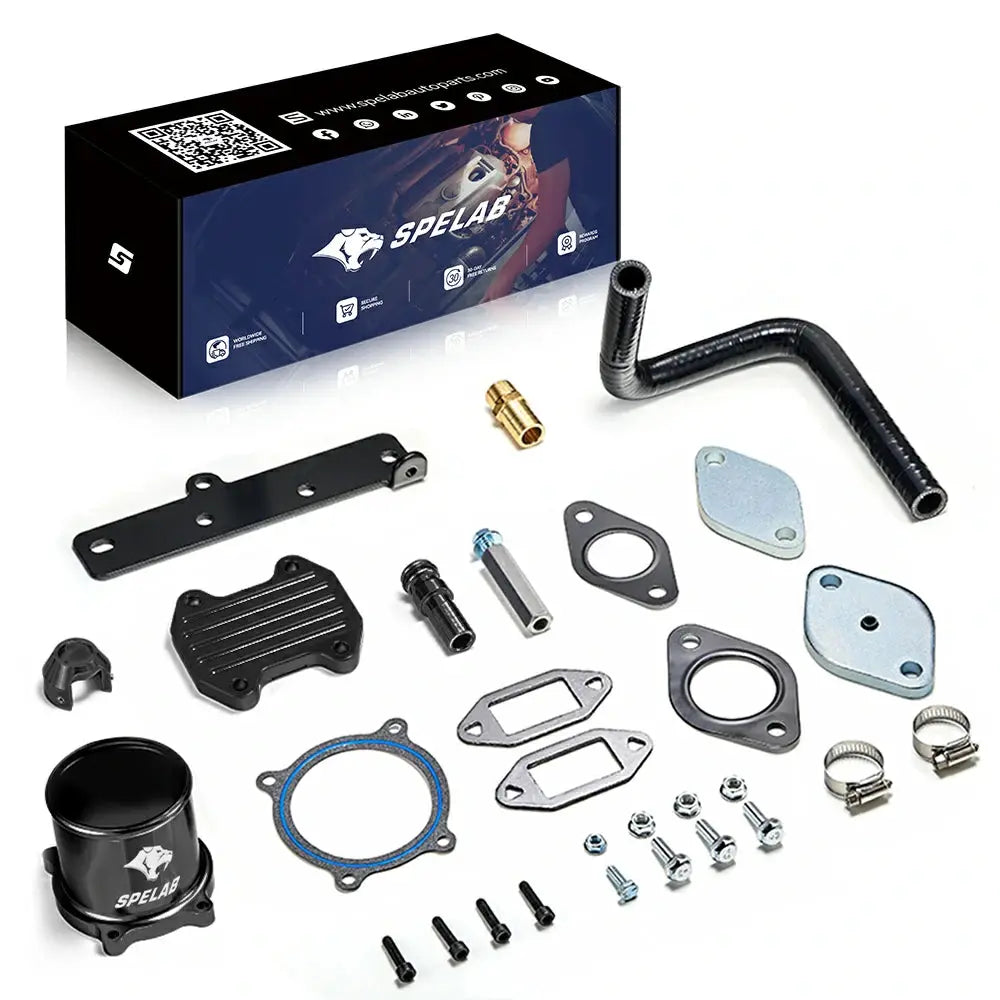
SPELAB 2013–2018 Ram 6.7L Cummins EGR Cooler & Throttle Valve Delete Kit
Fitment: 2013–2018 Dodge Ram 2500 / 3500 6.7L Cummins Diesel.
Designed for off-road, race, or legally permitted applications where EGR-related components are being addressed as part of a year-matched setup.
Check FitmentWhat Are the Real Benefits of a 6.7 Cummins EGR DPF Delete Kit?
Delete kit discussions often focus on big horsepower numbers. Real-world results are more complicated. In legally permitted off-road setups, some owners report improved throttle response, reduced exhaust restriction, fewer DPF-related maintenance events, and possible MPG or power gains when proper tuning is used. However, exact numbers are not guaranteed.
| Area | Possible Result | What Affects the Outcome |
|---|---|---|
| Horsepower | Some owners report noticeable gains with proper tuning | Tune level, turbo health, fuel system, transmission limits, and supporting mods |
| Torque | Low-end and mid-range response may improve | Torque management, transmission tuning, tune aggressiveness, and drivetrain condition |
| MPG | Some off-road setups report improved fuel economy | Driving style, tire size, gearing, load, tune quality, and previous regen frequency |
| EGT | May run cooler under load due to reduced restriction | Trailer weight, terrain, ambient temperature, turbo condition, and tune quality |
| Maintenance | Fewer DPF/EGR-related service events in modified setups | Installation quality, retained components, tune support, and inspection requirements |

EZ Lynk vs EFI Live vs RaceMe Ultra: Which Tuner Should You Choose?
Your tuner choice determines whether the hardware works correctly. It also affects drivability, power delivery, transmission behavior, and how easy it is to update or troubleshoot the truck later.
| Feature | EZ Lynk Auto Agent | EFI Live AutoCal | RaceMe Ultra |
|---|---|---|---|
| Best For | DIY users, tow rigs, app-based support | Custom builds and professional calibration | Budget-minded older trucks |
| Setup | OBD-II device with app-based workflow | Usually requires calibrator support | OBD-II interface with preloaded options |
| Flexibility | Strong remote support potential | High customization with the right calibrator | Simpler feature set |
| Best Use Case | Most owner-installed off-road builds | High-power or shop-built setups | Older platforms where support is confirmed |
| Compatibility Warning | Always confirm current firmware, model-year support, and tune availability before buying, especially for 2019–2024 trucks. | ||
For Cummins owners comparing tuning paths, SPELAB offers broader diesel tuner options, including app-based EZ Lynk delete tuners and select H&S Mini Maxx tuner options where compatible and legally permitted.
For 2019–2024 Trucks: Confirm Compatibility First
For 2019–2024 Ram 6.7L Cummins trucks, tuner compatibility changes frequently because of updated ECM security and changing aftermarket support. Do not assume an older tuner or older firmware will work. Confirm current compatibility with the tuner provider, calibrator, or retailer before purchasing.
Which 6.7 Cummins Model Years Need Which Delete Components?
The 6.7L Cummins platform changed significantly over time. Year-specific kit selection is essential. The biggest correction to remember: early 2007.5–2009 6.7 Cummins trucks did have EGR and DPF, but they did not have the later factory DEF/SCR system.
| Year Range | Emissions Systems Present | Delete Complexity | Recommended Setup | Notes |
|---|---|---|---|---|
| 2007.5–2009 | EGR + DPF; no factory DEF/SCR | Moderate | DPF/EGR setup with compatible tuner | Early 6.7 Cummins emissions layout. Do not treat these as “EGR only” trucks. |
| 2010–2012 | EGR + DPF + DEF/SCR-related system | Moderate to high | Year-matched full setup with tuner | Confirm cab configuration and exhaust layout before ordering. |
| 2013–2018 | EGR + DPF + DEF/SCR + CCV considerations | Moderate | Full bundle with DPF pipe, EGR kit, tuner, and optional CCV reroute | Strong aftermarket support and common platform for off-road builds. |
| 2019–2024 | Full emissions system + updated ECM security | High | Verified hardware and current tuner support only | Do not buy before confirming tuner firmware and year coverage. |
Note: Early 2007.5–2009 6.7 Cummins trucks are sometimes mistakenly described as “EGR only.” In reality, these trucks used EGR and DPF systems but did not have the later factory DEF/SCR setup. Always verify your emissions layout before ordering parts.
Cab & Chassis vs. Pickup Fitment
Cab & Chassis trucks often use different exhaust routing, hangers, wheelbase layouts, and emissions-component positioning than standard pickup models. Always confirm whether a kit is for pickup or C&C before ordering.
4-Inch vs 5-Inch Exhaust: Which Size Is Better for a 6.7 Cummins Delete?
Pipe diameter matters, but bigger is not always better. For many Ram 2500 / 3500 owners, a 4-inch system is easier to route, easier to live with, and more than enough for moderate setups. A 5-inch system makes more sense when airflow demand is much higher.
| Diameter | Best For | Sound / Fitment | Recommendation |
|---|---|---|---|
| 4-inch | Most work trucks, tow rigs, daily-driven diesel builds, and moderate off-road setups | Deep tone, easier routing, usually less drone | Best choice for most 6.7 Cummins owners. |
| 5-inch | High-flow competition builds, compound turbo setups, and heavier modifications | Louder, deeper, more clearance-sensitive | Choose only when the build actually needs the extra flow. |
Full Delete Kit vs DPF-Only Pipe: Which Is Better?
A partial setup may seem cheaper upfront, but it can leave other emissions-system issues unresolved. For off-road or legally permitted builds, many owners prefer a complete, year-matched package because the hardware, sensors, exhaust layout, and calibration can be planned together. However, the right scope depends on vehicle use, local law, budget, and whether the truck still needs to pass inspection.
| Factor | DPF-Only Pipe | Complete Year-Matched Setup |
|---|---|---|
| Upfront cost | Lower | Higher |
| EGR-related issues addressed? | No | Yes, if included in the bundle |
| DEF/SCR-related calibration addressed? | Usually no | Yes, if included and supported by tune |
| Tuning complexity | Still required | Still required, but planned as a complete setup |
| Best for | Specific exhaust-only off-road goals | Owners who want a more complete, coordinated setup |
Transmission Reality Check: 68RFE vs Aisin
The 6.7 Cummins can handle serious torque, but the transmission is often the limiting factor once torque is increased. The 68RFE especially needs responsible tuning and conservative torque management when power is added.
How Hard Is It to Install a 6.7 Cummins Delete Kit?
This is not a beginner maintenance job. Installation difficulty depends on rust, model year, exhaust layout, coolant routing, tuner workflow, and whether you are working on a pickup or Cab & Chassis truck. Professional installation is recommended for many owners.
Before You Start
- Scan and record existing DTCs: Know what codes were already present before modifying anything.
- Let the engine cool completely: EGR and coolant work can burn you if rushed.
- Use penetrating oil: On 2013–2018 trucks especially, soak DPF flange bolts the night before.
- Confirm tune and firmware: Do not start removing hardware until the tuner and calibration support are confirmed.
- Keep stock parts: Store the DPF, sensors, clamps, and brackets in case the truck must be returned to factory configuration later.
Common Installation Mistakes
- Not burping the coolant system: Air trapped after EGR coolant rerouting can cause overheating.
- Damaging sensors: Remove and label exhaust sensors carefully before removing the factory assembly.
- Wrong cab configuration: Pickup and Cab & Chassis exhaust routing can differ.
- Wrong tuner support: A hardware kit without compatible tuning is not a working setup.
- Over-aggressive tuning: Big torque numbers can damage a weak transmission.

Gear Up: SPELAB Parts to Check Before You Buy
Before ordering a delete-related setup, confirm your model year, cab configuration, exhaust diameter, tuner support, and legal use. Then compare the SPELAB categories below.
Core Delete Components
- 6.7 Cummins DPF Delete Pipe — For off-road exhaust restriction reduction and 4-inch / 5-inch pipe selection.
- 6.7 Cummins EGR Delete Kit — For EGR cooler, throttle valve, coolant reroute, and soot-related setups.
Tuning Support
- EZ Lynk Delete Tuner — For compatible tuning support where legally permitted.
- Diesel Tuner Collection — Compare tuner options before removing emissions-related hardware.
Supporting Upgrades
- CCV/PCV Reroute Kit — Helpful for reducing oil vapor contamination in the intake path where legally permitted.
- Cold Air Intake Kit — Supporting airflow upgrade for tuned, towing, or higher-load applications.
- All Cummins Applicable Products — Browse SPELAB parts built for Cummins diesel applications.
If You Cannot Delete: Legal and Maintenance Alternatives
For street-driven trucks or emissions-tested areas, maintaining or repairing the factory system is usually the safer and more compliant path. These alternatives can address many symptoms without removing emissions equipment:
If your truck is still street-driven, basic maintenance may solve some symptoms before emissions hardware is removed. Start with correct oil service using our 6.7 Cummins oil capacity and maintenance guide, then inspect MAP sensor readings, EGR cooler condition, DEF/SCR sensors, and DPF regeneration behavior.
- Perform a proper forced regen diagnosis: Identify whether the problem is soot loading, sensor failure, short-trip use, or another fault.
- Clean or replace the MAP sensor: A dirty MAP sensor can cause poor readings and drivability problems.
- Inspect the grid heater and intake tract: Soot buildup can restrict airflow.
- Repair or replace a failing EGR cooler: Coolant loss, white smoke, or overheating should be addressed quickly.
- Check DEF/SCR sensors and dosing components: Many warning lights are sensor or dosing-related rather than catastrophic failures.
- Consider a CCV/PCV reroute where legal: Reducing oil vapor contamination may help slow intake sludge formation.
- Maintain fuel filtration: Clean fuel and good filtration are critical on tuned or hard-working trucks.
Related 6.7 Cummins Guides
Legal Considerations: Know Before You Buy
This is the section you should read before buying anything. Removing or disabling emissions-control equipment can violate federal, state, and local regulations. Even if a product is marketed for off-road, race, farm, export, or specialized use, buyers should verify whether the vehicle, engine, and intended use are actually legally exempt.
| Legal Factor | What It Means |
|---|---|
| Clean Air Act | Federal law prohibits tampering with emissions controls and restricts defeat devices that bypass or disable emissions systems.[1] |
| Civil penalties | EPA lists civil penalties for noncompliant vehicles/engines, tampering events, and defeat-device sales; the amount depends on the violation type and circumstances.[2] |
| OBD or readiness checks | A modified truck may fail inspection if emissions monitors are incomplete, disabled, or not ready. |
| Visual inspections | Some jurisdictions physically inspect for missing DPF, EGR, DEF/SCR, DOC, sensors, or related hardware. |
| Warranty and resale | Emissions modifications may affect warranty claims, dealer service, trade-in value, financing, and resale. |
Frequently Asked Questions
Q: What is the best delete kit for a 6.7 Cummins?
A: The best 6.7 Cummins delete kit depends on your model year, cab configuration, exhaust diameter, tuner compatibility, and intended use. For off-road or legally permitted applications, most owners should look for a complete year-matched setup that includes DPF pipe, EGR components, calibration support, and a compatible tuner.
Q: What is the best EGR delete kit for a 6.7 Cummins?
A: The best EGR delete kit should include year-correct block-off hardware, coolant reroute components, gaskets, and fitment support for your exact Ram 2500/3500 configuration. For 2013–2018 trucks, SPELAB offers a 6.7 Cummins EGR cooler and throttle valve delete kit designed for off-road or legally permitted applications.
Q: What is the best DPF delete kit for a 6.7 Cummins?
A: The best DPF delete setup depends on your model year, cab configuration, and exhaust diameter. Most moderate builds use a 4-inch pipe, while 5-inch pipes are better suited to high-flow competition setups. Always pair hardware with compatible tuning support where legally permitted.
Q: What does a 6.7 Cummins delete kit include?
A: A complete setup may include a DPF delete pipe, EGR delete components, DEF/SCR-related calibration support, tuner, gaskets, clamps, block-off plates, and sometimes CCV/PCV reroute parts. Exact contents vary by model year and truck configuration.
Q: How much power can a 6.7 Cummins delete kit add?
A: In off-road or legally permitted applications, owners often report noticeable power gains when delete hardware is paired with proper tuning. However, exact horsepower or torque depends on tune level, turbo condition, fuel system, exhaust setup, transmission limits, and supporting modifications. No HP or MPG figure should be treated as guaranteed.
Q: Is a tuner mandatory even for a DPF-only delete?
A: Yes. A modern 6.7 Cummins uses sensors and ECU logic to monitor emissions systems. Removing hardware without proper calibration can trigger fault codes, limp mode, reduced power, or drivability problems. Tuning compatibility should be confirmed before hardware is removed.
Q: What is the best tuner for a 6.7 Cummins delete?
A: EZ Lynk is popular for app-based support and DIY-friendly workflows, EFI Live is commonly used for custom professional calibration, and RaceMe Ultra may be considered for some older trucks. The best tuner depends on model year, tune availability, power goal, and current firmware support.
Q: Can I use an older tuner on a 2019–2024 Ram 6.7 Cummins?
A: Do not assume so. 2019–2024 trucks have more complex ECM security and changing aftermarket support. Confirm current compatibility with your tuner provider, calibrator, or retailer before buying.
Q: What do forums say about 6.7 Cummins delete kits?
A: Forum discussions often emphasize three points: do not skip the tuner, confirm year-specific fitment, and avoid the cheapest no-name hardware if it has poor flange, hanger, or gasket quality. Use forum feedback as a starting point, not a substitute for professional fitment verification.
Q: Is a full delete kit better than a DPF-only pipe?
A: For off-road or legally permitted builds, a full year-matched setup is often easier to plan because DPF, EGR, DEF/SCR logic, sensors, and tuning can be addressed together. A DPF-only pipe may be cheaper upfront but can leave other emissions-related issues unresolved.
Q: What size exhaust do I need after a DPF delete?
A: For most 6.7 Cummins owners, 4-inch exhaust is the practical choice. It is easier to route and works well for many moderate builds. A 5-inch system is better suited to high-flow competition setups, compound turbos, or heavily modified engines.
Q: What year 6.7 Cummins is easiest to modify?
A: Many builders consider 2013–2018 the most supported range because parts, documentation, and tuning ecosystems are mature. However, 2007.5–2009 trucks should not be described as “EGR only”; they have EGR and DPF but no later factory DEF/SCR system.
Q: Are delete kits street legal in the United States?
A: For emissions-controlled vehicles used on public roads, removing or disabling emissions equipment can violate federal, state, or local law. Delete-related parts should only be considered for legally permitted applications, and the buyer should verify current rules before purchasing or installing anything.[1][2]
Q: Will a delete kit void my warranty?
A: It may affect warranty claims, especially if the modification is related to the failure. Dealers may also identify missing hardware or ECU flash history. If your truck is under warranty, consult your dealer and understand the risk before modifying emissions-related systems.
Conclusion
The best EGR DPF delete kit for a 6.7 Cummins is not simply the cheapest pipe or the most aggressive tune. It is the setup that matches your exact Ram model year, cab configuration, exhaust diameter, tuner support, transmission limits, and intended legal use.
For off-road, race, competition, or other legally permitted applications, a complete year-matched bundle can help reduce certain restrictions and emissions-system failure points when paired with responsible tuning. For street-driven trucks, the legal, inspection, warranty, resale, and environmental risks usually outweigh the benefits.
If you move forward, start with fitment and tuning support first. Then choose the correct 6.7 Cummins DPF delete pipe, 6.7 Cummins EGR delete kit, EZ Lynk tuner, or CCV/PCV reroute kit based on your truck’s exact configuration.
References
- U.S. EPA — Aftermarket Defeat Devices and Tampering Are Illegal and Undermine Vehicle Emissions Controls
- U.S. EPA — Clean Air Act Vehicle and Engine Enforcement Case Resolutions and Civil Penalty Information

John Lee
Lead Mechanical Engineer | 10+ Years Experience
John has spent the last decade engineering and testing high-performance automotive components. Specializing in diesel powertrain durability, thermal management, and fitment validation across Cummins, Powerstroke, and Duramax applications, he helps truck owners understand both performance potential and real-world risk.
Ready to Compare 6.7 Cummins Delete Kits?
If your Ram fits the 2019-2023 6.7 Cummins range, start with the recommended all-in-one product page. If your truck is a different year or configuration, browse the Cummins delete kit collection to compare other year-matched options.