
Updated on July 29, 2026.
Deleting EGR on a 6.7 Cummins means removing, blocking, bypassing, or electronically disabling the exhaust-gas-recirculation system that the engine was certified to use for NOx control. For a U.S. public-road truck, that is not a routine repair: federal law prohibits tampering with required emissions controls, and an “off-road use only” label does not automatically make a motor-vehicle delete legal. Diagnose the EGR valve, cooler, wiring, sensors, coolant circuit, intake leaks, and aftertreatment condition first; most street trucks need an emissions-compliant repair, not removal.
Key Takeaways
The correct first decision is legal vehicle use and verified failure mode, followed by exact model-year fitment.
- EPA treats hardware removal and software that defeats EGR monitoring as emissions tampering when applied to a certified motor vehicle outside a valid compliance basis.
- P0401, P0402, P0403, P2457, coolant loss, white vapor, or poor towing power do not prove that the EGR cooler should be removed.
- 2007.5-2009, 2010-2012, 2013-2018, 2019-2024, and 2025+ Ram applications can differ in cooler shape, brackets, throttle-valve hardware, sensors, coolant routing, and calibration.
- An EGR-cooler coolant reroute and a rear cylinder-head coolant bypass are different circuits and should not be treated as interchangeable parts.
- For a dedicated competition, export, or qualified nonroad application, document legal eligibility and use year-specific hardware and professional engineering support; this article does not provide instructions for defeating controls on a road vehicle.
Is a 6.7 Cummins EGR Delete Legal?
Removing or disabling EGR on a U.S.-certified motor vehicle can violate the Clean Air Act, and the same risk applies to selling, installing, or supporting a defeat device.
EPA identifies EGR hardware removal and calibration changes that prevent emissions monitoring as forms of tampering. The agency’s vehicle tampering enforcement policy explains that a party needs a documented reasonable basis for believing its work will not adversely affect emissions; a marketing label alone is not that documentation.
A truck used on public roads, driven between jobsites, registered for highway use, or occasionally street-driven does not become exempt because the owner also races, farms, tows, or drives off-road. Confirm federal, state, and local requirements before purchasing or modifying emissions-related hardware.
EPA has specifically brought Clean Air Act cases involving diesel tuners, exhaust replacement pipes, and EGR delete kits. The H&S Performance enforcement summary is a useful reality check for buyers and installers who assume a competition disclaimer eliminates federal exposure.
What the 6.7 Cummins EGR System Controls
The system meters cooled exhaust into the intake under commanded conditions to lower combustion temperature and reduce NOx while the ECM checks whether actual flow matches its model.
The circuit can include the EGR valve, cooler, crossover passages, temperature and pressure inputs, intake-air-control or throttle-valve hardware, coolant lines, wiring, connectors, and calibration logic. Exact hardware changes by year. Soot mixed with crankcase oil mist can build deposits in the intake path, but deposit load alone does not identify which component failed.
When we evaluate returned parts as a manufacturer, the complaint written on the box often says “bad EGR,” while the evidence points to a split charge-air boot, low coolant, a damaged connector, thermostat behavior, excessive idle time, or a DPF loading problem. A scan tool, cold pressure test, and visual inspection should come before a parts order.
Diagnose the Truck Before Modifying Anything
Use codes and symptoms to choose a test path, not as automatic proof that the cooler or valve must be removed.
| Complaint or code family | Possible causes | First checks | Street-legal repair direction |
|---|---|---|---|
| P0401 or insufficient EGR flow | Deposits, restricted passage, valve not moving, sensor bias, intake leak | Commanded vs. actual data, connector condition, passage inspection, boost-leak test | Clean or replace the confirmed failed component and restore the certified configuration |
| P0402 or excessive EGR flow | Valve stuck open, control fault, sensor error, incorrect airflow calculation | Valve command, MAF/MAP plausibility, wiring, intake-air-control operation | Repair control, sensor, wiring, or valve fault |
| P0403 or EGR control circuit fault | Open circuit, short, poor terminal tension, actuator failure | Wiring diagram, power, ground, connector pin fit, actuator test | Repair the circuit or replace the failed actuator |
| P2457 or cooler-efficiency concern | Coolant flow problem, temperature-sensor issue, cooler restriction, thermostat problem | Coolant level, temperature data, hose temperature change, cold pressure test | Repair cooling-system or cooler fault using approved parts |
| Coolant loss or white exhaust vapor | Internal cooler leak, hose or fitting leak, radiator, water pump, head sealing | Cold pressure test, dried residue, combustion-gas evidence, intake/exhaust inspection | Replace the leaking component after isolating the source |
| Weak power while towing | Boost leak, fuel restriction, turbo control, DPF loading, transmission protection | Requested vs. actual boost, rail pressure, exhaust pressure, DTC freeze-frame | Repair the system that fails the measured test |
Code wording and enable criteria can vary by model year and scan tool. If coolant is disappearing, use how to separate internal and external coolant loss before assuming the visible EGR hardware is the only possible source.
Choose the Correct Path for the Truck
A street truck, a diagnosed repair, and a documented competition application require different decisions even when they share the same 6.7 Cummins badge.
| Vehicle situation | Correct priority | Avoid |
|---|---|---|
| Registered or public-road Ram | Restore emissions compliance and repair the confirmed fault | Block-off plates, unplugged controls, delete tuning, readiness-monitor suppression |
| Coolant loss with no confirmed source | Pressure-test cold and isolate external vs. internal leakage | Replacing several systems at once and losing the diagnostic evidence |
| Repeated flow code after parts replacement | Check wiring, sensor plausibility, airflow leaks, software updates, and installation | Assuming every replacement component is good because it is new |
| Used truck purchased with missing equipment | Document what is absent and plan an emissions-compliant restoration | Driving until inspection, resale, warranty, or derate problems appear |
| Dedicated competition, export, or qualified nonroad build | Obtain written compliance basis and application-specific engineering support | Assuming a product label or occasional off-road use establishes legality |
6.7 Cummins EGR Fitment by Model Year
The engine displacement does not establish fitment because brackets, cooler layout, throttle-valve hardware, coolant connections, sensors, and ECM strategy changed across Ram generations.
| Model-year group | Truck generation | Verification points | Buying rule |
|---|---|---|---|
| 2007.5-2009 | Late third generation | Early cooler, crossover, brackets, connectors, and coolant routing | Use only a listing that explicitly names this early range |
| 2010-2012 | Early fourth generation | Mounting, intake-control hardware, hoses, and emissions package | Do not force 2013-2018 hardware onto the earlier layout |
| 2013-2018 | Late fourth generation | Cooler plates, throttle-valve parts, gaskets, coolant fittings, pickup vs. cab chassis | Match every included component to the truck configuration |
| 2019-2024 | Fifth-generation HD | Updated calibration, sensors, packaging, standard-output vs. high-output application | Use a page that explicitly covers the exact model year and chassis |
| 2025 and newer | Updated HD powertrain | VIN, emissions label, hardware revision, connector and calibration support | Do not assume a 2019-2024 kit carries forward |
Verify the emissions label, VIN, model year, pickup or cab-and-chassis configuration, and every original connection before comparing components. Product-page year ranges can change as fitment data is updated.
What EGR-Related Hardware Changes Affect
Each removed or blocked component changes a different mechanical, cooling, diagnostic, or emissions function, so a box of plates is not a complete engineering plan.
| Hardware area | Original function | Risk when altered |
|---|---|---|
| EGR valve and ports | Meter recirculated exhaust | Exhaust leak, boost leak, flow-code mismatch, increased NOx |
| EGR cooler | Transfer heat from recirculated exhaust to coolant | Incorrect coolant routing, air pocket, external leak, unsupported line |
| Throttle or intake-air-control hardware | Support EGR flow and operating strategy on applicable years | Shutdown behavior, airflow mismatch, wiring faults, and accidental damage to nearby intake or grid-heater hardware |
| Sensors and wiring | Report temperature, pressure, position, and plausibility | Diagnostic blind spots, warning lights, derate, hidden failure |
| ECM calibration | Coordinate airflow, fueling, turbo, EGR, and aftertreatment | Illegal monitor suppression, unstable operation, excessive temperature or smoke |

Grid-Heater Hardware Is a Separate Inspection
On applicable grid-heater-equipped configurations, the intake-heater terminal and retaining hardware sit near work performed on the intake side, but they are not part of the EGR system.
If service access exposes that assembly, inspect for a loose terminal, heat discoloration, damaged insulation, or missing hardware using the model-year service procedure. Prevent any fastener or debris from entering the intake, and replace a suspect assembly before operation rather than tightening damaged electrical hardware by feel.
EGR Cooler Reroute vs. Rear-Head Coolant Bypass
The short connection used after changing EGR-cooler plumbing is not automatically the same as a dedicated rear cylinder-head coolant bypass system.
An EGR cooler uses engine coolant to remove heat from recirculated exhaust. Legal replacement work must restore that circuit without trapped air, kinked hose, damaged O-rings, or cross-connected ports. In a documented nonroad configuration, any changed circuit still needs a pressure-cap-compatible hose, proper support, abrasion clearance, and the service procedure’s fill and bleed method.
A rear-head bypass is a separate thermal-management modification with its own pickup point, outlet, thermostat strategy, fittings, and model-year fitment. Do not assume that an EGR kit includes it, that every truck needs it, or that adding one repairs an EGR cooler leak.
High-Level Planning for a Documented Competition Application
A lawful dedicated build needs written eligibility, controlled vehicle use, year-specific engineering, and post-work leak and temperature validation; it should not be planned from a generic removal checklist.
- Document why the vehicle and intended use qualify under applicable federal, state, and local rules.
- Record VIN, engine, model year, emissions label, chassis type, current hardware, and calibration state.
- Compare every plate, gasket, hose, fitting, bracket, sensor provision, and mating surface with the actual engine.
- Have a qualified diesel professional plan exhaust sealing, coolant routing, wiring protection, and calibration compatibility.
- Treat exhaust-crossover and manifold fasteners as heat-cycled hardware that may be corroded or seized. Follow the vehicle service procedure and stop before a fastener twists or stretches; controlled heat and extraction work require fire-safe professional judgment around wiring, insulation, oil residue, and fuel-system components.
- Use the correct coolant chemistry and the specified vacuum-fill or bleed procedure. Operate only a designated bleeder when the service information identifies one, and never loosen a random thermostat-housing fastener or sensor to vent air.
- Validate cold and hot coolant sealing, exhaust sealing, charge-air sealing, temperatures, and diagnostic behavior before competition use.
- Keep the vehicle out of public-road service and retain the compliance and build documentation.
During first warm-up, stop the engine if coolant temperature rises abnormally, cabin heat suddenly goes cold, or the degas bottle level behaves erratically; those signs can indicate trapped air or lost circulation. The broader decision path for competition builds can provide additional context, but exact fitment still requires application-specific verification.

Product Fitment References for Qualified Applications
The listings below are hardware references for separately verified competition, export, or qualified nonroad use and do not establish legal eligibility for a particular truck.
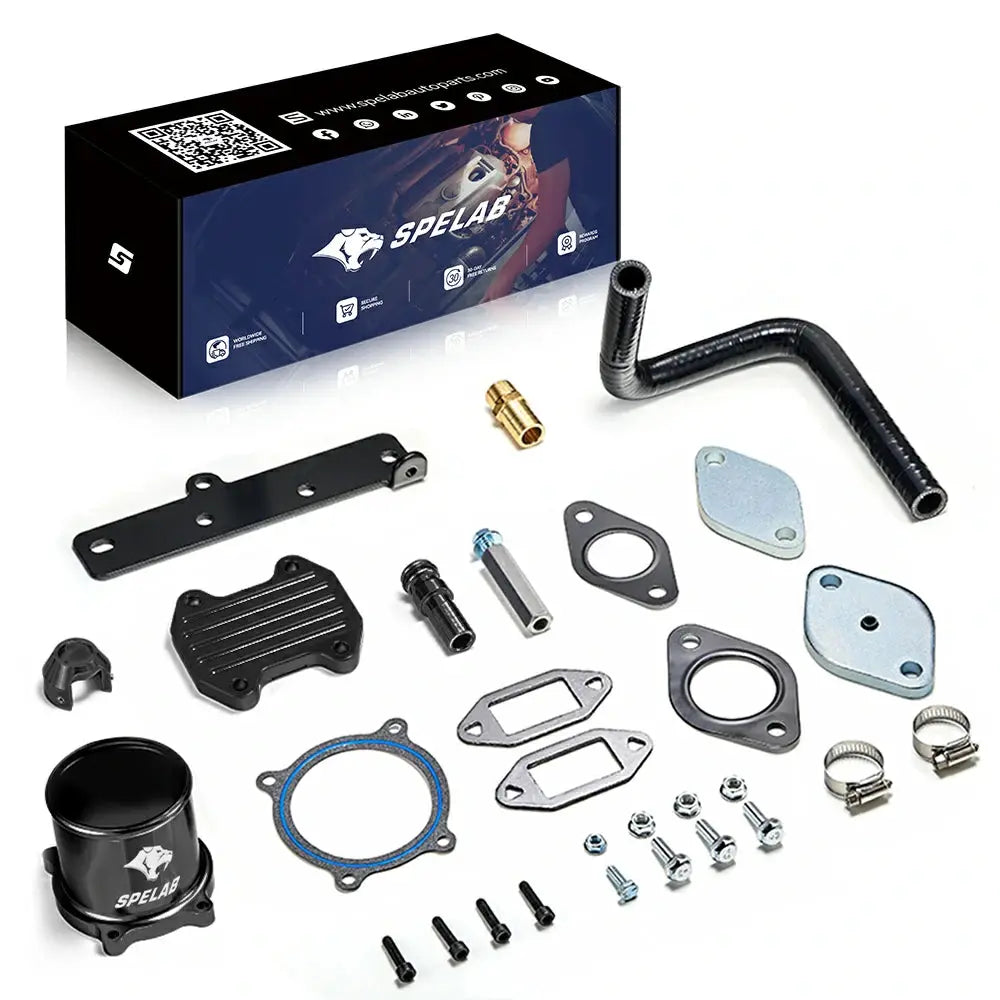
- 2013-2018 Ram 6.7L EGR cooler and throttle valve delete kit: verify cooler layout, throttle hardware, coolant fittings, and chassis.
- 2009-2025 Ram 6.7L EGR delete kit: confirm the live product-page fitment against VIN and original hardware rather than relying on the broad range alone.
- 2007-2025 Ram 6.7L throttle valve delete kit: this addresses intake-control hardware and is not a complete EGR-cooler or coolant-routing solution.
Compare the Dodge Ram diesel EGR delete kits only after confirming that the intended application and use are lawful.
EGR vs. DPF, DEF, and SCR
EGR works in the engine’s air path, while DPF and SCR operate downstream in the exhaust; disabling one system does not repair the others.
| System | Primary job | Typical complaint | Correct diagnostic direction |
|---|---|---|---|
| EGR | Reduce engine-out NOx | Flow code, valve sticking, cooler leak, intake deposits | Airflow data, valve command, cooler and coolant testing |
| DPF | Capture particulate matter | Frequent regen, high differential pressure, ash loading | Pressure sensors, temperature sensors, fuel system, duty cycle, service regen |
| DEF/SCR | Reduce NOx downstream | DEF quality code, dosing fault, NOx-sensor plausibility | Fluid quality, heater, pump, injector, sensors, catalyst efficiency |
Use how downstream soot-control problems differ when a truck’s main complaint is regeneration frequency or exhaust restriction rather than EGR flow.

Towing, Payload, Jobsite, and Weather Considerations
Heavy use makes weak cooling, airflow, wiring, and aftertreatment faults easier to expose, but it does not make emissions removal the correct diagnosis.
Towing and Long Grades
Loaded climbs raise exhaust energy, coolant temperature, boost demand, and transmission load, so use logged data instead of blaming the first emissions-related code.
Watch requested vs. actual boost, rail pressure, coolant temperature, transmission temperature, exhaust pressure, and freeze-frame conditions. A loose charge pipe can create low power and excess soot that later appears as an EGR or DPF complaint.
Jobsite and Extended Idle
Long idle time and low-load operation can increase deposit and regeneration complaints even when the hardware is electrically functional.
Check duty cycle, thermostat operation, engine temperature, idle-management practices, air filter restriction, and DPF service information before replacing major assemblies.
Cold Weather and Short Trips
Cold operation lengthens warm-up and can prevent a truck from completing the conditions needed for normal emissions-system management.
Verify the correct thermostats, coolant concentration, batteries, sensors, and block-heater operation where equipped. Do not mask a cold-running engine with calibration changes.
Frequently Asked Questions
These answers separate legal repair, diagnostic work, and qualified competition planning.
Q: What should I do if an exhaust crossover fastener will not move?
A: Stop before the fastener twists off in the manifold. Verify the service procedure, tool engagement, corrosion, and access; seized or already-stretched hardware may require controlled heat, extraction equipment, or manifold removal by a shop equipped to manage nearby fuel, oil, wiring, and insulation safely.
Q: Can I block the EGR and leave the factory tuning?
A: Blocking flow while the ECM expects operating hardware can create flow codes, warning lights, derate, and incorrect diagnostic behavior. On a street truck, restore the certified hardware and calibration rather than defeating its monitoring.
Q: Does an EGR code prove the cooler is bad?
A: No. Valve deposits, wiring, sensor bias, intake or boost leaks, thermostat behavior, and aftertreatment faults can produce related symptoms. Test the circuit identified by the code and freeze-frame data.
Q: Can EGR removal fix unexplained coolant loss?
A: It may remove a leaking cooler from a qualified nonroad configuration, but coolant can also escape through hoses, fittings, radiator seams, water pump, heater core, oil-cooler circuits, or cylinder sealing. Isolate the source first.
Q: Is the EGR cooler reroute the same as a #6 cylinder coolant bypass?
A: No. Cooler rerouting reconnects the circuit affected by cooler plumbing. A rear-head bypass is a separate system with different ports, flow strategy, and fitment.
Q: Will plates alone add horsepower?
A: No reliable horsepower claim can be assigned to plates alone. Output depends on calibration, turbo control, fuel delivery, airflow, temperatures, transmission protection, and engine condition.
Q: What is the best path for a daily-driven Ram with EGR problems?
A: Read the DTCs and freeze-frame, test wiring and airflow, pressure-test the cooling system cold, confirm the failed component, and restore the emissions-certified configuration with correct year-specific parts.

About the Author
John Lee
Mechanical Engineer | 10+ Years Experience
John has spent the last decade engineering and testing high-performance automotive components. Specializing in drivetrain durability and thermal management across Powerstroke, Cummins, and Duramax applications, he bridges the gap between OEM limitations and aftermarket performance. His philosophy: "Factory parts are just a starting point."





3 comments
Same question as John- Nov 28, 2023
I also have a 2012 Ram 2500. Thank you
Do I need to order a delete kit code reader before I strip my truck