Updated on July 19, 2026.
A DPF delete means removing or replacing the diesel particulate filter hardware and changing the vehicle's control strategy so the truck no longer runs normal DPF monitoring and regeneration logic. On a modern Powerstroke, Cummins, or Duramax, that is not just a pipe swap. It affects exhaust backpressure, EGT behavior, differential pressure sensor logic, soot-load modeling, inspection readiness, warranty exposure, and road-use legality. For a public-road truck, the right first move is diagnosis and compliant repair, not deletion.
Key Takeaways
- DPF delete is a hardware and calibration change that removes the diesel particulate filter from normal aftertreatment operation.
- A DPF traps soot in a wall-flow ceramic substrate and burns it during passive, active, or service regeneration.
- High soot load, ash load, bad pressure data, failed regen, and upstream engine faults can make owners think delete is the only answer.
- Public-road diesel trucks should use compliant diagnosis, cleaning, repair, or replacement because emissions tampering can create legal and inspection risk.
- For legal off-road or competition use, fitment, pipe diameter, ECM/TCM support, SOTF calibration, EGT control, and sensor strategy must be planned as one system.
What Is DPF Delete?
DPF delete is the removal of the diesel particulate filter from the exhaust aftertreatment system, paired with calibration changes so the vehicle does not keep trying to run DPF regeneration and pressure checks.

That definition sounds simple, but the real truck is not simple. The DPF talks to the ECU through differential pressure data, EGT sensors, soot-load estimates, ash-load history, and regeneration status. Remove the filter without a matched system plan and the truck can set codes, enter limp mode, abort regen logic, or run poorly because the computer sees impossible data.
For street-driven trucks, the practical question is not "how do I delete it?" The practical question is "is the DPF actually failed, or is the truck reacting to bad sensors, bad airflow, or incomplete regen?" If you need the full aftertreatment map first, this diesel aftertreatment system layout explains where the DPF sits with the DOC, SCR, DEF, EGR, and sensors.
Legal And Compliance Boundary
DPF delete is not a compliant repair path for emissions-controlled public-road vehicles in the United States.
The EPA states that the Clean Air Act prohibits tampering with emissions controls and manufacturing, selling, or installing aftermarket devices intended to defeat those controls. That is why public-road trucks should be diagnosed and repaired through compliant paths before any non-road hardware conversation starts.
How A DPF Works Before Anyone Talks About Deleting It
A DPF is a wall-flow ceramic soot trap that catches diesel particulate matter and uses heat to burn soot into a smaller ash residue.
Diesel combustion creates tiny carbon particles when fuel and air do not burn perfectly in every pocket of the cylinder. The DPF substrate forces exhaust gas through porous channel walls. Gas moves through; soot gets trapped. Over time, the soot layer becomes its own filter, which is why a loaded but healthy DPF can still filter well while also increasing backpressure.
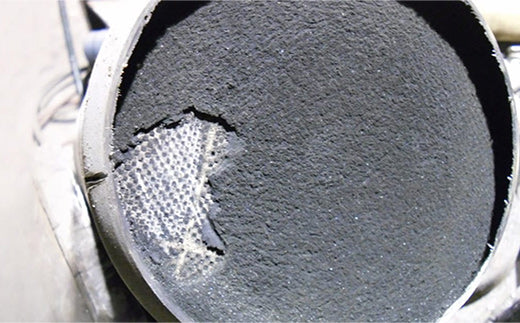
Regeneration is the burn-off cycle. Passive regen happens when towing, highway load, or steady heat keeps exhaust temperature high enough. Active regen happens when the ECU adds heat through fuel strategy and exhaust temperature control. Service regen is commanded with a scan tool when the soot load is recoverable and the shop has confirmed that the filter is not cracked, melted, oil-soaked, or ash-packed.
Why Do Diesel Owners Consider A DPF Delete?
Most owners consider DPF delete after repeated warning lights, failed regen, high backpressure, poor throttle response, or repair quotes that feel bigger than the truck's remaining value.

Real-world pain usually shows up under load. A hot-shot driver pulling a heavy gooseneck up a grade sees EGT climb and throttle response fade. A contractor truck idles cold around a jobsite, never finishes regen, and comes back with the filter light again. A farm truck spends half its life on gravel roads and half its life in short trips, so soot load keeps coming back.
That frustration is real, but it does not prove the DPF is the first failed part. A cracked intercooler boot, lazy thermostat, injector over-fueling, dirty MAP sensor, melted pressure tube, bad EGT probe, or interrupted regen cycle can make the DPF look guilty. Before budgeting parts, use this cost and labor planning guide and include diagnostics, not just hardware.
What Should Be Diagnosed Before DPF Delete?
A DPF delete decision should never be made before checking whether the filter is truly restricted, whether the sensor data is valid, and whether the root cause is upstream.
| Check | What It Tells You | Why It Matters |
|---|---|---|
| DTCs and freeze-frame data | When the fault happened, under what load, and with what temperature data. | Clearing codes first throws away evidence. |
| Soot load and ash load | Whether the filter may be regenerated, cleaned, or physically near the end of service life. | Soot can burn; ash does not burn away. |
| DPF differential pressure | Whether exhaust restriction is actually high at idle, snap throttle, or loaded acceleration. | A flat 0 psi under load can mean hose or sensor trouble, not a clean filter. |
| EGT sensor data | Whether regen can reach and hold the needed temperature window. | Bad temperature data can abort regen. |
| Boost, MAF/MAP, and intake leaks | Whether the engine is getting enough clean air under load. | Low air or bad readings create soot and failed regen conditions. |
| Injectors, thermostat, turbo control, and oil consumption | Whether the truck is making excess soot or running too cool. | Replacing exhaust parts will not fix a dirty-burning engine. |
As a rough field reference, and it varies by engine, sensor scaling, scan tool, temperature, and test setup, a healthy DPF is often under 0.2 to 0.5 psi at hot idle. During hard acceleration or a loaded uphill pull, pressure should rise smoothly and often stays below about 1.5 to 2.5 psi on a clean system. Under heavy load, readings above 3.5 to 4.0+ psi can point toward serious restriction, while a reading that stays at 0 psi no matter how throttle and load change can point toward a melted, cracked, plugged, or disconnected pressure hose, or a sensor/wiring problem.
Clean, Replace, Or Delete: Decision Guide
The right repair path depends on whether the truck is street-driven, whether the DPF is soot-loaded or ash-loaded, and whether the filter is physically damaged.
| Situation | Better First Move | Shop-Floor Reason |
|---|---|---|
| Moderate soot load, valid sensors, no substrate damage | Service regen or professional cleaning | The filter may be recoverable if the upstream cause is fixed. |
| High ash load on a high-mileage truck | Professional cleaning or replacement | Ash is mineral residue and cannot be burned away by regen. |
| Cracked, melted, oil-soaked, or collapsed substrate | Replacement or a legal-use system plan | A damaged filter is not a cleaning candidate. |
| Public-road daily driver | Compliant repair path | Inspection, registration, warranty, and emissions laws matter. |
| Legally permitted off-road or competition build | Complete hardware and calibration plan | Pipe, sensors, tune, EGT, transmission, and use case must match. |
If you are still on the fence, this emissions decision guide helps separate a real non-road build plan from a repair problem that should be diagnosed first.
Hardware And Calibration: Why A DPF Delete Is Not Just A Pipe
Modern diesel trucks need the exhaust hardware, sensors, ECM/TCM strategy, and calibration to agree with each other.
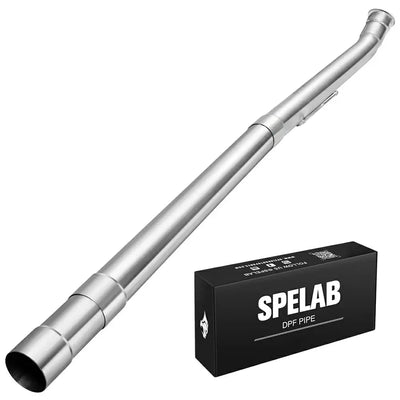
A DPF delete pipe changes the physical exhaust path and removes a major restriction, but the ECU still expects pressure drop, EGT behavior, soot-load modeling, and regen status to make sense. Some older platforms may be easier to support. Some late-model platforms may involve encrypted or locked controllers, security gateways, ECM unlocks, bench flashing, controller-specific calibration, SOTF files, and TCM support. Verify by VIN, controller family, ECM strategy, model year, and legal-use status before parts are ordered.
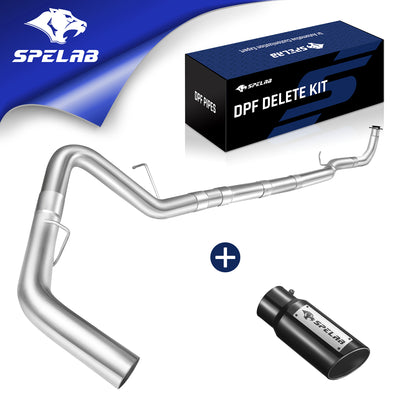
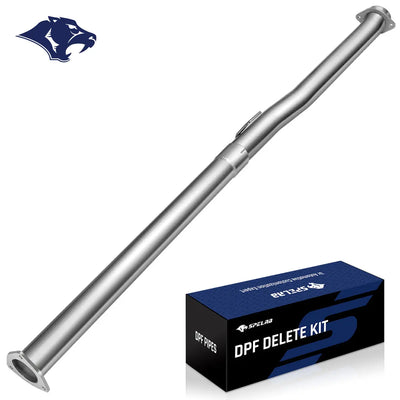
For legal off-road or competition projects, owners commonly compare DPF Delete Kits by platform. The hard part is not clicking the category; the hard part is making sure the build has the correct pipe section, clamps, hanger layout, EGT control, smoke control, torque management, and calibration support.
Powerstroke, Cummins, And Duramax Fitment Notes
Ford, Ram, and GM diesel trucks need platform-specific parts because pipe routing, sensor locations, DEF/SCR layout, cab and bed combinations, and chassis styles vary.
A Ford Super Duty owner may compare a 2011-2024 Ford 6.7 Powerstroke DPF delete race pipe, but still needs to verify year split, cab, bed, downpipe-back section, and controller support. A Ram owner looking at a 2013-2018 Dodge Ram 6.7 Cummins DPF delete race pipe should confirm pickup vs cab-and-chassis layout and towing use. A GM owner choosing a 2011-2016 LML 6.6 Duramax DPF delete race pipe should confirm LML year range, sensor strategy, DEF/SCR layout, and exhaust section.
Pipe Size, Sound, Towing, And Real Use
Pipe size should follow the truck's job, not the loudest comment in a forum thread.
A 4 inch pipe is usually the cleaner choice for daily driving, towing, jobsite use, and lower drone. A 5 inch pipe is more about deeper sound and aggressive off-road presence, and it needs more clearance around the frame, spare tire, axle, crossmembers, heat shields, and lines. A 5 inch straight setup can drone hard around highway cruise RPM, especially on crew cab long-bed tow rigs.
For a hot-shot driver pulling a heavy trailer, the priority is EGT control, clean torque management, transmission behavior, and reliable fitment. For a weekend off-road truck, the owner may accept more sound and tighter packaging. Either way, bolt-on should still mean bolt-on: correct clamps, hangers, sensor bungs, pipe length, and safe clearance.
What DPF Delete Can And Cannot Fix
A DPF delete can reduce exhaust restriction in a legal-use non-road build, but it cannot repair a dirty-burning engine, poor calibration, weak turbo control, injector problems, or bad sensor data.
Dry EGR soot mixed with CCV oil vapor can turn into black peanut butter inside the intake manifold, intake horn, Y-bridge, or MAP sensor pocket. That tar-like sludge can distort boost and load readings, cause lazy throttle response, smoke under payload, aborted regen, or premature soot loading. If the truck smokes heavily, builds soot too fast, or aborts regen, the smart mechanic checks the engine and sensors before blaming the DPF alone.
We as parts manufacturers see the same pattern in real conversations: an owner wants a race pipe because the dash says "exhaust filter full," but the truck has been short-tripped, idled cold, run with a boost leak, or fed bad pressure data for months. That is not a pipe-size problem. That is a diagnosis problem.
FAQ
Q: What is DPF delete in simple terms?
A: DPF delete means removing or replacing the diesel particulate filter hardware and changing the control strategy so the truck no longer runs normal DPF monitoring and regeneration logic.
Q: Is DPF delete legal for a street truck?
A: Removing or disabling required emissions equipment on public-road vehicles creates legal and inspection risk in the United States. Street-driven trucks should use compliant diagnosis, cleaning, repair, or replacement.
Q: Does DPF delete increase horsepower?
A: Removing exhaust restriction can reduce backpressure in a legal-use non-road build, but big power changes usually come from calibration, fueling, turbo, and transmission strategy. A pipe alone is not a full performance plan.
Q: Can I install a DPF delete pipe without buying a tuner or changing the tune?
A: That is not a sound diagnostic path. Modern ECM logic still checks differential pressure, EGT behavior, soot-load model, regen state, and NOx/DEF/SCR/EGR plausibility. A pipe that does not match factory calibration may trigger codes, derate, limp strategy, smoke, or drivability problems. Diagnose the truck and verify legal-use limits before buying parts.
Q: Can a clogged DPF be cleaned instead of deleted?
A: Yes, if the filter is soot-loaded and not cracked, melted, oil-soaked, or ash-loaded beyond service limits. Professional cleaning or service regen may work after the upstream fault is repaired.
Q: What should I check before replacing or deleting a DPF?
A: Check DTCs, freeze-frame data, soot load, ash load, differential pressure, EGT sensors, NOx sensors, pressure tubes, MAF/MAP data, boost leaks, injectors, thermostat operation, turbo control, and regen history.
Q: Do all trucks need the same DPF delete kit?
A: No. Fitment depends on make, model, engine, year range, cab, bed, chassis style, exhaust section, sensor layout, pipe diameter, and controller support. A Powerstroke pipe, Cummins pipe, and Duramax pipe are not interchangeable.

About the Author
John Lee
Mechanical Engineer | 10+ Years Experience
John has spent the last decade engineering and testing high-performance automotive components. Specializing in drivetrain durability and thermal management across Powerstroke, Cummins, and Duramax applications, he bridges the gap between OEM limitations and aftermarket performance. His philosophy: "Factory parts are just a starting point."