Updated on August 10, 2026.
This page is a direct-fit air intake catalog and installation-validation map. Use it to match a kit by vehicle family, engine, model-year boundary, sensor layout, tube connections, filter package, and heat-shield space. A product title or box graphic is not enough Fitment evidence.
For the separate question of whether a cold air intake can reduce restriction or add measurable power, use the dedicated truck performance analysis later in this guide. Here, the priority is ordering the correct hardware and proving that the MAF/IAT data, seals, and drivability remain correct after installation.
How to Use This Direct-Fit Intake Catalog
| Fitment gate | Useful evidence | What is not proof |
|---|---|---|
| Vehicle identity | VIN-confirmed model year, model, engine code, chassis type, and original intake layout | A shared engine badge or broad product-title year range |
| Sensor compatibility | Correct MAF/IAT flange, bore, insertion depth, orientation, connector, and harness reach | A sensor-shaped opening in the tube |
| Physical package | Matching couplers, breather ports, clamps, brackets, filter dimensions, and shield mounting points | "Bolt-on" without an included-parts diagram |
| Installed clearance | No contact with the hood, fan, belt, battery, coolant hose, wiring, or body through engine movement | A clean fit in a product photo from another configuration |
| Post-install validation | Stable scan data, no unmetered air, no dust track, and no new DTC after the same baseline route | No warning light during the first idle check |
Intake Pipe, Cold Air Intake, Intake Horn, and Intercooler Pipe
These parts are often grouped under "intake," but they do different jobs. Ordering the wrong one can leave the original restriction in place or create a new leak.
| Part | Location and job | Common buying mistake |
|---|---|---|
| Cold air intake kit | Usually includes a filter, inlet tube, couplers, clamps, and sometimes a heat shield before the throttle body or turbo inlet | Assuming an exposed filter always receives colder air |
| Intake pipe or inlet tube | Connects the filter or airbox to the throttle body or compressor inlet | Ignoring MAF/IAT ports, CCV connections, resonators, and diameter transitions |
| Intake horn or manifold | Distributes pressurized air from the charge-air path into the engine | Buying a manifold part to fix a pre-turbo filter restriction |
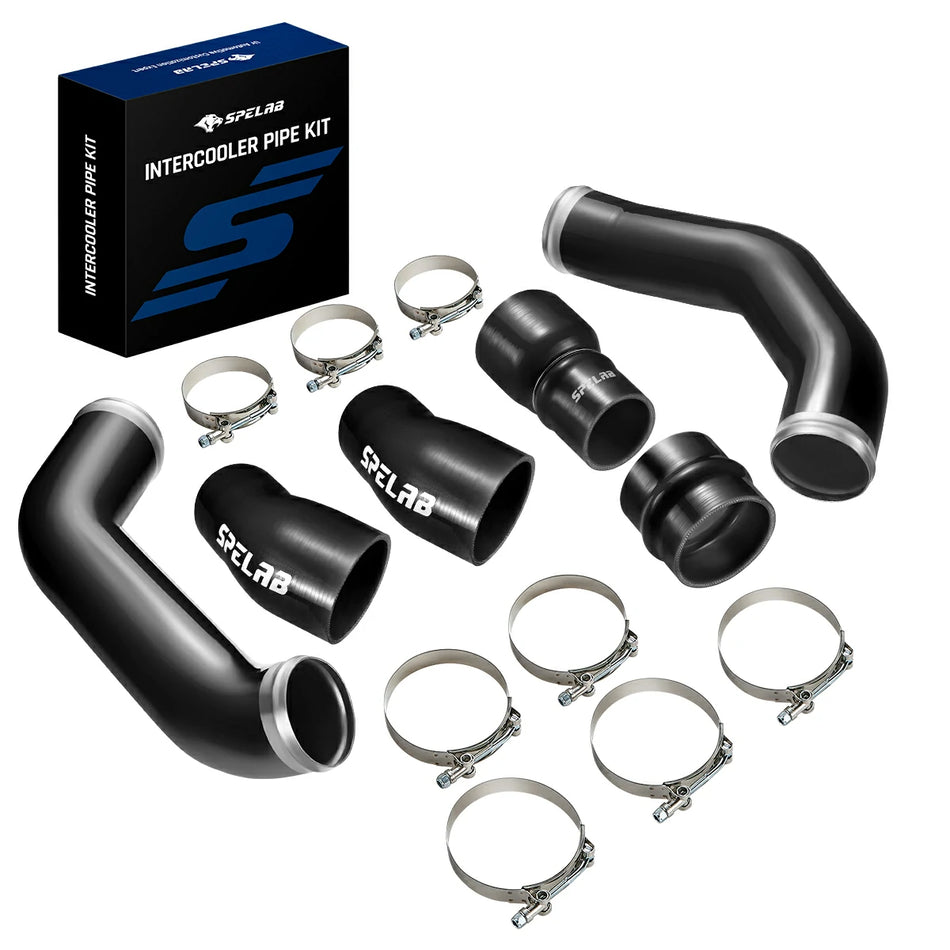
| Intercooler or charge pipe | Carries compressed air between the turbocharger, intercooler, and intake manifold | Calling a boost leak an air-filter problem |
Use the real-world truck intake gains and limits for the broader performance decision. This catalog page stays focused on component identity, vehicle matching, and installation verification.
Fitment Gate 1: Tube Area, Transitions, and Inlet Temperature
Round-pipe area is calculated as pi times the radius squared. A larger internal diameter can reduce velocity and pressure loss in part of the operating range, but the complete system still includes the filter, bends, transitions, sensor housing, turbo inlet, throttle body, and engine demand. A big tube with a sharp reducer or undersized filter can flow worse than a smaller, smoother system.
Air temperature matters because cooler air is denser at the same pressure, but the filter location and duct sealing matter more than whether the tube feels cool in the garage. An aluminum tube can absorb underhood heat during idle, while airflow during road load changes the result. Log intake-air temperature against ambient temperature during the same route instead of judging by touch.
Do not accept a universal percentage gain without the baseline vehicle, correction method, fuel, tune, tire setup, transmission gear, ambient conditions, and complete dyno graph. For a stock diesel truck, the most defensible benefits may be serviceability, sound, reduced measured restriction, and steadier airflow under load rather than a dramatic peak-power number. The separate cold air intake horsepower measurement guide explains how to judge gain claims.
Fitment Gate 2: MAF Geometry and Calibration
A mass-airflow sensor does not simply need a hole in the pipe. Its reading depends on housing cross-section, sensor depth, orientation, upstream bends, turbulence, and air leaks after the sensor. Moving the sensor into a different-diameter tube can change the relationship between actual airflow and the voltage or frequency reported to the ECU.
- Match the housing geometry: Compare the new sensor bore, mounting depth, clocking, and flow direction with the original system.
- Keep the sealing surface flat: A pinched O-ring or warped flange can allow unmetered air.
- Protect the element: Do not touch the sensing wire or film, and do not spray it with general-purpose solvent.
- Control filter oil: If the filter requires oil, use the specified amount and drying procedure. Excess oil can contaminate a nearby sensor.
- Support the harness: Wiring should not be stretched across a Rigid tube or left against a hot, vibrating edge.
Fitment Gate 3: Filter Package and Heat Shield
| Design | Best use | Maintenance and risk |
|---|---|---|
| Dry synthetic or paper-style media | Daily driving, warranty-sensitive use, and owners who want simple service | Replace or clean only as specified; compressed air can damage some media |
| Washable cotton-gauze media | Owners prepared to clean, dry, and service the filter correctly | Confirm whether oil is required; over-oiling and incomplete drying can create problems |
| Open cone with partial shield | Street builds where induction sound and service access are priorities | Can ingest warmer underhood air at idle and needs careful sealing against splash paths |
| Enclosed or well-sealed airbox | Towing, dusty roads, Jobsite use, and extreme weather | Check drain paths, lid seals, inlet restriction, and replacement-filter availability |
| Prefilter or water-resistant cover | Fine dust, snow, and occasional splash exposure when approved for the filter | Can add restriction as it loads; it does not make the intake safe for deep water |
Off-roading through water requires more than a cone-filter cover. Know the inlet height and never enter water deep enough to submerge or directly splash the filter. A turbocharger can pull water through the intake quickly, and liquid entering a cylinder can bend connecting rods. In heavy snow or freezing rain, inspect the inlet and restriction indicator instead of assuming a washable filter cannot plug.
Three Direct-Fit Catalog Examples Across Platforms
These active listings cover an early Duramax truck, a HEMI passenger-car family, and a later Power Stroke truck. That platform spread is intentional: this page is a vehicle-fitment catalog, not a second diesel-only intake buyer guide. The links establish catalog Fitment only. They do not prove a horsepower percentage, tuning requirement, emissions approval, or suitability for every aftermarket engine-bay configuration.
2001-2004 Chevrolet/GMC 6.6L LB7 Duramax

The 2001-2004 LB7 Duramax cold air intake kit is listed for Chevrolet Silverado and GMC Sierra 2500HD/3500 trucks with the 6.6L diesel, including manual and automatic transmission applications. Verify the actual model year from the VIN because the 2004 LLY transition makes an engine-code check more reliable than the registration year alone.
2005-2010 Dodge and Chrysler HEMI Applications

The Dodge and Chrysler HEMI cold air intake kit listing breaks Fitment down as 2005-2008 Dodge Magnum, 2006-2010 Dodge Charger, 2008-2010 Dodge Challenger, and 2006-2010 Chrysler 300 V8 SRT8 applications. Do not apply the broad title range to every model. Verify the 5.7L or 6.1L engine, throttle-body connection, shield mounting points, and available hood clearance.
2017-2019 Ford 6.7L Power Stroke

The 2017-2019 Ford 6.7L Power Stroke intake kit is listed for F-250, F-350, F-450, and F-550 applications. Verify pickup versus cab-and-chassis packaging, MAF connector reach, heat-shield mounting points, hood clearance, and the complete included-parts photo. A product box graphic is not a substitute for a VIN and parts-layout check.
Other verified applications are available in the vehicle-specific air intake kit collection.
Listing Data Conflicts to Resolve Before Ordering
A direct-fit catalog is only useful when its fields agree. Check the product title, detailed Fitment tab, images, sensor ports, installation diagram, and material specification against one another. If two fields conflict, pause the order and ask for a part-number-level answer.
| Conflict | Why it matters | Required verification |
|---|---|---|
| Broad title range versus model-specific years | A 2005-2010 headline does not mean every listed model fits every year in that span | Use the detailed model/year table and VIN |
| Packaging graphic versus product application | Boxes and lifestyle images can be reused across SKUs | Use the part number, tube shape, ports, shield, and included-parts image |
| "Black powder-coated aluminum alloy" versus "T-304 aluminum" | T304 is a stainless-steel designation, not an aluminum grade | Ask for the actual alloy, wall thickness, coating, and manufacturing specification |
| Universal power percentage without a test sheet | Different engines, baselines, tunes, and conditions cannot share one defensible gain | Request the same-vehicle dyno graph and complete test conditions |
Duty-Cycle Validation After Fitment
| Use case | Priority checks | Common wrong assumption |
|---|---|---|
| Towing and long grades | Restriction under load, IAT versus ambient, filter seal, turbo-inlet stability, and repeatable scan data | A louder intake automatically adds towing torque |
| Heavy Payload or slide-in camper | Cooling-stack cleanliness, underhood temperature, wiring support, and service access with added equipment | An intake changes GVWR, GAWR, or Payload rating |
| Off-roading | Dust filtration, water path, filter support, coupler movement, and post-trail inspection | A prefilter makes deep-water crossings safe |
| Jobsite and farm roads | Shorter inspection intervals, downstream dust tracks, filter loading, and shield fasteners | A washable filter can be ignored until power drops |
| Extreme cold and snow | Snow ingestion, ice at the inlet, restriction-gauge behavior, and wet-filter recovery | An open cone cannot plug with snow |
| Daily gasoline performance car | Heat soak at traffic lights, fuel trims, MAF scaling, idle quality, and induction sound | A diesel-truck intake strategy transfers directly to a naturally aspirated V6 or HEMI |
The diesel snow-ingestion case study shows why winter inlet location and restriction checks matter as much as peak airflow.
Symptoms and Diagnostic Codes After Intake Work
| Symptom or code | What to inspect first | Do not assume |
|---|---|---|
| P0101 | MAF plausibility, housing diameter, sensor orientation, filter contamination, intake leaks, and boost leaks | The MAF sensor itself has failed |
| P0102 or P0103 | Connector lock, bent pins, harness tension, power, ground, signal, and sensor contamination | The new filter flows too much air |
| P0111, P0112, or P0113 | IAT sensor connection, port location, wiring, and temperature plausibility after a cold soak | Hot weather alone caused the code |
| Rough idle or stalling | Unmetered air, loose couplers, pinched seals, incorrect sensor depth, and disconnected breather lines | The ECU only needs more time to learn |
| Black smoke or frequent diesel regeneration complaints | Airflow data, filter restriction, boost leaks, EGR operation, fuel delivery, exhaust pressure, and aftertreatment sensors | The intake kit is the only possible cause |
| Whistle, hiss, or rubbing noise | Coupler sealing, clamp position, tube-to-body contact, filter support, and turbo-inlet connection | Every new sound is normal induction noise |
Installation and Baseline Test Procedure
The three listings do not publish a part-number-specific clamp or sensor-screw torque table. Do not invent one generic range: worm clamps, T-bolt clamps, small sensor screws, rubber couplers, and metal brackets have different limits. Use the kit instructions or obtain the hardware manufacturer's value before final tightening.
- Scan the vehicle first. Save active, pending, and permanent codes plus idle MAF, IAT, ambient temperature, fuel trims where applicable, and diesel restriction data.
- Inspect the original system. Find cracked ducts, loose clamps, dust tracks, oil contamination, collapsed media, damaged resonators, and worn mounts before blaming restriction.
- Inventory the new kit. Confirm the pipe, filter, shield, couplers, clamps, sensor hardware, breather fittings, extensions, and installation instructions.
- Protect the open inlet. Keep tools, hardware, dirt, and shop towels away from the throttle body or turbo compressor.
- Transfer sensors carefully. Match orientation and depth, use the correct seal, and support the harness without tension.
- Dry-fit before tightening. Set hood, fan, belt, battery, coolant hose, wiring, and body clearance before applying final clamp torque.
- Use specified torque. There is no universal value for every worm clamp, T-bolt clamp, sensor screw, or bracket. Follow the kit and vehicle service information.
- Start and inspect. Check idle, leaks, rubbing, sensor data, and codes before a road test.
- Repeat the baseline route. Compare data under the same load and ambient conditions. Recheck clamps and dust tracks after the first heat cycle and towing trip.
Does a Direct-Fit Intake Require a Tune?
Some direct-fit systems can operate with the stock calibration when they preserve sensor geometry and airflow behavior. Others may create fuel-trim, MAF-plausibility, or drivability problems if the housing diameter or sensor location changes. "Bolt-on" describes installation, not calibration compatibility.
Do not use tuning to hide an intake leak or disable a diagnostic code. Fix the mechanical and sensor issue first. If a manufacturer says calibration is required, ask for the supported model years, engine and ECU strategy, emissions documentation, and the exact reason the stock calibration is not compatible.
Official Maintenance References
- 2017 Ford Super Duty owner's manual: 6.7L diesel air-filter replacement and factory service guidance.
- 2010 Ram diesel owner's manual supplement: factory air-cleaner inspection and replacement guidance.
FAQ
Q: How much horsepower will a cold air intake add?
A: There is no defensible universal number. Engine platform, baseline restriction, filter, tube geometry, calibration, ambient conditions, and test method all matter. Ask for a complete same-vehicle dyno graph rather than a percentage without test details.
Q: Does a cold air intake improve diesel towing power?
A: It can help if the original system shows measurable restriction under load, but it does not change tow rating, GVWR, GAWR, Payload, cooling capacity, or transmission limits. Diagnose the whole truck before treating the intake as the bottleneck.
Q: Will a Bolt-on intake work without tuning?
A: Sometimes, but not always. A system that preserves MAF/IAT geometry and seals correctly may work with the stock calibration. A different sensor housing or airflow pattern can require application-specific validation or calibration.
Q: Is a washable filter better than a disposable filter?
A: Not for every owner. A washable filter can reduce replacement frequency, but it requires correct cleaning, complete drying, and possibly precise re-oiling. Dry media can be the safer choice for owners who want simpler service or work in heavy dust.
Q: Why did P0101 appear after installing an intake?
A: Check sensor orientation, housing diameter, connector seating, unmetered-air leaks, filter contamination, boost leaks, and the intake calibration before replacing the MAF sensor.
Q: Can an open cone filter handle rain, snow, and Off-roading?
A: Only within the limits of its location and shielding. Direct splash, packed snow, fine dust, or deep water can restrict or damage the intake. Inspect it after severe weather and never submerge the filter.
Q: What is wrong with the term "T-304 aluminum"?
A: T304 identifies a stainless-steel grade, not an aluminum grade. Ask the seller for the actual alloy and specification before using material claims to compare durability or heat behavior.
About the Author
John Lee, Mechanical Engineer | More Than a Decade of Experience
John Lee writes practical diesel and performance intake guides built around Fitment, scan data, filtration, sensor geometry, and real garage inspection. His rule is simple: measure the restriction, protect the engine, and do not call a louder Mod a proven power gain.