
Updated: May 18, 2026
A 6.7 Cummins EGR delete kit cost is not just the price of the plates, plugs, and coolant hose. The real cost includes the kit itself, labor, coolant, gaskets, possible tuning, downtime, diagnostic work, inspection risk, warranty impact, resale issues, and the chance that another emissions or intake problem is being misdiagnosed as an EGR problem.
Quick answer: A basic 6.7 Cummins EGR delete kit may cost a few hundred dollars in parts, while the full installed cost can be much higher after labor, coolant, gaskets, tuning, and supporting diagnostics are included. However, deleting EGR on a public-road diesel truck in the United States can violate the Clean Air Act, fail inspection, affect warranty coverage, and create resale problems.[1] For most street-driven Ram 2500/3500 trucks, diagnose the EGR fault first and compare legal repair, cleaning, CCV oil-vapor control, and maintenance options before buying delete hardware.
This guide breaks down 6.7 Cummins EGR delete kit costs, labor variables, tuning costs, hidden expenses, common failure points, legal risks, and practical alternatives for Dodge Ram Cummins owners.
Legal Reality Before Pricing an EGR Delete
Before discussing parts and labor, the most important cost is compliance risk. On public-road vehicles in the United States, removing, disabling, bypassing, or tuning out emissions-control equipment can violate the Clean Air Act. This may include EGR, DPF, DEF/SCR, catalytic converters, emissions sensors, and software calibrations designed to defeat those systems.[1]
A 6.7 Cummins EGR delete may create:
- Failed emissions inspection
- Failed visual inspection
- Failed OBD readiness checks
- Check engine lights or limp mode if tuning is incorrect
- Warranty denial
- Registration or resale problems
- Return-to-stock costs
- Potential fines or enforcement risk
- Higher NOx emissions because EGR is designed to reduce combustion temperature
This article is for technical education and cost planning. Always confirm federal, state, provincial, and local rules before modifying emissions-related hardware or calibration.
What Is a 6.7 Cummins EGR Delete Kit?
An EGR delete kit removes, blocks, or bypasses parts of the Exhaust Gas Recirculation system. On a Dodge Ram 6.7L Cummins, the kit may include block-off plates, coolant reroute parts, throttle valve delete parts, gaskets, plugs, hose, clamps, and hardware depending on model year and kit design.
The EGR system routes a controlled amount of exhaust gas back into the intake to lower combustion temperature and reduce NOx emissions. Over time, that system can contribute to soot buildup, EGR valve sticking, cooler leaks, coolant loss, and intake sludge—especially when oil vapor from the crankcase ventilation system mixes with dry EGR soot.
For fitment research, start with the 6.7 Cummins EGR delete kit collection, but confirm your vehicle year, intended use, emissions rules, and tuning requirements before purchasing.
Typical 6.7 Cummins EGR Delete Kit Cost
The part cost depends on model year, included components, material quality, and whether the kit is a simple plate kit or a more complete cooler/throttle valve delete package.
| Cost Item | Typical Range | What It Includes |
|---|---|---|
| Basic EGR delete plate kit | Low hundreds | Block-off plates, gaskets, plugs, and basic hardware |
| Cooler / throttle valve delete kit | Mid hundreds | Coolant reroute parts, throttle valve delete parts, hose, clamps, fittings |
| Professional labor | Several hundred to over $1,000+ | Depends on shop rate, rust, access, coolant work, and model year |
| Tuning / calibration | Varies widely | May be required to prevent codes or limp mode; legal use must be confirmed |
| Fluids and extras | Low to mid hundreds | Coolant, gaskets, clamps, sensors, shop supplies, diagnostic time |
A simple parts-only estimate can be misleading. The real-world cost is usually the total installed cost plus legal and ownership risk.
Why the Cost Varies So Much
Not every 6.7 Cummins EGR delete job is the same. Model year, emissions layout, corrosion, labor access, tuning needs, and related repairs can change the price significantly.
1. Model Year and Fitment
2007.5–2009, 2010–2012, 2013–2018, and 2019+ trucks can use different emissions layouts, sensors, coolant routing, and throttle valve configurations. A kit for one year range may not fit another.
2. Cooler Removal vs. Block-Off Only
Some kits focus on blocking the EGR path. Others remove the cooler and reroute coolant. Cooler removal can add time because coolant must be drained, hoses must be routed correctly, and leaks must be checked after the engine heat cycles.
3. Tuning and Diagnostic Work
Modern diesel ECMs monitor EGR flow, throttle valve behavior, intake airflow, exhaust temperature, and emissions readiness. If hardware is removed without a correct calibration strategy, the truck may set codes, derate, or run poorly.
For emissions-related calibration research, compare the diesel tuner collection, but confirm legal use case before applying any emissions-related tune.
4. Fuel System Stability on Tuned Trucks
EGR delete hardware itself does not require a fuel tank sump. But if the truck is also receiving a high-power tune, larger injectors, upgraded turbo, or heavy-towing calibration, fuel delivery stability becomes much more important.
On 2019–2020 Ram 6.7 Cummins trucks equipped with the CP4.2 pump, fuel-system health is especially sensitive. On other 6.7 Cummins years, CP3 or related high-pressure pump systems are generally more forgiving, but air ingestion, suction starvation, dirty fuel, and aggressive rail-pressure tuning can still shorten component life.
For high-horsepower or heavy-towing builds, a billet aluminum fuel tank sump kit can help improve low-tank pickup consistency by feeding from the lower point of the tank. It should be treated as a fuel-system support upgrade, not as a required part of every EGR delete.
Product Reference: 2013–2018 Ram 6.7 Cummins EGR Plate Cooler and Throttle Valve Delete Kit
The original article referenced the SPELAB 2013–2018 Dodge Ram 6.7L Cummins EGR plate cooler and throttle valve delete kit. It is still relevant as a fitment-specific product example, but it should not be presented as a universal street-use recommendation.
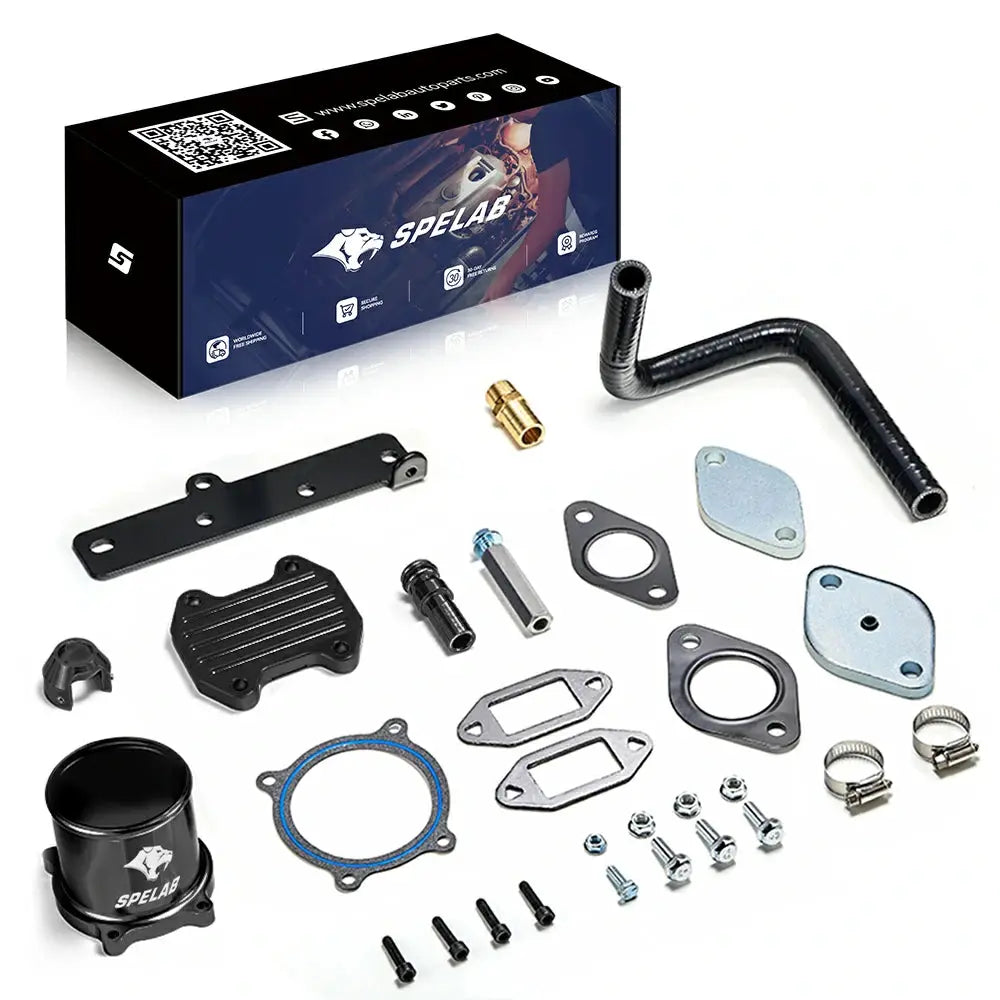
SPELAB 2013–2018 Dodge Ram 6.7L Cummins EGR Plate Cooler & Throttle Valve Delete Kit
Fitment: 2013–2018 Dodge Ram 2500 / 3500 6.7L Cummins Diesel.
This kit is relevant for owners researching off-road-use EGR hardware for specific 2013–2018 6.7 Cummins configurations. Confirm fitment, intended use, local laws, tuning requirements, and emissions compliance before purchase or installation.
View 2013–2018 Cummins KitEGR Delete vs. EGR Cleaning vs. EGR Repair Cost
Many owners look at delete kits because dealership repair quotes can be expensive. But before choosing deletion, compare the actual problem and the legal alternatives.
| Option | Typical Cost Pattern | Best For | Main Risk |
|---|---|---|---|
| EGR cleaning | Lower to moderate | Soot buildup without failed hard parts | May not solve cooler leaks or failed sensors |
| EGR valve replacement | Moderate | Sticking valve, flow codes, actuator issues | Root cause may be oil/soot contamination |
| EGR cooler replacement | Higher | Coolant loss, white smoke, internal cooler leak | Labor-intensive and model-year dependent |
| EGR delete | Parts may be modest; installed cost varies | Off-road or non-road use where legally allowed | Street-use legal risk, tuning risk, inspection failure |
| Oil vapor reduction | Moderate | Reducing oil mist that turns soot into sludge | Must be installed correctly and legally |
If the truck is a daily driver, a legal repair or maintenance path is usually the safer first step. For oil vapor control that may reduce intake sludge formation, compare the Cummins oil catch can collection.
Why Owners Consider EGR Delete on a 6.7 Cummins
The common frustrations are real. The 6.7 Cummins EGR system can become a maintenance pain point as trucks age, tow heavy, idle often, or operate in stop-and-go conditions.
Common reasons owners research EGR delete include:
- EGR valve sticking or clogging
- EGR cooler leaks
- Coolant loss or white smoke
- Intake horn and manifold sludge
- Repeated EGR flow codes
- Throttle valve contamination
- High repair quotes
- Off-road or competition-only build planning
But deleting EGR is not always the correct first diagnosis. Soot buildup may be made worse by oil vapor from the CCV system, failed sensors, poor drive cycle, turbo control issues, boost leaks, thermostat problems, or DPF regeneration issues.
The Intake Restriction Problem: EGR Soot, CCV Oil, and Pressure Drop
On a 6.7 Cummins, the real-world restriction is often not one single part. It is the combination of dry EGR soot, CCV oil vapor, grid heater restriction, throttle valve contamination, and intake horn geometry. When oil vapor acts as the sticky binder, soot can build into a thick sludge that narrows the air path.
A simple way to describe the intake-side pressure relationship is:
ΔP = Pboost - Pplenum
When the intake throat, grid heater area, EGR inlet, or plenum becomes restricted by soot sludge, the turbocharger may need to work harder to maintain the same manifold pressure. That can increase thermal load, delay throttle response, raise EGT under load, and complicate DPF regeneration behavior. This does not mean every truck needs an EGR delete. It means the intake and emissions system should be diagnosed as one connected airflow system.
The EGR + DPF Relationship
Many owners ask about EGR and DPF together because these systems interact through the engine’s emissions strategy. The EGR system reduces NOx by lowering combustion temperature. The DPF captures soot and burns it during regeneration. Removing one system while leaving the other can create unexpected problems if the calibration is not designed for that configuration.
For example, deleting EGR while keeping the DPF may alter airflow, exhaust temperature, soot-load calculation, and regeneration behavior. That is why “EGR-only delete” is not always a simple or safe shortcut.
For deeper context, read what happens when EGR is deleted without deleting DPF.
How Much Labor Does a 6.7 Cummins EGR Delete Take?
Labor time varies by year range and shop process, but the job is not just “bolt on a plate.” It can involve coolant draining, intake disassembly, EGR cooler removal, throttle valve work, hose routing, gasket surfaces, sensor management, and post-install leak checks.
Labor cost depends on:
- Shop hourly rate
- Model year and emissions layout
- Rust or broken hardware
- Whether the cooler is removed
- Whether coolant hoses are replaced
- Whether intake cleaning is performed
- Whether tuning or diagnostics are included
- Whether boost leaks or related faults are found
For installation documents and general product instructions, use the SPELAB installation instructions page.
Installation Overview: What the Job Usually Involves
This is not a replacement for the product manual, but it helps explain why labor cost varies. A typical EGR delete or cooler delete job may include:
- Disconnect both batteries.
- Allow the engine to cool completely.
- Drain coolant as needed.
- Remove intake components for access.
- Remove or loosen related charge-air and coolant plumbing.
- Disconnect EGR-related wiring and sensors as required.
- Remove EGR pipes, valves, cooler parts, or throttle valve parts depending on kit design.
- Clean gasket surfaces carefully.
- Install block-off plates, plugs, hoses, clamps, and gaskets.
- Route coolant lines without kinks or heat exposure.
- Refill and bleed coolant.
- Check for coolant leaks, exhaust leaks, and boost leaks.
- Scan for codes and verify operating temperature.

Do EGR Delete Kits Add Horsepower?
An EGR delete kit by itself should not be described as a guaranteed horsepower part. Removing EGR hardware may reduce intake contamination and eliminate one restriction path, but most noticeable power changes come from tuning, fueling, airflow, turbo behavior, exhaust restriction, and engine condition.
On a stock or near-stock truck, the honest claim is:
- Throttle response may feel cleaner if the old EGR system was causing drivability problems.
- Intake contamination may be reduced when exhaust soot is no longer routed back into the intake.
- Power gains are not guaranteed without tuning and supporting hardware.
- Poor tuning can create high EGT, transmission stress, fuel-system stress, and reliability problems.
For broader platform-specific parts, browse Dodge Cummins parts.
Does EGR Delete Improve Fuel Economy?
Some owners report better fuel economy after deleting emissions systems, but it should not be treated as guaranteed. MPG depends on tuning, tire size, gearing, load, route, driving style, regeneration history, engine health, and whether the truck had an actual EGR-related restriction or fault before the modification.
For SEO and user trust, avoid promising fixed MPG gains. A more accurate statement is: fuel economy may change, but results vary widely and the legal risk can outweigh the savings for street-driven trucks.
Hidden Costs Most Owners Forget
The kit price is only one part of the decision. These hidden costs often matter more:
| Hidden Cost | Why It Matters |
|---|---|
| Tuning | Incorrect calibration can trigger codes, limp mode, high EGT, excessive rail pressure, or drivability problems. |
| Fuel system stress | Aggressive tunes can increase demand on lift pump, filters, injectors, and high-pressure pump systems. |
| Coolant leaks | Cooler delete jobs disturb coolant hoses, plugs, fittings, and gasket surfaces. |
| Boost leaks | Charge-air plumbing may be removed and reinstalled during the job. |
| Inspection failure | A missing EGR system can fail visual or OBD inspection. |
| Warranty denial | Engine, emissions, turbo, cooling, fuel system, and drivetrain claims may be affected. |
| Resale issues | Deleted trucks may be harder to sell, register, trade, or finance. |
| Return-to-stock cost | Reinstalling factory emissions parts can cost more than the original modification. |
Fuel System Support: When a Fuel Tank Sump Makes Sense
A fuel tank sump is not an EGR delete part. It becomes relevant when the truck is also being built for high horsepower, heavy towing, larger injectors, upgraded turbo airflow, or aggressive tuning that increases fuel demand.
A high-flow aluminum fuel tank sump with integrated return can help reduce suction starvation by allowing the fuel system to draw from a lower point in the tank. This can help maintain more consistent supply to the lift pump and high-pressure pump under load, especially when fuel level is low or the truck is used for towing.
Use this as a supporting fuel-system upgrade for demanding builds—not as a blanket requirement for every 6.7 Cummins owner researching EGR costs.
Legal Alternatives Before Deleting EGR
If the truck is street-driven, emissions-inspected, commercially used, or under warranty, consider lower-risk options first.
| Problem | Legal First Step | Why It Helps |
|---|---|---|
| EGR valve sticking | Inspect, clean, or replace EGR valve | Targets the failed component without removing the system |
| EGR cooler leak | Pressure test and replace cooler if needed | Solves coolant loss or white smoke at the source |
| Intake sludge | Clean intake path and reduce CCV oil vapor | Oil vapor is what turns dry soot into sticky sludge |
| Frequent regen | Diagnose DPF soot load, ash load, thermostat, injectors, sensors, and drive cycle | DPF problems are not always caused by EGR alone |
| Oil in intake | Service CCV filter or install sealed catch can where appropriate | Reduces oil mist contamination without deleting EGR |
| Low power | Check boost leaks, MAF/MAP data, fuel pressure, turbo control, and exhaust pressure | Many low-power complaints are diagnostic issues |
If your main issue is oil sludge in the intake, a baffled oil catch can for 5.9L and 6.7L Cummins may be a more balanced first step than emissions hardware removal. It helps reduce the CCV oil mist that makes dry EGR soot turn into sticky sludge. For a broader explanation, read what CCV means and how it works.
Cost Decision Matrix: Should You Delete, Repair, or Maintain?
| Truck Situation | Best Direction | Reason |
|---|---|---|
| Street-driven, inspected, under warranty | Repair and maintain EGR system | Lowest legal and ownership risk |
| High-mileage truck with EGR sludge | Diagnose EGR, CCV, intake, and DPF together | Root cause may be oil vapor + soot, not EGR alone |
| Off-road-only build where legally allowed | Fitment-specific kit with proper calibration | Hardware and tuning must work as a system |
| Truck has coolant loss or white smoke | Pressure test EGR cooler before buying parts | Cooler leak diagnosis should come first |
| Truck has frequent regen | Diagnose DPF and sensor data first | EGR delete may not solve a DPF or sensor problem |
| High-power tuned truck with fuel starvation symptoms | Inspect lift pump, filters, tank pickup, sump, and rail pressure behavior | Fuel supply issues should be fixed before pushing harder tuning |
Diagnostic Checklist Before Buying an EGR Delete Kit
Before spending money, confirm what is actually wrong. A delete kit may hide symptoms without fixing the root cause.
- Scan all active, pending, and history codes.
- Check EGR valve movement and commanded position.
- Pressure test the cooling system for EGR cooler leaks.
- Inspect intake horn, throttle valve, and MAP sensor for sludge.
- Check CCV filter condition and oil vapor carryover.
- Inspect charge-air boots and clamps for boost leaks.
- Review DPF soot load, ash load, and regeneration history.
- Check EGT sensor and differential pressure sensor data.
- Confirm thermostat operation and engine operating temperature.
- Inspect fuel filters, lift pump behavior, and rail pressure if tuning is planned.
- Confirm the truck’s legal use case before buying emissions-related hardware.
For a step-by-step platform article, read how to delete EGR on a 6.7 Cummins. For legal context, read whether EGR delete is legal.
Final Verdict: What Does a 6.7 Cummins EGR Delete Really Cost?
The visible cost is the kit price. The real cost includes labor, coolant, gaskets, tuning, diagnostics, downtime, inspection risk, warranty impact, return-to-stock risk, and the possibility of misdiagnosing a CCV, DPF, boost leak, fuel supply, or sensor problem as an EGR problem.
If the truck is a dedicated off-road or competition-use vehicle where the modification is legally allowed, an EGR delete kit may be part of a larger build strategy. But if the truck is a daily driver, tow rig, commercial vehicle, or emissions-inspected vehicle, legal repair and maintenance should be evaluated first.
The smartest path is not “delete everything.” The smartest path is to diagnose the actual failure, price the full job honestly, understand the legal risk, and choose the solution that matches how the truck is really used.
FAQ
Q:How much does a 6.7 Cummins EGR delete kit cost?
A:Parts can range from low to mid hundreds depending on the kit, but the full installed cost can be much higher after labor, coolant, gaskets, tuning, and diagnostics are included.
Q:How much does it cost to delete a 2014 Cummins?
A:A 2014 6.7 Cummins EGR delete cost depends on the kit, labor rate, tuning needs, coolant work, and whether other emissions systems are involved. The total can range from parts-only pricing to a much higher installed cost.
Q:Is it worth deleting EGR on a 6.7 Cummins?
A:For public-road trucks, legal and ownership risks often outweigh the benefits. For off-road-only builds where legally allowed, it may be considered as part of a complete hardware and calibration plan.
Q:Does a 6.7 Cummins EGR delete increase horsepower?
A:Not reliably by itself. Most noticeable power gains come from tuning and supporting airflow/fueling changes, not simply installing block-off plates.
Q:Does EGR delete improve MPG?
A:Some owners report MPG changes, but it is not guaranteed. Fuel economy depends on tuning, driving style, truck condition, tire size, load, route, and whether a real restriction existed before the modification.
Q:Do I need a tuner for a 6.7 Cummins EGR delete?
A:Many modern diesel platforms require a calibration strategy after emissions hardware changes to avoid codes or derate. However, emissions-related tuning can create legal risk for public-road vehicles.
Q:Can I delete EGR without deleting DPF?
A:It is technically discussed, but it can create calibration, airflow, and regeneration issues if not engineered correctly. Read the EGR-with-DPF relationship before attempting any emissions-related change.
Q:What is cheaper: EGR cleaning or EGR delete?
A:EGR cleaning is often cheaper upfront and carries lower legal risk for street trucks. EGR delete parts may seem affordable, but the installed cost and ownership risk can be much higher.
Q:What are symptoms of a bad EGR cooler on a 6.7 Cummins?
A:Common signs may include coolant loss, white smoke, coolant smell, overheating, or EGR-related codes. Pressure testing and inspection should be done before buying delete hardware.
Q:Can EGR delete damage the engine?
A:Poor tuning, high EGT, coolant routing mistakes, boost leaks, or incorrect installation can create problems. Hardware removal alone is not a guarantee of better reliability.
Q:Does a 6.7 Cummins EGR delete require a fuel tank sump?
A:No. A fuel tank sump is not required for a basic EGR delete. It becomes relevant on high-horsepower or heavy-towing builds where fuel pickup consistency and supply stability matter.
Q:Should 2019–2020 6.7 Cummins owners worry about CP4?
A:Yes, 2019–2020 Ram 6.7 Cummins trucks with CP4.2 pumps deserve extra fuel-system attention. Clean fuel, good filtration, air-free supply, and conservative tuning matter.
Q:Is EGR delete legal?
A:For public-road vehicles in the United States, removing or disabling emissions-control systems can violate the Clean Air Act and fail inspection.[1]
Q:What are legal alternatives to EGR delete?
A:Legal alternatives may include EGR cleaning, EGR valve replacement, EGR cooler repair, DPF diagnosis, sensor repair, CCV filter service, sealed catch can installation where appropriate, and emissions-compliant tuning or maintenance.
Q:How long will a 6.7 Cummins last?
A:A well-maintained 6.7 Cummins can last hundreds of thousands of miles, but engine life depends on maintenance, oil quality, cooling system health, fuel system condition, towing load, tuning, and how problems are diagnosed.
Legal Notes
[1] In the United States, tampering with emissions-control systems can violate the Clean Air Act. EPA states that the Clean Air Act prohibits tampering with emissions controls and also prohibits manufacturing, selling, and installing aftermarket devices intended to defeat those controls. Reference: EPA: Stopping Aftermarket Defeat Devices for Vehicles and Engines.
[2] EPA also explains that selling or installing parts that bypass, defeat, or render emissions controls inoperative is prohibited. Reference: EPA Enforcement Alert on Aftermarket Defeat Devices and Tampering.

John Lee
Mechanical Engineer | 10+ Years Experience
John has spent the last decade engineering and testing high-performance automotive components. Specializing in drivetrain durability and thermal management across Powerstroke, Cummins, and Duramax applications, he bridges the gap between OEM limitations and aftermarket performance. His philosophy: "Factory parts are just a starting point."





1 comment
Do i need to remove my exaust pipes on 2011 Ram 2500