
Last updated: September 17, 2026.
A 6.7 Powerstroke delete commonly means removing or disabling some combination of the EGR, DPF, DOC, SCR/DEF hardware, related sensors, and factory emissions-control logic. Sellers may describe those changes as a 6.7 Powerstroke EGR delete, DPF delete, DEF delete, full delete kit, or emissions-off tune, but the labels do not prove what a package contains or whether it fits a specific truck. For a Ford Super Duty operated on U.S. public roads, removing required emissions controls is not a legitimate repair path: diagnose the fault and restore the certified system. Before spending money, identify the model year, VIN, pickup or cab-and-chassis configuration, actual fault data, legal-use status, and the full cost of returning the truck to stock.
Key Takeaways
The smart decision starts with legal use and a scan-tool diagnosis, because a warning light does not prove that the 6.7 Powerstroke needs emissions hardware removed.
- Federal law prohibits tampering with required emissions controls on certified motor vehicles; a farm plate, private property, or occasional competition use does not create a blanket exemption.
- P20BA, P0401, P2002, P2463, P207F, and P0299 point to different systems and require different tests before parts are condemned.
- 2011-2014, 2015-2016, 2017-2019, 2020-2022, and 2023+ trucks should not be treated as one universal bolt-on fitment.
- A tune cannot make an illegal road configuration legal, and code suppression is not the same as repairing the root cause.
- For a towing, payload, jobsite, or winter truck, complete diagnostics, predictable thermal management, and serviceability usually matter more than an unverified MPG or horsepower claim.

What Does Deleting a 6.7 Powerstroke Mean?
A complete 6.7 Powerstroke delete changes an integrated engine-and-aftertreatment system, not one isolated exhaust pipe, valve, or software switch.
The factory system can include exhaust-gas recirculation (EGR), a diesel oxidation catalyst (DOC), diesel particulate filter (DPF), selective catalytic reduction (SCR), diesel exhaust fluid (DEF) dosing, temperature and pressure sensors, NOx sensors, and PCM/OBD monitors. A product advertised as an EGR delete kit may affect a different group of components than a DPF delete pipe or DEF delete tune, and a partial change can leave the remaining systems unable to complete their expected monitors or regeneration strategy.
That distinction matters in the shop. An EGR cooler leak is a coolant fault. P20BA is commonly associated with reductant-heater control performance. P0299 is an underboost condition. A loaded DPF can be caused by failed regeneration, but it can also be the result of short trips, a biased pressure sensor, a thermostat that keeps the engine cold, an injector problem, or a charge-air leak. Calling every one of those complaints a “delete problem” skips the diagnosis.
Is a 6.7 Powerstroke Delete Legal for Road Use?
Removing, bypassing, or rendering required emissions controls inoperative on an EPA-certified motor vehicle can violate the U.S. Clean Air Act, even where a local inspection program is limited.
The EPA identifies EGR blockers, straight pipes that replace filters or catalysts, and software that overrides OBD monitoring as examples of potential defeat devices. Its current vehicle and engine tampering policy explains how the agency evaluates aftermarket parts and emissions-control changes.
Inspection exposure is only one part of the decision. A modified truck may also face registration, fleet-contract, resale, financing, insurance, and return-to-stock problems. For a street-driven F-250, F-350, F-450, or F-550, repairing the factory emissions system is the low-risk path.
Diagnose These 6.7 Powerstroke Codes Before Modifying Anything
The exact DTC, freeze-frame data, commanded values, measured values, and physical inspection should determine the next test.
| Code or symptom | Likely system | First evidence to collect | Do not assume |
|---|---|---|---|
| P20BA | DEF/reductant heater control performance | Battery voltage, connector condition, heater command, circuit test, ambient-temperature history | That the DPF itself is plugged |
| P0401 | Insufficient EGR flow | Commanded versus measured flow, MAF/MAP plausibility, passages, wiring, exhaust leaks | That the EGR cooler is cracked |
| P2002 | DPF efficiency below threshold | DPF pressure, EGT sensor behavior, exhaust leaks, regeneration history, soot and ash estimates | That a new filter is the first move |
| P2459 or frequent regen | Regeneration frequency and engine operating conditions | Trip length, idle time, coolant temperature, pressure lines, injector correction, boost leaks | That normal highway driving will fix an active hardware fault |
| P2463 | DPF soot accumulation | Calculated load, actual differential pressure, failed-regen reason, oil dilution, engine-out smoke | That forced regeneration is safe in every case |
| P207F | Reductant quality or SCR performance | DEF condition, contamination, dosing, NOx sensor data, exhaust leaks, related codes | That the tank only needs more fluid |
| P0299 or weak towing boost | Charge-air, turbo control, exhaust drive pressure, or air metering | Smoke test, boots and clamps, target versus actual boost, VGT command, air-filter restriction | That exhaust backpressure is the only cause |
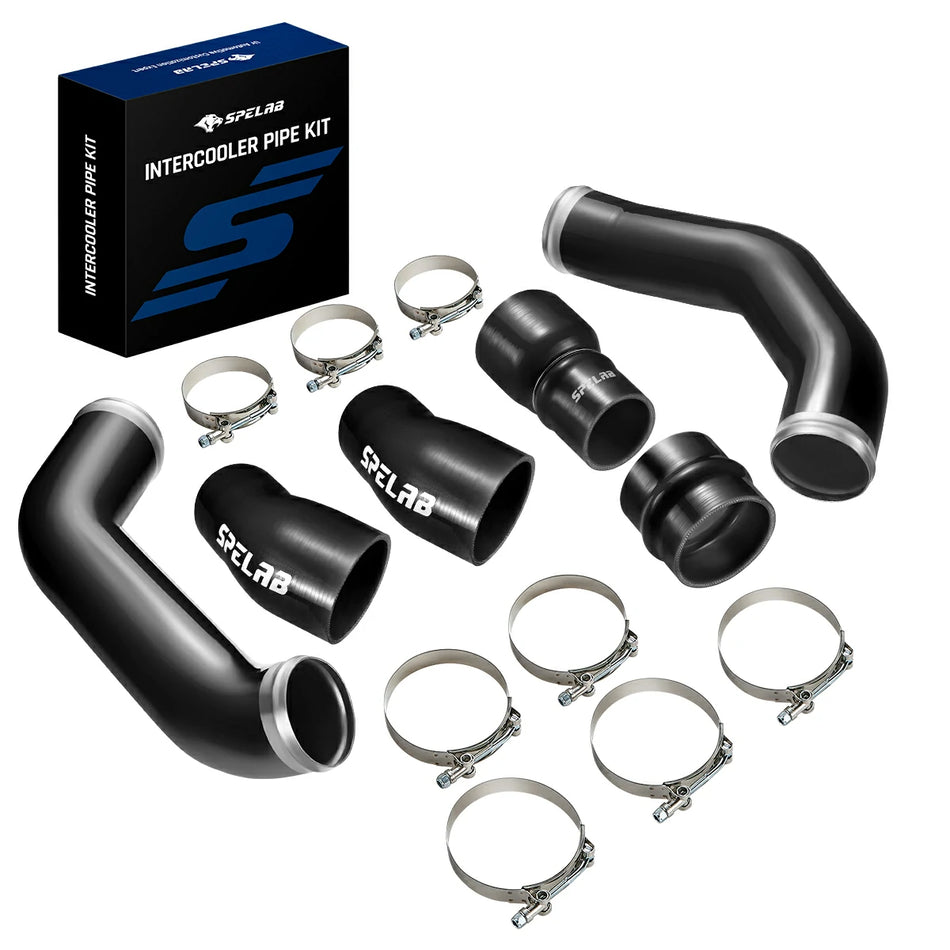
Do not clear the codes before saving freeze-frame information. Check battery and charging voltage, wiring rub-through, connector water intrusion, exhaust leaks, pressure-sensor hoses, coolant level, intake restriction, and charge-air boots. A split cold-side pipe can create low boost, excess smoke, higher EGT, and rapid soot loading; a correctly matched 2011-2025 6.7 Powerstroke intercooler pipe kit can address that confirmed airflow fault without disabling emissions controls. Select the product variant by model year, hot-side or cold-side location, and, on 2023-and-newer trucks, standard-output or high-output engine configuration.
6.7 Powerstroke Fitment Changes by Model Year
Engine displacement alone is not enough to order parts, because Ford changed turbo hardware, chassis packaging, sensors, cooling circuits, controls, and aftertreatment details across the 6.7L production run.
| Model-year group | What to verify | Common ordering mistake |
|---|---|---|
| 2011-2014 | Early engine hardware, pickup versus cab chassis, exhaust length, cooling layout, connector and sensor positions | Treating a later kit as an identical bolt-on setup |
| 2015-2016 | Second-generation engine changes, revised VGT turbo system, charge-air layout, and dedicated two-year hardware listings | Assuming early up-pipe or downpipe geometry interchanges because a flange looks close in a photo |
| 2017-2019 | Redesigned Super Duty chassis, wheelbase, cab/bed or upfit layout, pipe clearance, sensor provisions | Ignoring pickup versus F-450/F-550 cab-and-chassis packaging |
| 2020-2022 | Later engine and control architecture, exact emissions family, software service requirements, chassis configuration | Assuming an older hardware or calibration plan carries forward |
| 2023 and newer | VIN, standard-output versus high-output application, current Ford service information, sensors, software, and warranty status | Trusting a broad marketplace title instead of the current product page and vehicle label |
Use the truck's VIN, door label, underhood emissions label, wheelbase, cab/bed configuration, and visible hardware. Then compare the physical connection points and the current manufacturer listing. Our fitment work repeatedly finds that a “2011+” search result is not proof of a universal installation. For a focused exhaust-side comparison, review the year-by-year fitment limits before making a parts decision.
Which System Is Actually Causing the Complaint?
EGR, DPF, SCR/DEF, turbo, cooling, and fuel faults overlap at the driver's seat but leave different evidence in scan data and under the hood.
| System | Typical complaint | Evidence that matters | Road-legal repair direction |
|---|---|---|---|
| EGR | Flow code, deposit-related response issue, coolant loss if the cooler leaks | Commanded flow, MAF/MAP response, valve action, pressure test | Clean a serviceable passage or replace the confirmed failed component |
| DPF/DOC | Frequent regen, high differential pressure, soot-load warning | Pressure at known load, soot/ash estimate, EGT response, failed-regen reason | Correct the engine-out cause, then service or replace the aftertreatment as required |
| SCR/DEF | DEF countdown, heater or quality code, NOx-conversion fault | Fluid quality, temperature, dosing command, NOx values, leak inspection | Repair the heater, wiring, doser, sensor, leak, or contaminated-fluid issue identified by testing |
| Charge-air/turbo | Hiss, oil mist at a boot, P0299, smoke, high EGT under load | Pressure or smoke test, boost error, VGT command, exhaust leaks | Repair the pipe, boot, clamp, actuator, sensor, or turbo fault |
| Cooling | Low coolant, dried residue, fan roar, temperature recovery problem | Cold pressure test, cap test, hose and reservoir inspection, temperature trend | Repair the leak, restore the correct coolant mix, vacuum-fill, and verify fan operation |
| Fuel/combustion | Hard start, contribution fault, smoke, low rail pressure, repeated soot loading | Fuel quality, rail pressure, injector correction, filter restriction, metal inspection | Repair fuel delivery or combustion before blaming the DPF |
How Towing, Payload, Jobsites, and Weather Change the Decision
A heavy-duty work truck should be evaluated at the load, speed, altitude, and ambient temperature where the complaint occurs, because an airflow, cooling, or regeneration problem may not appear while the truck idles unloaded in the driveway.
Towing a 5th-Wheel
A loaded grade raises exhaust energy, coolant temperature, charge-air temperature, and transmission load together. Log boost target versus actual, coolant and transmission temperature, regen status, and DPF pressure before blaming one system. A boost leak that feels minor empty can turn into high EGT and fast soot loading with 14,000 pounds behind the truck.
Payload and Jobsite Use
Long idle time, low vehicle speed, dust, chaff, and stop-and-go duty reduce passive heat flow and can interrupt regeneration. Inspect the air filter, cooling stack, pressure lines, wiring, and idle history. A work truck needs predictable uptime and parts availability more than an unverified mileage claim.
Off-Road and Slow-Speed Operation
Slow climbs combine high engine load with weak ram-air flow. Watch fan engagement, coolant recovery, IAT, boost error, and transmission temperature. “Off-road” describes the driving surface; it does not settle federal certification or tampering questions.
Extreme Cold
Cold weather exposes weak batteries, DEF-heater faults, connector moisture, gelling fuel, and incomplete warm-up. Diagnose P20BA with voltage, temperature, circuit, and command data instead of treating every winter countdown as a reason to remove hardware.
Extreme Heat and Altitude
Hot thin air reduces cooling and compressor margin. Verify the cooling stack, degas bottle, fan system, boots, clamps, and air filter before raising power. A small leak can become a large target-versus-actual boost gap on a mountain tow.
What Does a 6.7 Powerstroke Delete Really Cost?
The real budget includes diagnosis, parts, labor, software support, downtime, legal exposure, inspection, warranty disputes, resale loss, and possible return-to-stock work.
A cheap parts total can hide the expensive side of the job. Seized fasteners, damaged connectors, cut factory wiring, missing sensors, discarded OEM hardware, poor pipe alignment, and unsupported software can turn a weekend mod into weeks of downtime. A proper cost comparison should price the confirmed repair, factory-style replacement, professional cleaning where appropriate, and the full restoration path.
A first-pass scan and targeted diagnostic session typically requires about 1-3 shop hours, depending on whether the fault needs a road test, smoke test, circuit test, or forced-regeneration assessment. Restoring a previously deleted truck can roughly range from $4,000 to more than $15,000 when the DPF/DOC/SCR assembly, sensors, harness sections, and stock calibration are missing; the actual total depends on local labor rates, new versus used OEM parts, corrosion, wiring damage, and software recovery. These figures are planning ranges, not repair quotes.
Use this repair-path cost comparison to separate filter service, replacement, modification, labor, and downtime instead of comparing one pipe with an entire repair invoice.
Warranty law also needs accurate wording. The FTC explains that an aftermarket part does not automatically cancel the whole vehicle warranty, but coverage may be denied for damage caused by a defective part or improper installation. Read the FTC guidance on auto warranties and aftermarket parts, keep maintenance records, and ask the warranty administrator to state any denial and causal basis in writing.
Why a 6.7 Powerstroke Delete Tuner Is Not a Mechanical Shortcut
A 6.7 Powerstroke delete tuner or emissions-off calibration can suppress warning logic, but software cannot repair a failed reductant heater, cracked EGR cooler, boost leak, contaminated DEF system, damaged DPF substrate, or weak fuel system.
The PCM coordinates airflow, turbo vane position, fueling, torque management, exhaust-temperature control, regeneration, reductant dosing, and OBD monitors. Changing one group of expected inputs can affect the rest of that strategy. A file that starts the engine and turns off the dash light has not proved safe cylinder pressure, controlled EGT, correct transmission torque reporting, or stable towing behavior.
We see the same shop pattern across Power Stroke builds: drivability depends on the mechanical condition of the truck and the quality of the complete calibration, not the advertised peak number. A work tune should never hide a rail-pressure drop, leaking charge pipe, cooling fault, or slipping transmission; those faults can still raise EGT, reduce torque, or cause a derate under towing load.
Safer Repair and Reliability Options Before a Delete
For a road-driven 6.7 Powerstroke, fix the measured failure and support the truck's airflow, cooling, fuel, and maintenance needs without disabling required emissions controls.
- Confirm the operating complaint. Save every code, freeze-frame record, regen history, and relevant live-data channel before clearing memory.
- Repair engine-out smoke and airflow faults first. A split boot, dirty sensor, injector issue, low fuel pressure, or cold-running thermostat can overload the aftertreatment again after service.
- Service the DPF only after testing. Soot loading, ash loading, a failed sensor, and a cracked substrate are different conditions.
- Repair DEF/SCR faults by circuit. Test fluid, heater, wiring, pump, doser, NOx feedback, and exhaust leaks instead of replacing the entire system by guesswork.
- Pressure-test coolant leaks cold. A leaking reservoir seam, cap, hose, turbo coolant line, radiator, and EGR cooler can leave similar dried residue.
- Verify under real load. Recheck boost error, temperatures, fan behavior, DPF pressure, and warning status during a controlled drive before returning to heavy-duty towing.
Where inspection confirms a failed plastic charge pipe, leaking degas bottle, or contaminated cooling circuit, the relevant repair choices include a 2011-2019 aluminum coolant reservoir and a 2011-2016 coolant filtration system. Confirm exact year, hose routing, cap compatibility, and installation clearance before ordering. Owners comparing heavy-duty airflow repairs can also browse the Powerstroke intercooler pipe collection.
6.7 Powerstroke Repair or Modification Decision Table
The right path depends on the truck's legal use, confirmed failure, duty cycle, warranty position, and whether the owner can document a reliable return-to-stock plan.
| Truck use | Best first path | Data to collect | Main risk to control |
|---|---|---|---|
| Daily-driven or public-road tow rig | Compliant diagnosis and repair | DTCs, regen history, load data, maintenance records | Road legality, uptime, inspection, warranty, resale |
| Commercial or fleet truck | OEM procedure and documented repair | Duty cycle, idle hours, service contract, compliance records | Fleet policy, DOT exposure, repeat downtime |
| Jobsite or agricultural road vehicle | Match the repair to duty-cycle data and applicable operating rules | Road use, registration, emissions label, low-speed duty data | Low-speed heat, dust, idle hours, and repeat regeneration |
| Purpose-built competition machine | Document permitted use, vehicle status, transport, and fitment before purchasing | Vehicle certification history, transport method, event rules, parts documentation | Unsupported calibration, unclear event rules, and no return-to-stock plan |
| Used truck with missing hardware | Document the current state and price a stock restoration | PCM calibration ID, harness condition, missing parts, readiness monitors | Unknown tune, cut wiring, unavailable OEM components |
For a deeper legal screen before purchase, read the discussion of federal and state road-use risks. Laws and inspection programs can change, so verify current requirements where the truck is registered and operated.
Final Recommendation
The best outcome comes from spending money on the confirmed fault instead of treating a search term like a parts list.
Start with the VIN and emissions label, save the full scan report, identify the failed circuit, and test the truck under the duty cycle that triggers the complaint. A street-driven, towing, payload, or commercial Ford Super Duty should retain or restore its certified emissions system while the confirmed airflow, fuel, cooling, or electrical root cause is repaired. That approach preserves OBD diagnostics and leaves the next technician with a truck that can be serviced normally.
For any purpose-built competition machine, document the vehicle status and permitted use, then verify every physical connection, calibration dependency, and return-to-stock requirement against current manufacturer data before ordering parts.
FAQ
These answers cover the most common 6.7 Powerstroke delete, diagnosis, fitment, towing, cost, tuning, and warranty questions.
Q: Is it legal to delete a 6.7 Powerstroke in the United States?
A: Generally no for an EPA-certified motor vehicle used on public roads. Federal tampering restrictions apply, and state or local inspection and registration rules may add requirements.
Q: What is included in a 6.7 Powerstroke full delete kit?
A: A 6.7 Powerstroke full delete kit usually refers to some combination of EGR hardware changes, DPF/DOC/SCR exhaust replacement, DEF-system changes, sensors, and PCM/OBD calibration. Package names are inconsistent across sellers and model years, so the words “full” or “all-in-one” do not prove component coverage, legal use, or fitment.
Q: Can P20BA be fixed without deleting the truck?
A: Yes. P20BA commonly directs diagnosis toward reductant-heater control performance. Check voltage, wiring, connectors, ambient-temperature history, command data, and the correct Ford service procedure before replacing parts.
Q: Does P0401 prove the 6.7 Powerstroke EGR cooler is bad?
A: No. P0401 indicates insufficient EGR flow, which can involve deposits, valve control, sensor bias, wiring, an exhaust leak, or restricted passages. A coolant pressure test and persistent white vapor are more relevant when investigating an internal cooler leak.
Q: Will deleting the DPF fix P0299 and high EGT while towing?
A: Not if the root cause is a leaking boot, split charge pipe, VGT control problem, intake restriction, exhaust leak, or weak fuel delivery. Pressure-test the charge-air system and compare target versus actual boost under controlled load first.
Q: Does an aftermarket part automatically void the whole truck warranty?
A: No. The FTC says an aftermarket part does not automatically cancel the entire warranty, but a manufacturer or dealer may deny coverage for damage caused by a defective part or improper installation. Emissions tampering also creates separate legal and service concerns.
Q: What should I check on a used 6.7 Powerstroke that may have been deleted?
A: Check the emissions label, visible hardware, harnesses, sensor connectors, exhaust welds, coolant routing, PCM calibration ID, readiness monitors, complete scan report, cold-start behavior, and service records. Price the OEM parts, wiring repair, compliant calibration, labor, and drive-cycle verification needed for a stock restoration.

About the Author
John Lee
Mechanical Engineer | 10+ Years Experience
John has spent the last decade engineering and testing high-performance automotive components. Specializing in drivetrain durability and thermal management across Powerstroke, Cummins, and Duramax applications, he bridges the gap between OEM limitations and aftermarket performance. His philosophy: "Factory parts are just a starting point."





1 comment
I have a 2020 f350 what are the steps to upgrading to a EGR delete kit of your best for this year. Does my ecm have to be removed and sent to be reprogramed? And who will do it?