Updated: May 17, 2026
Emissions delete is one of the most debated topics in the diesel truck world. Some owners see it as the fastest way to reduce maintenance headaches and wake up performance. Others see it as a legal, inspection, warranty, and resale risk that can create bigger problems than it solves.
Quick answer: Most street-driven diesel trucks do not “need” an emissions delete. If the truck is registered, inspected, or driven on public roads, deleting EGR, DPF, DEF, or SCR equipment can create serious legal and inspection problems. In many cases, diagnosis, cleaning, sensor repair, DPF service, oil-vapor control, or platform-specific maintenance is the smarter first move.
That does not mean emissions systems never fail. EGR coolers leak. DPFs clog. DEF heaters and NOx sensors fail. But the right question is not “Can I delete it?” The right question is: What problem am I actually trying to solve, and is delete the lowest-risk solution?

First: What Counts as an Emissions Delete?
An emissions delete usually means removing, disabling, bypassing, or tuning out emissions-related hardware or software. On modern diesel trucks, that may involve one or more of these systems:
- EGR: Exhaust Gas Recirculation, used to reduce NOx by recirculating a controlled amount of exhaust gas into the intake.
- DPF: Diesel Particulate Filter, used to trap soot and particulate matter from diesel exhaust.
- DEF/SCR: Diesel Exhaust Fluid and Selective Catalytic Reduction, used to reduce NOx downstream in the exhaust.
- ECU calibration: Tuning that changes how the truck monitors, commands, or reports emissions system behavior.
For a basic explanation, read what EGR delete means. For the filter side, read what the DPF does.
The Legal Reality: Street Trucks Are Different
This is the part many old-school delete articles avoid. In the United States, tampering with emissions control systems can violate the Clean Air Act. EPA describes common tampering examples as removing emissions hardware such as EGR, DPF, or SCR, and changing software or calibrations that allow an engine to operate without emissions controls or prevent OBD systems from recognizing the change.[1]
For a street-driven truck, the practical risks can include:
- Failed emissions inspection
- Failed visual inspection
- Failed OBD readiness check
- Check engine light or limp mode
- Warranty denial
- Resale difficulty
- Potential fines or compliance action
If the truck is a daily driver, work truck, tow rig, or registered road vehicle, the legal and ownership risks often outweigh the performance claims.
Why Owners Consider an Emissions Delete
Most owners do not wake up wanting to remove emissions hardware. They usually start with a real failure or repeated frustration:
- Clogged DPF and frequent regeneration
- EGR cooler leaks or repeated EGR valve problems
- DEF heater, pump, injector, or NOx sensor failures
- Derate countdowns or limp mode
- High repair quotes
- Reduced power under load
- Concern about long-term reliability
Those frustrations are real. But a real problem does not always mean delete is the best solution. A clogged DPF might need cleaning. A derate might be caused by a failed NOx sensor. A soot problem might come from short trips, bad injectors, boost leaks, or a dirty MAP sensor. Deleting parts before diagnosing the cause can hide the symptom while leaving the underlying problem alive.
Common Codes That Make Owners Think About Delete
Many owners start researching emissions delete after seeing fault codes on a scan tool. Those codes are useful clues, but they do not automatically mean the entire emissions system should be removed.
| Code | Common Meaning | What to Diagnose First |
|---|---|---|
| P242F | Diesel Particulate Filter restriction / ash accumulation | DPF ash load, differential pressure, regen history, EGT sensors, driving duty cycle |
| P2002 | Diesel Particulate Filter efficiency below threshold | DPF condition, leaks, pressure sensors, temperature sensors, soot load modeling |
| P0401 | EGR flow insufficient | EGR valve movement, plugged passages, cooler restriction, MAP/MAF data, wiring |
| NOx sensor codes | SCR conversion or sensor feedback issue | NOx sensors, DEF quality, SCR function, wiring, exhaust leaks |
| Derate countdown | Emissions system fault requiring repair | DEF heater, DEF injector, SCR system, NOx sensors, ECU updates |
These codes should start a diagnostic process. They should not automatically end in an emissions delete.
When You Probably Do Not Need an Emissions Delete
For most owners, the honest answer is: you probably do not need one if the truck is still used on public roads.
Delete is usually not the right first step if:
- The truck is a daily driver.
- You live in an emissions inspection area.
- The truck is still under warranty.
- You use the truck for commercial work.
- You plan to sell or trade the truck later.
- The actual failure has not been diagnosed yet.
- You are trying to fix a sensor, boost leak, injector, or maintenance issue with a delete.
Before choosing a delete, read what the law means for diesel owners.
When an Emissions Delete Is Usually the Wrong Fix
An emissions delete is especially risky when the truck has a repairable system fault. In many cases, owners blame the entire emissions system when the real problem is a single component.
| Problem | Common Real Cause | Smarter First Step |
|---|---|---|
| Frequent DPF regen | Short trips, boost leak, bad injector, dirty sensor, soot/ash load | Read soot load, ash load, differential pressure, and regen history |
| DEF warning or derate | DEF heater, DEF injector, level sensor, NOx sensor, crystallization | Scan codes and test the DEF/SCR components before replacing or deleting anything |
| EGR-related codes | Dirty EGR valve, cooler leak, stuck valve, wiring issue, pressure sensor problem | Inspect, clean, pressure test, and verify sensor data |
| Black smoke or low power | Boost leak, turbo issue, dirty MAP/MAF sensor, over-fueling | Perform boost leak test and scan airflow/boost data |
| Oil sludge in intake | CCV oil vapor mixing with soot | Control oil vapor with maintenance or a sealed catch can |
EGR Delete: What It Actually Solves
EGR systems can create real maintenance problems. Exhaust soot can mix with oil vapor and form carbon sludge in the intake. EGR coolers can leak. EGR valves can stick. Those are legitimate complaints.
An EGR delete may reduce soot entering the intake in an off-road or competition context where legally permitted. But for a street-driven vehicle, removing or disabling EGR can create compliance, inspection, NOx emissions, and tuning problems.[1]
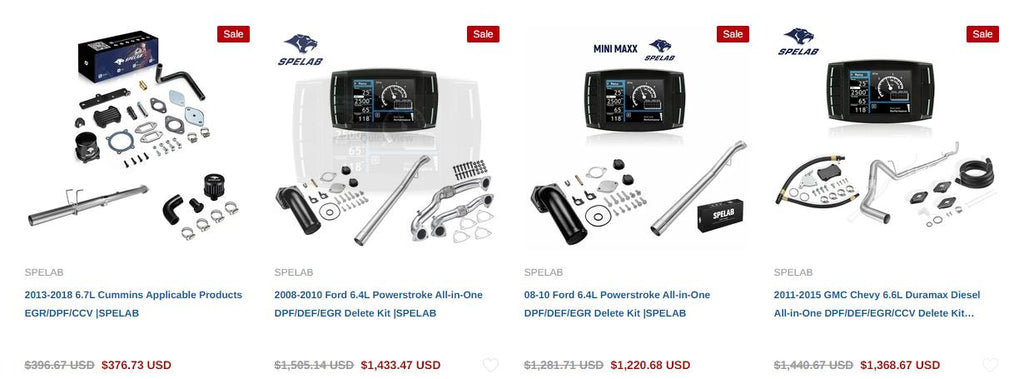
For owners who are still researching the category, the broad product path is the EGR delete kit collection. For street-driven trucks, consider cleaning, cooler diagnosis, sensor checks, and oil-vapor control first.
DPF Delete: Why the Temptation Is Strong
The DPF is one of the most expensive diesel emissions components. It can clog with soot, load up with ash, fail regeneration, or trigger backpressure-related warnings. That is why many diesel owners start searching for DPF delete information.
But a clogged DPF is not always a DPF problem. It can be the result of:
- Short trips that interrupt regeneration
- Excessive idling
- Bad injectors
- Boost leaks
- Turbo problems
- High ash load from age and mileage
- Failed DPF pressure or temperature sensors
The differential pressure across the DPF is one of the key clues used to understand restriction:
ΔP = Pinlet - Poutlet
As soot and ash accumulate, pressure drop rises. If the ECU cannot trust pressure, temperature, and airflow feedback, regeneration may be mistimed, incomplete, or blocked by fault logic. That is why DPF diagnosis should include differential pressure, soot load, ash load, EGT sensors, boost leaks, and regen history before any hardware decision.
For diagnosis, read whether DPF removal is worth it. If the truck must remain street legal, cleaning, forced regen, sensor repair, or DPF replacement may be the only practical path.
DEF/SCR Delete: What Owners Are Trying to Avoid
DEF and SCR systems reduce NOx emissions downstream in the exhaust. Owners often get frustrated with DEF crystallization, heater failures, NOx sensor faults, and derate countdowns.
Deleting DEF/SCR may look attractive because it removes a complex system. But for road-use vehicles, that complexity is part of the certified emissions package. Removing or disabling it can create legal risk and inspection failure.[1]
If your truck has DEF/SCR problems, start with scan data. Confirm whether the issue is the DEF heater, pump, injector, level sensor, quality sensor, NOx sensor, wiring, or software update before assuming the whole system is the enemy.
The Hidden Risk: Tuning and OBD Readiness
Modern diesel trucks do not only rely on hardware. They also use software logic to monitor EGR flow, DPF soot load, DEF quality, NOx conversion, exhaust temperature, boost pressure, and OBD readiness monitors.
If hardware is removed but calibration is wrong, the truck may develop:
- Check engine lights
- Limp mode or derate
- Incomplete OBD readiness
- Failed inspection
- Poor fueling or boost behavior
- Excess smoke or high EGTs
- Transmission and drivability issues if torque modeling is wrong
EPA also identifies software or calibration changes that allow a vehicle to operate without emissions controls, or prevent OBD systems from recognizing changed behavior, as a form of tampering.[1]
Safer Alternatives Before You Delete
Before deciding that emissions delete is the only path, work through the failure logically.
- For EGR problems: Clean or replace the EGR valve, inspect cooler leaks, check MAP/MAF data, and inspect soot buildup.
- For DPF problems: Check soot load, ash load, differential pressure, EGT sensors, regeneration history, and boost leaks.
- For DEF/SCR problems: Test DEF quality, heater function, injector operation, level/quality sensors, and NOx sensors.
- For oil sludge: Address CCV oil vapor before blaming only the EGR system.
- For repeated short-trip regen issues: Change duty cycle if possible or diagnose why regen cannot complete.
If your problem is intake soot sludge, an emissions delete may not be the right first move. EGR soot is mostly dry carbon; CCV oil vapor is the glue that turns it into sticky sludge. For street-driven trucks, a sealed diesel oil catch can collection can reduce oil-vapor contamination without removing EGR, DPF, or SCR hardware.
A sealed catch can is especially useful for daily-driven trucks in emissions inspection areas. It does not “delete” emissions hardware. It targets the oil-vapor side of the intake contamination problem, helping keep the turbo inlet, intercooler boots, intake horn, and sensors cleaner for longer.
When Off-Road Builds Enter the Conversation
There are trucks used in racing, off-road, agricultural, or non-public-road contexts where owners research complete emissions system changes. Even then, the decision should not be casual. Hardware, calibration, sensors, airflow, exhaust temperature, and use case need to match.
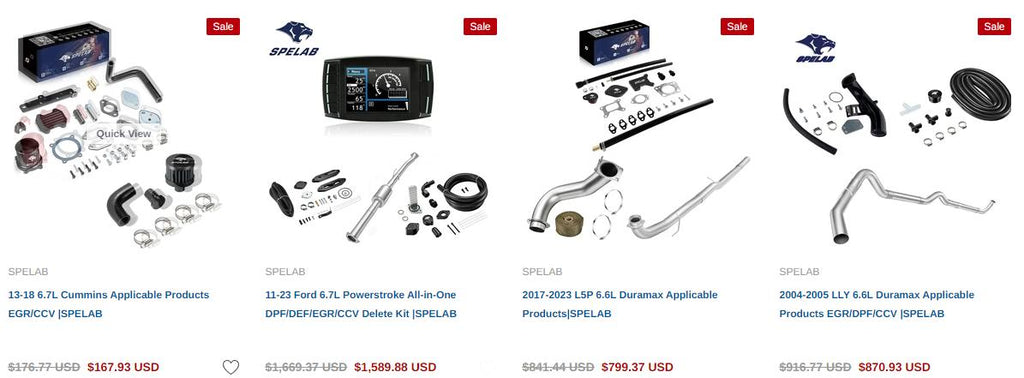
For category research, some owners compare the EGR and DPF delete combo kit collection or platform-specific all-in-one kits. But the owner must understand that federal, state, provincial, and local rules can vary, and EPA’s position on tampering is strict for vehicles and engines originally certified with emissions controls.[2]
Platform-specific examples include:
- Powerstroke delete kit all-in-one collection
- Cummins tuner delete kit collection
- Duramax delete kit all-in-one collection

How to Decide: Repair, Maintain, or Delete?
Use this decision framework before spending money:
| Question | If Yes | Best Next Step |
|---|---|---|
| Is the truck street-driven? | Yes | Repair and maintain emissions systems; avoid tampering risk. |
| Is there a real DTC or derate? | Yes | Diagnose the exact failed sensor, heater, injector, cooler, or filter. |
| Is the DPF ash-loaded? | Yes | Professional cleaning or replacement may be required. |
| Is the issue intake sludge? | Yes | Clean intake parts and control CCV oil vapor. |
| Is the truck truly non-road use? | Maybe | Confirm legal status before choosing any emissions hardware path. |
So, Do You Really Need an Emissions Delete?
For most street-driven diesel trucks, no. You need accurate diagnosis, proper maintenance, and a repair strategy that keeps the truck reliable and compliant.
For heavily modified or non-road builds, maybe. But even then, it should be treated as a complete system decision, not a shortcut. EGR, DPF, DEF/SCR, sensors, ECU calibration, and inspection consequences are connected.
The smartest diesel owners do not delete parts because the internet says so. They identify the actual failure, understand the legal limits, and choose the lowest-risk solution that solves the real problem.

FAQ
Q:Do I really need an emissions delete?
A:Most street-driven diesel trucks do not need an emissions delete. If the truck is registered, inspected, or driven on public roads, repair and diagnosis are usually safer than removing emissions equipment.
Q:Is an emissions delete legal?
A:For vehicles originally certified with emissions controls, removing, disabling, bypassing, or tuning out emissions equipment can violate the Clean Air Act in the United States.[1]
Q:What codes make owners think about deleting emissions systems?
A:Common examples include P242F for DPF ash accumulation or restriction, P2002 for DPF efficiency below threshold, and P0401 for insufficient EGR flow. These codes should be diagnosed before any delete decision.
Q:Does an emissions delete increase horsepower?
A:It may support performance in certain modified setups, but gains depend on the full system: tuning, turbo, fueling, exhaust, airflow, and engine condition. It is not a guaranteed result.
Q:Will an emissions delete improve fuel economy?
A:Sometimes owners report MPG changes, but results vary heavily by driving style, tuning quality, gearing, tire size, load, and engine health. Treat any MPG claim as conditional.
Q:What is the main risk of deleting EGR?
A:The main risks are emissions non-compliance, inspection failure, increased NOx emissions, warranty issues, check engine lights, and tuning complications.
Q:What is the main risk of deleting DPF?
A:The main risks are emissions non-compliance, smoke, inspection failure, OBD readiness problems, resale issues, and poor tuning if the truck is not calibrated correctly.
Q:Can I delete DEF but keep DPF?
A:On modern diesel trucks, DEF/SCR, NOx sensors, DPF regeneration, and ECU logic are connected. Changing one system can affect the others and may create compliance or drivability issues.
Q:What should I try before an emissions delete?
A:Diagnose the actual failure. Check sensors, DPF soot and ash load, EGR cooler leaks, DEF quality, NOx sensor data, boost leaks, injectors, and CCV oil-vapor contamination.
Q:Is a catch can a better first step than delete?
A:If the issue is intake oil sludge, yes. A sealed catch can can reduce CCV oil vapor that mixes with soot, helping keep the intake cleaner without removing EGR, DPF, or SCR hardware.
Q:Who should consider emissions delete?
A:Only owners who fully understand the legal, tuning, inspection, warranty, and emissions consequences should consider it. For most public-road trucks, it is not the right first solution.
Legal Notes
[1] In the United States, tampering with a vehicle emissions control system can violate the Clean Air Act. EPA identifies examples including removing emissions hardware such as EGR, DPF, or SCR, and altering software or calibrations that allow the vehicle to operate differently from its certified configuration. Reference: EPA Clean Air Northeast: Tampering and Aftermarket Defeat Devices.
[2] The Clean Air Act also prohibits manufacturing, selling, offering for sale, or installing aftermarket parts or devices that bypass, defeat, or render emissions controls inoperative. EPA states there is no Clean Air Act exemption for converting an EPA-certified motor vehicle into a competition-use vehicle exempt from the tampering prohibition. Reference: EPA Enforcement Alert: Aftermarket Defeat Devices and Tampering.

John Lee
Mechanical Engineer | 10+ Years Experience
John has spent the last decade engineering and testing high-performance automotive components. Specializing in drivetrain durability and thermal management across Powerstroke, Cummins, and Duramax applications, he bridges the gap between OEM limitations and aftermarket performance. His philosophy: "Factory parts are just a starting point."