Updated on July 28, 2026.
An ABS light that stays on after startup or comes on while driving means the anti-lock brake controller has detected a fault or cannot trust part of its data. If the amber ABS light is the only warning, many vehicles retain normal hydraulic braking but may lose anti-lock control and related traction or stability functions. If the red brake warning light is also on, the pedal feels soft, braking changes, or fluid is leaking, pull over safely and arrange professional service instead of driving the truck home.
Key Takeaways
The warning-light combination, brake-pedal feel, and ABS module data determine whether this is a service-soon problem or a stop-driving problem.
- An amber ABS light by itself does not identify a bad sensor; it only confirms that the controller found a fault or unreliable input.
- An ABS-capable scan tool is required because a basic engine-code reader may not access chassis codes or live wheel-speed data.
- Wheel-speed wiring, encoder rings, hub-bearing play, mismatched tires, low voltage, and recent axle work can imitate a failed sensor.
- Do not tow heavy, run a loaded jobsite route, or drive into snow and ice with an unresolved ABS fault.
- The exact owner's manual controls warning-lamp meaning and fail-safe behavior for that model, so save the messages and verify the vehicle-specific guidance.
What Does The ABS Light Mean?
The ABS light means the anti-lock brake system has stored a fault, failed a self-check, or disabled control because one or more inputs are not reliable.
ABS watches wheel rotation and modulates brake pressure during a lockup event. Modern trucks may share the same wheel-speed data with traction control, electronic stability control, hill-descent control, four-wheel-drive logic, adaptive cruise functions, and other systems. One failed input can therefore light several warnings at once.
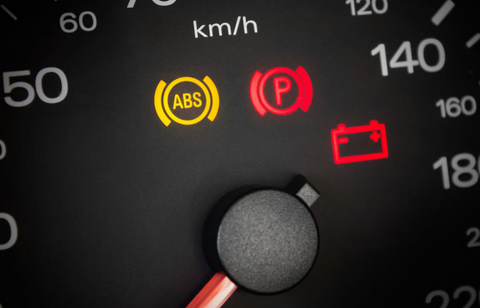
The ABS lamp normally illuminates briefly during startup as a bulb and system check. A lamp that never goes out, returns at a certain speed, or appears only during turns, bumps, rain, or low-speed stops gives the mechanic useful direction, but it does not prove which part failed.
Can You Drive With The ABS Light On?
Driving risk depends on which warnings are present and whether the base brake system still feels and operates normally.
| What You See Or Feel | Likely System State | Safe Next Step | Avoid |
|---|---|---|---|
| ABS lamp during startup, then it turns off | Normal bulb and self-check on many vehicles | No action unless another symptom or message appears | Assuming every brief startup lamp is a fault |
| Amber ABS lamp only; pedal and base braking feel normal | ABS and related stability functions may be limited or disabled | Drive only as necessary in good conditions and schedule an ABS scan promptly | Hard towing, snow, ice, steep grades, or panic-stop testing |
| ABS plus traction-control or stability-control warnings | A shared wheel-speed, network, voltage, or controller fault is possible | Scan every affected chassis module and compare live wheel speeds | Replacing multiple modules from the warning icons alone |
| ABS plus red brake warning | The regular brake system may also have a fault, low fluid, or an applied parking brake | Release the parking brake, stop safely, inspect for fluid loss, and arrange service or towing | Continuing because the pedal still feels acceptable |
| Soft or sinking pedal, leak, pulling, grinding, smoke, or weak stopping | A hydraulic or mechanical brake failure may be present | Stop driving and have the vehicle transported for inspection | Clearing codes or adding fluid without finding the leak |
Ford states that normal braking may remain when the ABS lamp alone indicates a system error, unless the brake-system warning lamp is also illuminated. Chevrolet likewise separates an ABS-only warning from simultaneous ABS and regular-brake warnings. Check the exact owner's manual because icons and fail-safe behavior vary by platform. See the official Ford warning-lamp guidance and Chevrolet warning-light guidance for manufacturer examples.
What Commonly Causes An ABS Light?
The most common ABS warning causes are a bad wheel-speed signal, damaged wiring, encoder or tone-ring trouble, hub-bearing movement, tire-speed mismatch, low electrical voltage, or a brake-system fault that affects shared logic.
| Cause Group | Typical Clue | What To Inspect Or Measure | Common Wrong Move |
|---|---|---|---|
| Wheel-speed sensor or circuit | One wheel reads zero, drops out, spikes, or disagrees with the others | Connector fit, reference or supply, ground, signal, pin tension, and harness continuity using model-specific data | Replacing the sensor because the code names that wheel |
| Tone ring or magnetic encoder | Intermittent low-speed activation or repeating signal dropout at one wheel | Cracks, rust lift, missing teeth, debris, wrong orientation, or damage to an encoder integrated into the seal or hub | Cleaning aggressively with tools that damage the magnetic surface |
| Hub or wheel bearing | Growl, looseness, signal change while turning, or excessive air-gap variation | Bearing play, torque, hub condition, sensor mounting surface, and encoder runout | Installing another sensor on a loose hub |
| Harness or connector damage | Light appears after a bump, steering input, suspension work, or wet weather | Rub-through, stretched wire, corroded terminals, poor retention, water path, and previous splice quality | Pulling on wiring or filling a wet connector with random sealant |
| Tire or wheel-speed mismatch | Fault starts after tire replacement, rotation, spare-tire use, or a change in tire size | Actual rolling circumference, pressure, tire wear, programmed size, and matched tires across the axle or driveline | Assuming the sidewall size proves all four tires roll the same |
| Low voltage, fuse, ground, or network fault | Multiple warning lamps after a cold start, jump-start, battery replacement, or charging problem | Battery load test, charging voltage, module grounds, fuses, network DTCs, and recent electrical work | Condemning the ABS module before power and communication pass |
| Hydraulic unit or ABS controller | Internal pump, valve, processor, or communication DTC after external circuits test correctly | Power, ground, CAN communication, commanded tests, brake fluid condition, and factory diagnostic steps | Buying a module before confirming programming and bleed requirements |
Do Not Replace The Wheel-Speed Sensor Too Fast
A wheel-specific ABS code identifies the circuit or data channel that failed the controller's test; it does not automatically prove that the removable sensor is bad.
In our testing as a parts manufacturer, wiring near the knuckle and hub deserves attention after brake, bearing, axle, leveling, or steering work. A harness can look intact while the conductor is broken inside the insulation, a terminal is pushed back, or the wire becomes tight at full steering lock and suspension droop.
- Compare all available wheel-speed PIDs before removing parts.
- Inspect the sensor mounting surface for rust that changes the air gap.
- Check hub play and noise before installing a new sensor.
- Confirm whether the encoder is a separate tone ring, magnetic seal, or integrated hub component.
- Use the service-manual test method; some active sensors should not be judged by a simple resistance check.
- Never probe module or CAN terminals with a test light or an unapproved powered method.
For an older passive two-wire variable-reluctance sensor, the factory procedure may specify a resistance test or an AC-voltage test while the hub turns at a controlled speed. Identify the sensor type first, disconnect it only as directed, and compare the reading with the model-specific specification or the matching sensor on the other side. Do not use 0.5-2.0 VAC as a universal pass/fail range: output changes with sensor design, wheel speed, air gap, encoder condition, and the meter. Active Hall-effect or magnetoresistive sensors require a different powered signal test and are better checked with service data, live PIDs, or a scope.
How Do You Diagnose An ABS Light Step By Step?
A reliable ABS diagnosis records the warning combination and chassis codes first, then proves the wheel-speed, electrical, mechanical, or hydraulic fault before parts are ordered.
- Confirm the exact warning state. Note ABS, red brake, traction, stability, four-wheel-drive, steering, and message-center warnings. Verify that the parking brake is fully released.
- Check base brake safety. Inspect brake-fluid level without introducing dirt, look for leaks, and note pedal travel, firmness, pulling, grinding, heat, or odor.
- Verify battery and charging condition. Low voltage can set multiple chassis and communication faults, especially during cold starts on a dual-battery diesel.
- Use an ABS-capable scan tool. Read the ABS module and related chassis modules, not only engine P-codes from a generic code reader.
- Save codes and data before clearing. Record status, freeze-frame information when available, module voltage, and recent repair history.
- Compare live wheel speeds. Use a safe, controlled test method and watch for one wheel dropping out, lagging, or reporting speed while stopped. Do not watch a laptop while driving.
- Inspect the named corner physically. Check the harness through full steering and suspension travel, connector pins, sensor seating, tone ring or encoder, hub play, tire size, and wheel-bearing torque. If service information confirms that the sensor is removable, clean loose rust around the bore, remove the retaining bolt, apply only an approved penetrant, and work the sensor out gently. Forcing a seized plastic sensor can break its snout inside the knuckle or hub.
- Test the circuit by factory procedure. Verify supply, ground, signal, continuity, and terminal load only with the correct pinout and approved tools.
- Repair, clear, and verify. Complete any required calibration or automated bleed, then perform a controlled road test and rescan every affected module.
If this diagnosis is part of preparing a used work truck for a trailer, follow a complete pre-tow inspection sequence instead of treating the warning lamp as the only safety item.
Why Does The ABS Light Come And Go?
An intermittent ABS light usually means a signal, connection, voltage, or mechanical air-gap problem changes with speed, steering angle, vibration, moisture, or temperature.
After Rain Or A Car Wash
Moisture in a damaged connector or corroded splice is possible, but water should not be assumed to be the root cause. Inspect seals, terminal tension, wire entry, corrosion tracks, and the actual code before applying cleaner or dielectric grease.
During Turns Or Over Bumps
A harness may stretch at full lock, rub the tire, or open internally as the suspension moves. Hub-bearing play can also change sensor-to-encoder clearance when corner load shifts.
Near The End Of A Stop
False low-speed ABS activation can occur when one wheel signal fades sooner than the others. Rust under a sensor, a cracked tone ring, a damaged magnetic encoder, or hub runout should be checked before replacing the hydraulic unit.
After A Cold Start
Cold batteries, poor grounds, a weak alternator, or high key-on electrical load can pull module voltage down. Save voltage and communication codes before disconnecting batteries because that evidence can disappear.
ABS Problems After Tires, A Lift, Or Axle Work
An ABS warning that begins immediately after wheel, tire, hub, brake, suspension, or axle work should be treated as a Fitment and workmanship clue until testing proves otherwise.
- Tire circumference: match actual rolling size and pressure, especially on 4WD and AWD vehicles.
- Harness routing: verify slack at full steering lock, full droop, and full compression; keep wiring away from the tire, rotor, axle shaft, and sharp brackets.
- Hub and encoder: confirm the correct hub, bearing, seal orientation, tone-ring tooth count, and connector style for the exact year and axle.
- Fastener torque: improper hub, axle-nut, wheel, or bracket torque can create movement or damage that changes the speed signal.
- Programming: confirm whether the vehicle requires tire-size configuration, steering-angle calibration, yaw-rate calibration, or another relearn after the work.
Do not assume a Bolt-on Mod is electrically neutral just because the brackets fit. Rigid mounting, correct wire retention, matched tires, and full-travel clearance matter more on a Heavy-duty truck that sees off-road articulation or high Payload.
How Does An ABS Fault Affect Towing And Bad Weather?
An unresolved ABS fault removes safety margin when tire grip changes quickly, so towing, loaded downhill braking, snow, ice, mud, and wet jobsite travel should wait until the system is diagnosed.
Towing And Payload
A fifth-wheel or equipment trailer adds heat and stopping demand. The truck may still have base brakes with an ABS-only warning, but anti-lock control, stability intervention, or traction functions may be limited. The trailer brake controller and trailer brakes are separate systems, so an ABS lamp does not prove the trailer brakes are working.
Before a summer haul, combine the ABS repair with practical summer towing heat checks.
Off-Road And Jobsite Use
Mud, gravel, brush, ice, and pressure washing can damage exposed harnesses or pack debris around a tone ring. Rinse gently, avoid forcing water into connectors, and inspect every clip after a hard trail or muddy jobsite.
Snow And Extreme Cold
Cold reduces battery output and road grip at the same time. Correct battery, tire, and brake issues before relying on the truck in winter, and use a full cold-weather traction preparation rather than clearing the light and hoping it stays off.
What Repair Does An ABS Fault Actually Need?
The correct repair is the lowest-level confirmed fault, not the most expensive component named in a parts catalog.
| Confirmed Finding | Reasonable Repair Path | Additional Requirement |
|---|---|---|
| Loose, dirty, or lightly corroded connector with sound terminals | Clean by approved method, restore retention and sealing, then retest | Find the water path or missing clip so the fault does not return |
| Open, shorted, stretched, or rubbed-through harness | Replace the harness or make an OEM-quality sealed repair in a protected location | Restore factory routing and full-travel slack |
| Sensor signal fails while power, ground, wiring, air gap, and encoder pass | Replace the verified wheel-speed sensor | Use the exact connector, mounting depth, and application |
| Loose or noisy hub with an integrated encoder | Replace the correct hub or bearing assembly | Follow axle-nut, hub, and wheel torque procedures |
| Cracked tone ring, damaged encoder, or severe rust lift | Replace the serviceable ring, encoder, shaft, hub, or bearing specified for that design | Check runout and the sensor mounting surface |
| ABS pump, valve, or controller fault after external circuits pass | Professional module or hydraulic-control-unit diagnosis and replacement when confirmed | Programming, setup, and automated bleeding may be required |
| Red brake warning, leak, soft pedal, poor braking, or contaminated fluid | Immediate hydraulic and mechanical brake inspection | Transport the vehicle when safe braking is uncertain |
Brake Safety Notice
Warning-lamp meaning, fail-safe behavior, testing procedures, torque specifications, and relearn requirements vary by vehicle, so the owner's manual and model-specific service information control the repair.
FAQ
These direct answers cover the warning combinations and diagnostic decisions owners ask about most often.
Q: Can low brake fluid turn on the ABS light?
A: Low brake fluid more directly triggers the red brake-system warning on many vehicles, but related faults can also affect ABS or stability logic. If fluid is low, inspect pad wear and the entire hydraulic system for leakage instead of simply topping it off.
Q: Will disconnecting the battery reset the ABS light?
A: It may erase useful evidence or temporarily clear a voltage-related state, but it does not repair the fault. Read and save ABS and network codes before disconnecting power, then follow the vehicle's relearn procedures.
Q: Can a bad wheel bearing cause an ABS light?
A: Yes. Bearing play, runout, noise, or a damaged encoder integrated into the hub can distort the wheel-speed signal. Check the hub mechanically and compare live wheel-speed data before replacing only the sensor.
Q: Why did the ABS light come on after changing tires?
A: A large difference in rolling circumference, incorrect pressure, a mismatched spare, damaged sensor wiring, or an unprogrammed tire-size change can make wheel-speed data disagree. Measure and inspect rather than relying only on the printed sidewall size.
Q: Can a basic OBD-II scanner read ABS codes?
A: Many basic readers access only engine and emissions P-codes. ABS diagnosis requires a tool and software that communicate with the specific vehicle's ABS or chassis module and display relevant live data.
Q: Why does the ABS activate when I am almost stopped?
A: One wheel signal may be dropping out at low speed because of rust under the sensor, excessive air gap, a cracked tone ring, a weak magnetic encoder, damaged wiring, or hub movement. Compare all wheel-speed signals during a safe low-speed test.
Q: Is it safe to tow with only the ABS light on?
A: It is not a sound plan. Even if base braking remains, anti-lock and related stability functions may be unavailable when trailer weight raises stopping demand. Diagnose the truck and verify the separate trailer-brake system before towing.

About the Author
John Lee
Mechanical Engineer | 10+ Years Experience
John has spent the last decade engineering and testing high-performance automotive components. Specializing in drivetrain durability and thermal management across Powerstroke, Cummins, and Duramax applications, he bridges the gap between OEM limitations and aftermarket performance. His philosophy: "Factory parts are just a starting point."