Updated on July 31, 2026.
A bigger intercooler is worth it when a diesel truck has a damaged charge-air cooler, repeatable heat soak under sustained load, or a properly calibrated build that moves more air than the stock core can handle. A healthy daily driver does not automatically need the thickest core that will fit behind the grille.
That distinction matters on a Ram 2500 or 3500 pulling a fifth-wheel through a summer grade. The intercooler, also called the charge-air cooler or CAC, must reject heat without creating too much pressure drop or starving the radiator and A/C condenser behind it. Core design, end-tank construction, airflow through the whole cooling stack, and exact model-year fitment matter more than size alone.
The Short Answer: When a Bigger Intercooler Pays Off
Keep the stock CAC if it is sealed, clean, and holding stable intake-air temperature and boost on the truck's normal route. Upgrade when testing confirms the core is leaking or when a clean, leak-free system repeatedly loses thermal control during towing, high payload, hot-weather pulls, or jobsite duty. On a higher-airflow build, the right core also needs low enough pressure drop for the turbo and calibration; core thickness by itself proves nothing.
What Does an Intercooler Actually Do on a Diesel Truck?
The turbocharger compresses intake air, and compression raises the air temperature. The charge-air cooler, commonly called the intercooler, routes that hot pressurized air through tubes and fins so outside airflow can remove heat before the air reaches the intake manifold. Cooler air is denser, so the engine control system has a more stable air charge to work with under load.
A Ram owner's manual describes the same path: air cleaner, turbocharger, charge-air cooler, then intake manifold. It also tells owners to keep the charge-air cooler, condenser, and radiator surfaces free of debris and to inspect the hoses for cracks or loose clamps. That practical maintenance guidance is available in the official Ram charge-air cooler information.
An intercooler is not the engine radiator. A better charge-air cooler may help stabilize intake-air temperature and sometimes exhaust gas temperature under a controlled load, but it does not directly regulate engine coolant temperature. If the coolant gauge climbs, inspect the radiator, fan operation, thermostat, water pump, coolant level, condenser blockage, and operating conditions instead of blaming the intercooler first. Owners who want the full airflow path can review what happens to compressed charge air.
When Is a Larger Diesel Intercooler Worth It?
The honest answer depends on the truck's data and work cycle. A short empty drive across town barely loads the charge-air system. A 14,000-pound fifth-wheel, a steep grade, 100°F ambient air, and repeated boost demand are a different test.
| Truck condition or use | Likely best move | Why |
|---|---|---|
| Stock daily driver, stable boost, no leaks, normal intake-air trend | Keep the stock unit and maintain it | A larger core may add cost, weight, and cooling-stack restriction without a measurable benefit. |
| Cracked end tank, damaged core, or confirmed pressure leak | Replace the failed unit | An OEM-style replacement restores function; an all-aluminum upgrade may add durability if the truck works hard. |
| Repeatable heat soak while towing or hauling in hot weather | Consider a higher-capacity direct-fit core | More effective heat rejection and thermal mass can help the charge-air temperature recover between pulls. |
| Higher-airflow turbo and fueling with a lawful, properly calibrated setup | Evaluate the core and piping as one system | A good core must support airflow without excessive pressure drop, while boots and clamps must hold the requested boost. |
| Underboost, hiss, oil mist at a boot, or pipe movement | Repair the leak before buying a larger core | A new intercooler will not fix a split coupler, loose clamp, damaged charge pipe, or turbo-control fault. |
Why Is My Diesel Losing Power Under Load? Check These 7 Things
Heat soak is a thermal-capacity problem; a boost leak is a sealing problem. Both can make a truck feel strong on the first pull and lazy later, so run the checks in order instead of buying the largest core on the shelf.
- Compare requested and actual boost: A widening gap under load points toward a leak, turbo-control problem, or restriction. On a 6.7L Cummins, include the Holset variable-geometry turbo (VGT), actuator, and control strategy in the diagnosis.
- Inspect hot-side and cold-side plumbing: Look for a hiss, a boot pushed past its bead, loose clamps, worn contact points, cracked plastic sections, or fresh oil tracks around a joint. A light oil film alone is not proof of a failed core because crankcase vapor can leave residue throughout the intake tract.
- Check the air filter and turbo inlet: A restricted filter, collapsed duct, loose connection, or debris at the inlet reduces delivered air before the CAC gets a chance to do its job.
- Validate the sensors: Compare manifold pressure and intake-air temperature readings with key-on engine-off conditions and known-good service data. On a cold 6.7L Cummins start, grid-heater operation can temporarily affect intake temperature; do not call that heat soak.
- Watch the temperature pattern: Heat soak is more likely when boost still tracks its target but charge-air temperature keeps climbing over repeated pulls and recovers slowly after load drops. Test on the same route with similar weather, trailer weight, speed, and gear strategy.
- Clean and inspect the cooling stack: Mud, cottonwood, bugs, bent fins, winter salt, missing air seals, or an obstructed grille reduce airflow through the A/C condenser, CAC, and radiator.
- Check exhaust, aftertreatment, and calibration: Active regeneration, excessive exhaust restriction, an emissions-system fault, or mismatched fueling can change power and temperature behavior. A bigger intercooler cannot correct a bad calibration or a restricted exhaust system.
If a pipe connection is suspect, these steps can help you find the source of a boost leak. A regulated pressure or smoke test is useful only at the pressure and procedure specified for that truck. Never feed unregulated shop air into the charge-air system or treat a product's burst-test rating as a diagnostic test pressure.
Measure Before and After the Upgrade
"It feels cooler" is not a test result. Build a simple baseline on the same road, with similar ambient temperature, trailer weight, speed, gear strategy, and warm-up condition. A scan tool that can log data is far more useful than a single dashboard snapshot.
| Data point | What it tells you | Important limitation |
|---|---|---|
| Ambient air temperature | Provides the reference for every other temperature | Compare similar weather; raw intake-air temperature alone can mislead. |
| Intake-air temperature | Shows how the charge-air system behaves during and after a pull | Sensor location differs by platform, so compare the same truck and sensor. |
| Requested versus actual boost | Helps expose a leak or control problem | A single manifold pressure reading does not measure core pressure drop. |
| Exhaust gas temperature, if properly instrumented | Shows combustion heat under repeatable load | Probe location changes the number; do not compare unlike installations. |
| Coolant and transmission temperature | Shows whether the full cooling stack is coping with towing load | These temperatures are influenced by many systems beyond the intercooler. |
Calculate CAC effectiveness and pressure drop
For an air-to-air CAC, a useful engineering comparison is:
CAC effectiveness (%) = (hot-side inlet temperature - cold-side outlet temperature) / (hot-side inlet temperature - cooling-air inlet temperature) x 100
Example: with 300°F charge air entering the core, 150°F leaving it, and 100°F air entering the front of the cooling stack, effectiveness is 75%. Use matched sensors at steady load. A weather-app temperature and a single factory IAT sensor cannot produce a defensible result because underhood heat, sensor location, and stack preheating change the measurement.
Pressure drop, or Delta P, is the hot-side pressure minus the cold-side pressure at the same airflow and engine load. Measure both sides with matched, properly ranged sensors. There is no universal pass/fail number across stock and modified 5.9L and 6.7L Cummins trucks; compare the result with factory service data or a known-good baseline for that exact setup. A large pressure loss can come from a restrictive core, but a low cold-side reading can also come from a leak or turbo-control problem.
Log the stock setup, repair known leaks, repeat the route, and then compare the upgraded system. The same discipline applies after cleaning; see how to compare charge-air temperature before and after cleaning.
Bar-and-Plate vs. Tube-and-Fin Intercoolers
Neither design wins every job. The right choice depends on vehicle weight, airflow through the cooling stack, towing duration, boost demand, and how quickly the truck cycles between load and recovery.
| Design | Strengths | Tradeoffs | Typical fit |
|---|---|---|---|
| Tube-and-fin | Lighter, generally lower thermal mass, and often easier on cooling-stack airflow | May have less heat capacity and impact resistance than a comparable heavy bar-and-plate core | Stock or mild trucks, daily driving, and builds where radiator airflow is the first priority |
| Bar-and-plate | Rigid construction, higher thermal mass, and strong resistance to pressure cycling and road use | Heavier; a thick or dense core can increase pressure drop or reduce airflow to components behind it | Sustained towing, higher payload, repeated pulls, jobsite service, and properly matched modified trucks |
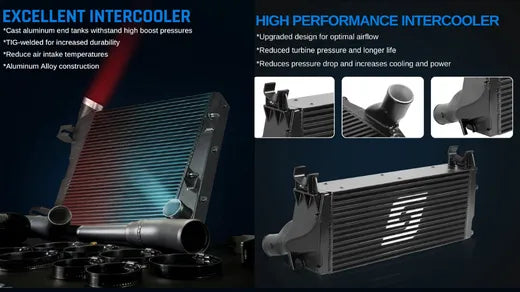
End tanks matter too. Crimped composite tanks can serve a stock truck for a long time, but age, heat cycles, and elevated boost can expose seam or neck failures. Cast or welded aluminum tanks remove the crimped plastic seam, but weld quality, internal shape, mounting stress, and pressure testing still determine whether the assembly is durable.
Fin density is another balancing act. More fin surface can transfer more heat, but tightly packed fins also catch mud, insects, winter salt, and jobsite debris. On an off-road or farm truck, a core that cannot be cleaned easily can lose real-world performance even if its catalog dimensions look impressive.
What about an air-to-water intercooler?
Most direct-fit Ram HD replacements in this guide are air-to-air cores. An air-to-water system uses a liquid circuit, pump, reservoir, and separate heat exchanger, which can solve tight packaging or short-duration competition needs. It also adds plumbing, electrical load, leak points, and heat-exchanger sizing work. For a towing or jobsite truck, a correctly sized bolt-on air-to-air CAC is usually the simpler serviceable choice.
6.7L Cummins Fitment: Match the Truck Before the Core
Ram fitment changes across engine and body-generation breaks. The 5.9L Cummins carried through early 2007; the 6.7L arrived for the 2007.5 Ram HD. The heavy-duty body change followed for 2010, even though the Ram 1500 had already changed for 2009. That one-year visual mismatch still causes wrong-part orders, so use the VIN, build date, engine, and Ram 2500/3500 application rather than grille shape alone.
Do not order by engine displacement alone, and do not assume a Power Stroke or Duramax core will share mounting points, pipe locations, sensor provisions, or cooling-stack clearance.
| Application on the current product page | Current bar-and-plate listing details | Fitment checks before ordering |
|---|---|---|
| 2003-2007 Ram HD 5.9L and 2007.5-2009 Ram HD 6.7L intercooler | 3.35-inch bar-and-plate core, cast aluminum end tanks, 3.50-inch inlet/outlet; product page lists a 27.36 x 25.57-inch core | Confirm engine, build date, truck versus chassis cab, pipe diameter, mounting tabs, and selected bar-and-plate or tube-fin variant. |
| 2010-2012 Ram 2500/3500 6.7L intercooler listing | 3.35-inch bar-and-plate core, cast aluminum end tanks, 3.50-inch inlet/outlet; product page lists a 26.3 x 26.7-inch core | Verify pickup or chassis-cab configuration, A/C and cooler-line routing, pipe connections, mounting hardware, and selected core design. |
| 2013-2018 Ram 2500/3500 6.7L intercooler listing | Product page lists a 3.35-inch bar-and-plate core with cast aluminum end tanks and also offers a tube-fin variant | Confirm model year, engine, transmission-related clearance, sensor and pipe provisions, front-end modifications, and package contents. |
| 2019 and newer Ram 6.7L, Ford Power Stroke, or GM Duramax | Not covered by the three recommendations above | Use a listing that explicitly names the truck's year, model, engine, and configuration. Never force cross-platform fitment. |
The pressure-test capability printed on a product page is not a target operating boost level and does not authorize a higher tune. Use the engine builder's, calibrator's, and vehicle manufacturer's limits for the complete system. Each year range and core style is grouped under these Cummins intercooler options.
Installation Checks That Prevent Comebacks
- Dry-fit before tightening: Confirm brackets sit flat and the core does not preload the A/C condenser, radiator, cooler lines, bumper, grille, or fan shroud.
- Protect the fins: A slipped wrench or core dragged across a bracket can flatten passages before the truck leaves the garage.
- Clean the mating surfaces: Oil on a boot lowers clamp grip. Clean the pipe bead and coupler with a material-safe cleaner, then let both dry.
- Clock clamps for access: Keep the screw housing away from sharp edges and moving parts. Use the supplied torque specification; there is no universal clamp torque.
- Check boot engagement: The coupler must cover the sealing area and sit behind the pipe bead without being stretched, folded, or twisted.
- Preserve factory ducting: Foam seals, air guides, and shrouds force outside air through the stack instead of around it.
- Retest under controlled load: Check for contact, leaks, stored codes, and stable requested-versus-actual boost before hooking to a heavy trailer.
On winter trucks, rinse road salt and packed slush from the stack when temperatures permit. On off-road and jobsite trucks, inspect for mud between the condenser and intercooler, not just on the visible front face. A clean, sealed stock core beats an oversized core buried behind debris.
Do You Need to Recover the A/C Refrigerant?
Check the installation procedure before removing the grille or cooling stack. Some Ram HD intercooler jobs require an A/C line to be moved or opened for clearance; other applications allow the CAC to come out without opening the refrigerant circuit. If a line must be opened, stop and have the refrigerant recovered with approved equipment. Intentionally venting MVAC refrigerant is prohibited, and paid A/C service requires properly trained personnel under federal rules. The current requirements are summarized by the EPA motor-vehicle A/C servicing program.
After the repair, the system must be evacuated, leak-checked, and charged by the specified refrigerant type and weight. That A/C step is often the line between a reasonable garage install and a job that belongs on a shop schedule.
When Is Cleaning Enough?
Clean the existing CAC when the fins are blocked but the tubes, end tanks, mounts, and pressure seals are sound. Remove loose debris, work from the back side when access allows, and use low-pressure water and a cleaner approved for aluminum. Replace the core when it has a confirmed seam leak, cracked neck, crushed passages, heavy corrosion, damaged mounts, or internal contamination that cannot be removed safely. If the core contains excessive engine oil, diagnose the turbocharger and crankcase-ventilation path before installing another unit.
How Much Does a Diesel Intercooler Upgrade Cost?
These are 2026 U.S. planning ranges, not quotes. Rust, bumper accessories, grille guards, chassis-cab packaging, and A/C access can move the bill quickly.
| Cost item | Planning range | What changes the number |
|---|---|---|
| Intercooler | About $400-$700 for the currently listed Ram variants | Model year, bar-and-plate versus tube-fin, package contents, and current pricing |
| Professional labor | Usually 3-6 hours | Front-end access, seized hardware, accessories, cooler-line routing, and pressure testing |
| A/C recovery, evacuation, and recharge | Often $150-$350 when required | Refrigerant type, charge amount, local labor rate, and whether a leak repair is also needed |
| Boots, clamps, seals, and shop supplies | About $40-$200 | Whether old couplers are reusable and whether the kit includes new hardware |
A first-time DIY installer should reserve a full day, not a rushed afternoon. Get the A/C question answered before teardown and keep another vehicle available if the truck has to wait for refrigerant service or a missing coupler.
A Realistic Towing Diagnosis
Picture a Ram 3500 that feels consistent empty but fades on the second long grade with a fifth-wheel attached. If actual boost follows the requested value, the charge-air system passes a regulated leak test, the cooling stack is clean, and repeat logs show declining CAC effectiveness under matched conditions, a higher-capacity direct-fit core is a reasonable next move.
If actual boost falls behind and there is fresh oil tracking from a cold-side boot, fix the coupler or pipe first. If coolant and transmission temperatures climb while charge-air behavior stays stable, inspect airflow through the radiator stack, fan operation, and the rest of the cooling system. Three symptoms can feel similar from the driver's seat, but they do not call for the same part.
Will an Aftermarket Intercooler Affect Warranty or Emissions Inspection?
Using an aftermarket part does not automatically erase the vehicle's entire warranty. The Federal Trade Commission's auto-warranty guidance says coverage can be denied for damage caused by a defective aftermarket part or incorrect installation. Keep the invoice, installation instructions, baseline logs, and photos of the completed fitment.
SPELAB's current policy provides a one-year limited warranty from delivery for eligible material or workmanship defects, subject to its terms and exclusions. Review the current SPELAB warranty policy before ordering.
A direct-fit CAC does not require removing the DPF, EGR, SCR, DEF system, or factory sensors. Keep every emissions component and required sensor functional, and do not pair the installation with an emissions-defeating calibration. Federal and state inspection requirements still vary, so no parts seller can promise a universal inspection result.
Frequently Asked Questions
Q: Does a bigger intercooler add horsepower to a diesel truck?
A: A bigger CAC does not create fuel or boost by itself. It earns its keep when the stock system is losing charge density to heat soak or pressure loss under sustained load. In that case, the upgrade can preserve power that was fading. A healthy stock commuter may show little measurable gain.
Q: Can a bigger intercooler cause turbo lag?
A: Yes, if the core and piping add too much internal volume or pressure drop for the turbo and engine setup. A properly matched direct-fit system balances thermal capacity, flow area, end-tank shape, and pipe diameter. Compare logged boost response before and after installation.
Q: Will an intercooler upgrade lower EGT?
A: It can lower exhaust gas temperature under a matched loaded test when cooler, denser charge air improves combustion conditions, but the result depends on fueling, calibration, turbo efficiency, probe location, and load. Use the engine builder's or vehicle manufacturer's limit for that exact EGT sensor location; there is no universal safe number for every Cummins setup.
Q: Is it safe to tow with a leaking intercooler or charge pipe?
A: No heavy tow should start with a known charge-air leak. The leak can worsen under boost, reduce passing and grade-climbing power, and increase turbo workload. Repair the joint or failed component, clear related faults, and verify requested-versus-actual boost before attaching the trailer.
Q: Does a thick intercooler block airflow to the radiator?
A: It can. Core thickness, fin density, duct sealing, bumper openings, condenser condition, and fan performance determine how much air reaches the radiator. After installation, log coolant and transmission temperature during the same towing route used for the charge-air test.
Q: Must the A/C system be discharged to replace a Ram intercooler?
A: Not on every Ram, but some model-year procedures require A/C line movement or removal. Read the instructions before teardown. If the sealed refrigerant circuit must be opened, use proper recovery equipment and arrange evacuation and recharge rather than venting refrigerant.
Q: Can I clean my intercooler instead of replacing it?
A: Clean it when external debris is the problem and the core is structurally sound and leak-free. Replace it when testing finds a cracked tank, leaking seam, damaged tube, crushed passage, failed mount, or contamination that cannot be removed without risking the core.