Updated on August 07, 2026.
A vehicle becomes more than transportation when it is built around a job. A race car exists to convert tire grip, aerodynamic load, braking force, and engine output into lap time. A street car must start in bad weather, idle in traffic, meet safety requirements, and survive years of mixed use. A diesel pickup may spend Monday at a Jobsite and Saturday pulling a fifth-wheel. Those are three different engineering assignments.
A high-speed open-wheel racing crash makes the difference obvious. Contact that looks small on a screen can redirect a light, fast car into a barrier because speed, load transfer, tire grip, and vehicle structure are interacting in fractions of a second. The lesson for a truck owner is not to copy race parts. It is to define the mission before changing the machine.
Good Mods solve a measured problem or prepare the vehicle for a known use case. Bad Mods chase a sound, stance, or horsepower number while ignoring Fitment, heat, Payload, braking, driveline geometry, legal use, and the parts that must carry the new load.

Purpose Changes Every Engineering Tradeoff
| Vehicle mission | Primary priorities | Accepted tradeoffs | Typical failure if copied blindly |
|---|---|---|---|
| Dedicated race car | Lap time, aero balance, low mass, tire temperature, fast service | Noise, harshness, short component life, narrow operating window | Track-only parts become unsafe, uncomfortable, or illegal on the street |
| Daily street car | Predictable braking, cold starts, visibility, crash protection, emissions, durability | More weight and conservative calibration | Aggressive setup loses wet grip, clearance, reliability, or compliance |
| Diesel tow or Payload truck | GVWR and GAWR control, cooling, braking, axle and transmission durability, Fitment | Weight, slower response, Heavy-duty component size | Power or stance changes outrun the cooling, chassis, tire, or brake margin |
| Jobsite or Off-roading truck | Ground clearance, impact protection, articulation, sealing, recovery access | Road noise, tire mass, steering effort, fuel use | Parts contact steering, brake hoses, driveshafts, bodywork, or terrain |
There is no universal "performance" setting. A rigid bushing that sharpens a race car may transmit tiring vibration into a daily truck. A taller tire that clears a trail can change effective gearing, braking effort, steering geometry, speedometer accuracy, and spare-tire Fitment. A high-flow intake that makes more sound may add no useful torque on a stock calibration.
Why Speed Turns Small Contact Into a Major Event
Kinetic energy follows the relationship E = 1/2 mv². Mass matters linearly, but speed is squared. Raising speed by 50 percent increases kinetic energy by 125 percent, assuming the same mass. That energy has to be redirected through tires, suspension, body structure, barriers, and restraint systems when a vehicle loses control.
Cornering uses a limited tire-force budget. If a tire is already near its lateral-grip limit, a steering correction, brake input, surface change, or contact can exceed what the tire can provide. Load transfers quickly, grip changes at each corner, and the vehicle rotates. Race cars add aerodynamic load, but aero also changes rapidly with speed, yaw, ride height, and damaged bodywork.
The street and truck version is slower but still serious. A pickup at rated Payload has more energy and asks more from the brakes and tires. A trailer adds another mass with its own brakes, tires, suspension, and yaw behavior. Four-wheel drive can help acceleration on loose ground; it does not create extra tire grip for stopping on ice.

Safety Is a System, Not One Strong Part
The damaged race vehicle looks destroyed because many exterior and suspension components are designed to separate, crush, or absorb energy while the protected occupant space and restraint system manage survival loads. That does not mean every broken component worked perfectly, and a photograph cannot prove the exact force path. It does show why one rigid part cannot define vehicle safety.
A road vehicle also depends on a system: tire condition, brakes, steering, seats, belts, airbags, crash structure, visibility, and driver-assistance hardware where equipped. Before modifying any of those areas, check the VIN for open recalls and repair baseline faults. A new suspension kit does not compensate for old tires, a soft brake pedal, loose ball joints, or a disabled warning lamp.
After a crash, track impact, curb strike, or serious Off-roading hit, inspect beyond visible body damage. Wheel runout, bearing play, alignment, steering linkage, subframes, axle brackets, frame measurements, restraint faults, and tire sidewalls can reveal damage that a quick walk-around misses.
Start Every Build With a Baseline Diagnosis
A dyno number or parts list is useless when the vehicle already has a boost leak, clogged filter, dragging brake, worn U-joint, cooling seep, weak battery, or uneven tire wear. Scan all modules, save codes and freeze-frame data, check fluid levels and condition, inspect hoses and wiring, measure tire tread and pressure, and road-test the vehicle in stock form.
Record data that matches the goal. A towing build needs coolant, transmission, engine-oil, charge-air, exhaust, and axle temperature trends under repeatable load. A handling build needs alignment, tire temperature and wear, ride height, bump travel, and brake behavior. A cold-air intake decision should start with restriction, sensor behavior, filtration, and actual airflow need; a cold air intake performance reality check separates sound from a measured improvement.
Fitment Means More Than Year, Make, and Engine
Confirm the VIN, production date, body style, engine code, transmission, axle, drive type, wheelbase, pickup versus cab-and-chassis configuration, factory options, and previous Mods. Mid-year changes are common. A 6.7L engine badge does not identify the track bar, radiator routing, front axle, rear differential, sensor package, or underhood clearance.
Physical measurements matter. Check bolt count and pattern, bracket spacing, hose diameter, port location, wheel offset, tire diameter and width, bump-stop gap, shock travel, driveshaft slip, U-joint working angles, steering sweep, and clearance at full compression and droop. Recheck with the truck loaded, because Payload changes ride height and available travel.
Electronic Fitment matters too. A changed tire diameter may require approved recalibration. Sensors, adaptive headlights, camera aiming, stability control, TPMS, electronic lockers, and driver-assistance systems can react to geometry or component changes. Follow the model-year service procedure rather than assuming a Bolt-on part ends the job.
Heat Is Usually the Limit That Owners Notice Too Late
Power creates heat, and heavy work holds that heat in the system. More boost can raise charge-air and exhaust temperature. Larger tires increase rotating mass and can change effective gearing. Towing loads the engine, transmission, transfer case, driveshaft, axle, brakes, and cooling stack at the same time.
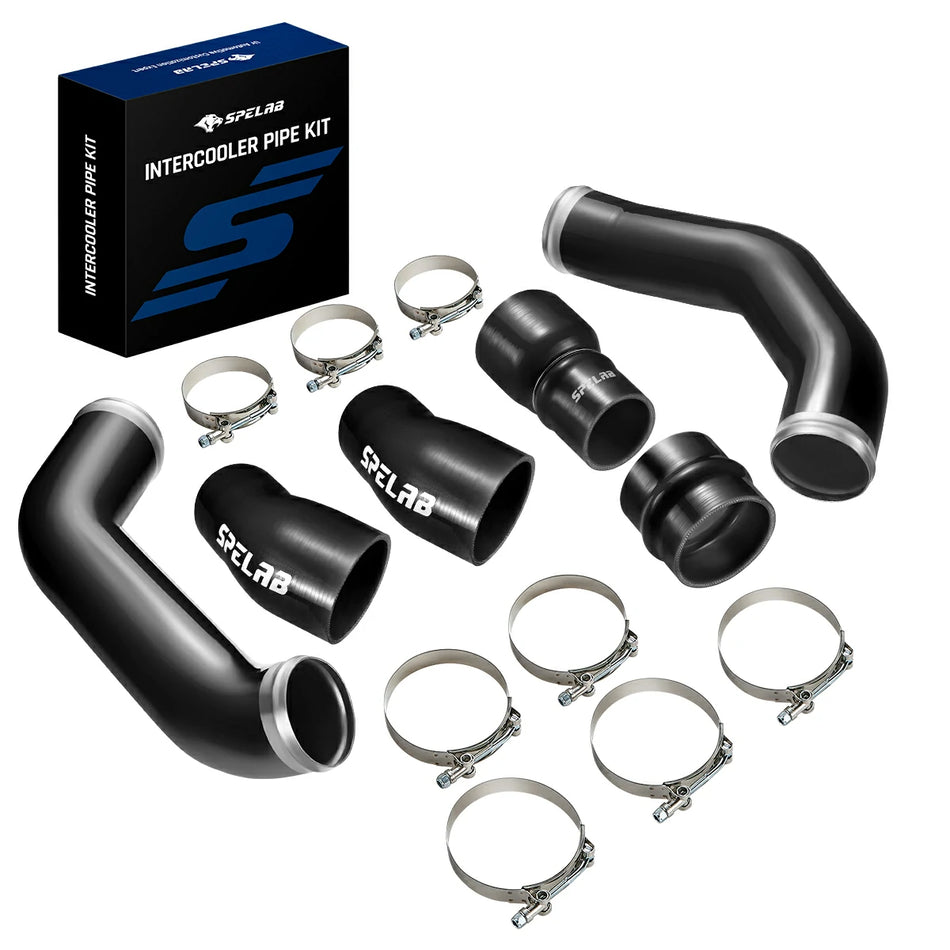
Do not solve every temperature concern by installing the largest available part. Air must still pass through the condenser, charge-air cooler, radiator, and transmission cooler. More fluid capacity can add thermal mass, but the component still needs correct flow and external heat rejection. A rigid pipe may remove one cracked plastic connection, but it cannot repair a weak cap, restricted radiator, water pump, thermostat, internal leak, or bad fan control.
Material names also need precision. 6061 is an aluminum-alloy designation; T304 is a stainless-steel designation. They are not interchangeable labels. Ask for the actual alloy, temper where relevant, wall construction, weld process, coating, clamp design, pressure or load rating, and evidence that the complete assembly matches the application.
Three Mod Types and the Decisions Behind Them
Chassis Geometry: Leveling a 2011-2022 Ford Super Duty
A 2.5-inch front leveling change can create tire clearance or correct a desired stance on a compatible 2011-2022 Ford F-250, F-350, or F-450 4WD 6.7L Power Stroke. It also changes axle position, caster, track-bar angle, drag-link relationship, shock operating range, bump travel, and headlamp aim. The kit must match the exact front suspension and surrounding hardware.
A 2.5" front leveling kit with track bar relocation bracket is one conditional option when those measurements and the truck's use support it. It does not increase GVWR, GAWR, Payload, receiver rating, or tire capacity. Align the truck, verify steering and hose clearance lock-to-lock, and road-test under the intended load.

Drivetrain Service: Protecting an AAM 11.5/11.8 Rear Axle
A differential cover can add service ports, a magnetic drain plug, a rigid sealing flange, protection, and cooling area. It cannot restore gear pattern, backlash, bearing preload, or damaged teeth. More capacity is useful only when the designed oil level agrees with the axle requirement and does not create aeration.
For selected 2001-2019 GM HD and 2003-2018 Ram HD trucks with a verified AAM 11.5/11.8 14-bolt rear axle, an AAM 11.5"/11.8" 14-bolt rear differential cover may fit the service goal. Confirm the axle tag, housing shape, bolt pattern, suspension clearance, spare tire, exhaust, fill method, and correct lubricant. A differential cover pros and cons guide explains the tradeoffs before purchase.

Reliability Repair: Replacing a Confirmed Ram Coolant-Pipe Failure
On compatible 2010-2024 Ram 2500HD and 3500HD 6.7L Cummins trucks, a rigid coolant-pipe Mod makes sense only after diagnosis identifies the original pipe, molded connection, or related coupler as the leak source. Product variants and hose routing can change across the long year range, so confirm the exact kit before draining coolant.
The Ram 6.7L Cummins upper coolant pipe is a material and serviceability decision, not a horsepower part. It does not raise the truck's tow rating or cure overpressure, another leak, trapped air, or internal engine trouble. A coolant pipe vs coolant hose comparison can help determine where rigid aluminum and flexible hose belong.

Use a Decision Matrix Before Ordering Parts
| Build goal | Evidence to collect | Adjacent systems | Pass-or-fail result |
|---|---|---|---|
| More power | Baseline codes, airflow, fuel pressure, boost, temperature, dyno or repeatable acceleration data | Transmission, clutch, cooling, brakes, tires, emissions compliance | Measured gain without unsafe temperature, slip, knock, smoke, or new faults |
| Towing reliability | Actual scale weights, grade data, cooling and fluid trends, brake behavior | GVWR, GAWR, GCWR, receiver, tires, trailer brakes, axle ratio | Stable temperatures and control while every rating remains respected |
| Lift or leveling | Ride height, alignment, travel, tire and wheel measurements | Track bar, drag link, shocks, driveshaft, hoses, wiring, sensors | No contact or binding through steering and suspension travel |
| Off-roading protection | Impact points, terrain, water depth, recovery plan | Breathers, skid plates, steering, brake lines, cooling airflow | Protection without trapping heat or reducing critical clearance |
| Appearance | Desired stance, wheel position, lighting and local requirements | Tire load rating, fender clearance, camera and radar calibration | The look does not create a mechanical or legal defect |
Real-World Build Priorities
- Daily driver: Start with recalls, maintenance, tires, brakes, alignment, lighting, and leaks. Keep noise, emissions, cold-start behavior, and service access practical.
- Towing: Weigh the loaded combination and verify GVWR, GAWR, GCWR, receiver, hitch, tire, and trailer-brake limits. Prioritize cooling, braking, axle service, and driveline condition before power.
- Payload and Jobsite: Protect wiring, hoses, cooling stack, differentials, and underbody components. A steel service body, tools, and fuel tank consume Payload before cargo is added.
- Off-roading: Build for articulation, steering clearance, low-speed heat, impact, dust, water intrusion, and recovery. Inspect after every hard contact.
- Extreme weather: Confirm fluid specifications, battery reserve, fuel strategy, coolant protection, tire type, cab heat, and material behavior at the expected temperature.
Inspect, Measure, and Recheck After Installation
Use the specified fasteners, torque sequence, thread treatment, gasket or sealant, fluid, bleed method, and ride-height procedure. Do not reuse deformed lock nuts or torque-to-yield hardware unless the service information permits it. Protect sensors and harnesses from heat, sharp edges, and moving parts.
After installation, cycle steering and suspension through the available range, pressure-test fluid systems, clear air correctly, align the truck where geometry changed, and scan for new codes. Recheck leaks, clamp position, fastener witness marks, tire rub, hose contact, and fluid level after the first heat cycles and again after the first loaded use.
Document the part number, version, installed measurements, alignment sheet, fluid specification, and service date. That record saves hours when the truck changes owners or another Mod is added later.
Official Sources
- NHTSA vehicle safety ratings
- NHTSA vehicle safety resources
- Ford GCWR guidance
- Ram towing and Payload guidance
- GM manuals and guides
Owners comparing parts should browse aftermarket parts by vehicle system only after the build goal and Fitment checks are clear.
FAQ
Q: Should I copy race-car modifications onto a street car or truck?
A: No. Race parts are designed for a narrow duty cycle with frequent inspection and accepted tradeoffs. Choose components for the street vehicle's weather, safety, legal use, service interval, Payload, and comfort requirements.
Q: What should I check before the first Mod?
A: Scan for faults, repair leaks and worn parts, inspect tires and brakes, verify fluid condition, and record baseline performance. Then define one measurable goal and the adjacent systems affected by it.
Q: Does a leveling kit increase Payload or towing capacity?
A: No. A leveling kit changes ride height and geometry; it does not change GVWR, GAWR, GCWR, receiver rating, tire capacity, or the payload label. Load limits remain in force.
Q: Does an aluminum differential cover always reduce axle temperature?
A: No. Material, fin area, airflow, oil level, capacity, internal flow, load, and test conditions all matter. Choose a cover for verified Fitment and features, not a guaranteed temperature claim.
Q: Does an aluminum coolant pipe add horsepower?
A: No. It can replace a confirmed failed pipe or plastic connection when the kit fits. It does not increase engine output, raise tow ratings, or repair another cooling-system fault.
Q: How do I verify aftermarket-part Fitment?
A: Use the VIN and production data, then verify the physical component, dimensions, ports, bolt pattern, chassis configuration, sensors, and clearances. Recheck against existing Mods instead of trusting engine size alone.
Q: What is the safest first upgrade for a used vehicle?
A: Bring the vehicle back to a known baseline: complete recalls, correct maintenance, sound tires, measured brakes, working lights and restraints, repaired leaks, and current fluids. Modification comes after the machine is healthy.